Monday, December 10, 2007

Aristocrats Furthest Below 52-Week High

A number of S&P's Dividend Aristocrats are trading at a wide discount from their 52-week high as noted in the table below. A large percentage of these firms are trading at these lower levels due to the impact surrounding the subprime mortgage market. Although a number of these companies fall into the financial sector, many have seen share prices increase over the past four weeks. Financial related firms have been some of the better performing stocks during this four week period.

(click on table for larger image)

dividend aristocrats trading below 52-week high December 10, 2007
bank sector versus S&P 500 December 10, 2007


Sunday, December 09, 2007

Income Oriented Closed-End Funds Trading at a Discount to NAV

A number of income oriented closed-end funds are trading at a discount to net asset value (NAV). The ones with the largest discount tend to be those with a high percentage of the fund assets invested in the financial sector. The subprime mortgage issues have weighed heavily on financial shares.

According to Thomas J. Herzfeld, publisher of The Investor's Guide to Closed-End Funds,
"these funds issue a fixed number of shares, which then trade on exchanges like stocks. As a result, prices are determined by investor demand and often differ from the value of the funds' portfolios. When the market swoons, as it did this year, investors often dump them indiscriminately for tax losses. That's what creates the discounts."
An investor can search for closed end funds using various criteria on the Closed-End Fund Association website. Following are some of the income oriented funds with wide discounts to NAV.

(click on table for larger image)

income oriented closed-end funds at discount to NAV December 9, 2007
Source: Closed-End Fund Association

Investors should keep in mind some of these closed-end funds can be more volatile due to higher exposure to certain sectors like financials. For example, in the Dreman/Claymore fund noted above, the financial sector represents 40% of the investments. Additionally, the largest holding, Altria Group, accounts for over 16% of the assets within the fund.

Source:
For Closed-End Funds, It's Open Season
BusinessWeek
By: Lewis Braham
December 17, 2007
http://bwnt.businessweek.com/interactive_reports/funds_closed-end/?chan=magazine+channel_personal+business


Saturday, December 08, 2007

Dividends Per Share and S&P 500 Index Exhibit Strong Relationship

The Political Calculations website recently detailed the relationship between the value of the S&P 500 Index and dividends per share going back to 1871. One conclusion drawn from the analysis is
over "long periods of time...the relationship between the S&P 500's index value and its dividends per share nearly parallel [each other from a] long-term trend perspective."

(click on chart for larger image)

S&P 500 graph versus dividend value

S&P 500 versus dividend per share
One will need to read the entire article to see the graphic representation of some trend and regression analysis. However, the data indicates:
"what the presence of so many straight lines tells us is that for long stretches of time, the ratio of the growth rates of price per share and dividends per share may be treated as a constant (emphasis added) during the periods where these lines exist.

"...the value that investors have placed on stocks has generally increased faster than the value they can expect to receive in dividends over time.

"This makes sense when you consider that the rate of dividend growth reflects only the rate of growth of company earnings that the boards of directors feel can be sustained for the foreseeable future. In addition to this additional earnings component, there are also a number of intangible components that may factor into investor valuations, including the value of the companies' brands, intellectual property, future expectations, etc., all of which add to the typical premium that investors are willing to pay for stocks.

"More than this, this premium in the growth rate of stocks compared to the growth rate of dividends explains why dividend yields have decreased over time, and to a lesser extent, why the price earnings ratio itself has tended to increase over time. It's a mathematically inevitable outcome of how investor's have historically valued stocks with respect to dividends (or rather, sustainable earnings.)"


Source:
The Sun, in the Center
Political Calculations
December 6, 2007
http://politicalcalculations.blogspot.com/2007/12/sun-in-center.html


Friday, December 07, 2007

Investing Success: Stick with a Philosophy that Works

From an investment perspective, investors are faced with a multitude of decisions surrounding the investment style to pursue in their portfolio. Investment success is more likely to occur if one sticks with a proven strategy.

Some aspects of a proven strategy entail:
  • Buying good companies at cheap prices.
  • Following a consistent philosophy
  • Maintaining a sense of perspective and,
  • Following a daily discipline
Ron Muhlenkamp of the mutual fund carrying his name, admits, discipline is the most difficult to achieve. If you have the first two, you see, you have them forever. But daily discipline is a daily battle. Every investor has the urge to bail out when a stock starts tanking. The key is not to. You may still sell, but you want to do so rationally -- and with good evidentiary reasons.

Source:

Stock Advice That Will Change Your Life
The Motley Fool
By: Tim Hanson and Brian Richards
November 30, 2007
http://www.fool.com/investing/small-cap/2007/11/30/stock-advice-that-will-change-your-life.aspx


Stryker Increases Dividend 50%

Stryker (SYK) announced a 50% increase in its annual dividend on Thursday. Stryker pays one dividend during the year. The new annual rate is 33 cents per share versus last years 22 cents per share. The company's 5 -year average payout ratio is approximately 8% with the payout ratio on the new dividend equaling 11.5% based on 2008 estimated earnings of $2.88 per share. The company has an S&P quality ranking of A.

(click on table/chart for larger image)


Investor Sentiment: Bulls Take Charge

In this week's release of the American Association of Individual Investors sentiment survey, the level of bullishness spiked higher to 40.65% versus the prior week's bullishness reading of 28.57%. The bearish sentiment fell to 39.84% versus last week's reading of 56.12%. On the other hand, this is the seventh straight week the 8-period moving average has declined. The most recent 8-period average of bullish sentiment equals 35.2% versus last week's 37.0%. The bull/bear spread increased to a +1% versus last week's -28%.

(click chart for larger image)


Wednesday, December 05, 2007

Fannie Mae Follows Freddie Mac and Cuts Dividend By 30%

Fannie Mae (FNM) announced it was reducing its quarterly dividend 30% to 35 cents per share versus the prior quarter dividend of 50 cents per share. Additionally, Fannie Mae will issue $7 billion of preferred stock to further absorb anticipated additional subprime mortgage losses.

(click on chart for larger image)


S & P Announces Rebalancing of Aristocrats Index

The annual rebalancing of S&P's Aristocrats Index will occur after the close of trading on December 21, 2007. The companies being removed from the index are:
  • First Horizon National (FHN)
  • Altria (MO)
  • SLM Corporation (SLM)
The companies that will be added to the index are:
  • Aflac (AFL)
  • Air Products & Chemicals (APD)
  • Exxon Mobil (XOM)
  • Integrys Energy (TEG)
  • Pitney Bowes (PBI)
According to S&P, the S&P 500 Dividend Aristocrats Index is designed to measure the performance of S&P 500 constituents that have followed a managed-dividends policy of consistently increasing dividends every year for at least 25 years. The index is equal-weighted, with constituents being re-weighted every quarter. Membership is reviewed each December.

Source:
Standard & Poor’s Announces Results of the Annual Rebalancing of the
S&P 500 Dividend Aristocrats Index (pdf)

Standard & Poor's
By: David Blitzer & Dave Guarino
December 4, 2007
http://www2.standardandpoors.com/portal/site/sp/en/us/page.article/2,3,2,2,1148449665924.html


Monday, December 03, 2007

Better To Be A Dividend Paying Stock Versus Non Paying One In November

For the month of November, Standard & Poor's reported that the dividend paying stocks in the S&P 500 Index outperformed the non paying stocks, -4.44% vs. -7.53%, respectively. As noted in the table below, the payers still lag the non payers on a year to date basis. For the 12-months ending November 2007, the payers did outperform the non payers, 3.39% vs. 1.78%, respectively.

(click on table for larger image)


Saturday, December 01, 2007

Currency Exchange Rates And Their Impact On International Returns

U.S. investors have experienced strong returns from their international investments over the past five years. A large part of the strong international results can be attributed to the weak dollar versus many foreign currencies. The U.S. investor's returns are enhanced because the foreign currency buys more dollars when converted.

An article in the November 2007 American Association of Individual Investors AAII Journal, Currency Exchange Rates: The International Wild Card ($), notes some economic impacts on exchange rates:
From an economic viewpoint, common sense dictates that if the demand for a currency exceeds its supply in the short term, the currency will appreciate. So when the goods and services of a country are in demand by foreign purchasers—a net trade balance surplus—the currency has a tendency to appreciate. Conversely, when foreign goods and services are in demand domestically—a net trade deficit—the currency tends to depreciate.

Inflation, productivity and costs in a country all contribute to trade balances and currency pressures. In addition, fiscal policy that stimulates or depresses economic growth, monetary policy, the money supply and central bank action—all move markets and currency exchange rates.

There is no precise or direct summary indicator of all these forces. But differences in interest rates between the domestic market and a foreign market or markets can reveal a great deal.

The differences in real rates of return, nominal return less inflation, probably provide an even better window to currency risk. In order to protect exchange rates, some countries at times maintain relatively high real rates of interest to generate demand for their currency. High real rates of interest, however, take their toll on domestic economic growth, many times forcing countries to devalue their currency or reduce interest rates, adversely affecting foreign investors who hold investments denominated in the currency.
The following table that appears in the article shows the return enhancement for a U.S. investor versus some foreign currencies over the past five years.

(click on table for larger image)

U.S. Dollar foreign currency adjusted returns November 2007
An investor needs to keep in mind that foreign currency exchange rates can boost ones returns and possibly make an underperforming investment look more attractive. Also, prognosticators that forecast foreign exchange rates are often incorrect. The point is, a continued weak dollar is not necessarily a given.

Lastly, the AAII Journal article provides several tables detailing the impact on returns for various percentage changes in the dollar exchange rate. The formula for calculating currency adjusted returns is:

(click on formula for larger image)

foreign currecy adjusted return formula
Source:
Currency Exchange Rates: The International Wild Card ($)
AAII Journal
November 2007
http://www.aaii.com/login/index.cfm?CALLER=/includes/DisplayArticle.cfm&denied=jrnl&Article_Id=3277&CFID=5700089&CFTOKEN=64684055


Thursday, November 29, 2007

Bearish Sentiment Near Early 2003 Level

In the American Association of Individual Investors sentiment survey released today, bullish sentiment moved slightly higher. On the other hand, investor bearishness increased to a level last seen in early 2003. The bearish sentiment this week was reported at 56.12%. This is the highest level since February 20, 2003 when the level of bearishness equaled 57.9%. This sentiment indicator tends to be a contrary one and the market performance since that time seems to support this.

(click on table/chart for larger image)

investor sentiment table November 29, 2007
historical investor sentiment chart as of November 29, 2007


Wednesday, November 28, 2007

McCormick & Co. Adds Spice To Dividend

McCormick & Co. (MKC) announced a 10% increase in its quarterly cash dividend today. The new quarterly dividend increases to 22 cents per share versus 20 cents per share in the same quarter last year. The projected payout ratio equals 41% based on November 2008 estimated earnings of $2.11 per share. The historical 5-year average payout ratio equals 38%.

(click on table/chart for larger image)

McCormick dividend analysis table November 2007
McCormick stock chart November 2007


Tuesday, November 27, 2007

Freddie Mac Cuts Dividend In Half

The mortgage fiasco hit Freddie Mac (FRE) investors today. The company announced it would pay a fourth quarter dividend of 25 cents per share versus 50 cents per share in the same quarter last year. This 50% cut jeopardizes FRE's listing on Standard & Poor's list of company's' that have increased annual dividends for at least 10 straight years. In addition to the dividend cut, the company announced plans to sell $6 billion of preferred stock in anticipation of more loan losses.

(click on chart for larger image)

Freddie Mac stock chart November 27, 2007


Saturday, November 24, 2007

Dividend Increases Improve Valuation Multiples More Than Share Buybacks

The Boston Consulting Group's 2007 Value Creation Report notes dividend increases do more to increase shareholder value than stock buybacks. The report notes one reason company's use cash to buy back shares is "buybacks boost EPS above the level that underlying organic growth in net income would on its own." The BCG report notes, "that EPS growth is not necessarily a differentiator of multiples. And when it is, investors are extremely sensitive to how the EPS is delivered."

The BCG research demonstrated that:
  • dividends have a far more positive impact on a company's valuation multiple than share repurchases do.
  • the report also noted that share repurchases actually erodes a company's valuation multiple as detail in the table below.
(click on graphic for larger image)

dividend payout versus stock buyback impact on valuation multiple September 2007
Source:
Avoiding the Cash Trap
The Boston Consulting Group
By: Eric Olsen, Frank Plaschke, Daniel Stelter
September 2007
http://www.bcg.com/about_bcg/media_center/press_releases.jsp?id=2421


Thursday, November 22, 2007

Low Bullish Investor Sentiment

The level of individual bullish investor sentiment as reported by the Association of Individual Investors declined to 25.58% versus the prior week's level of 33.01%. The bull/bear spread widened to -27. This level of bullishness was last achieved in July 2006 when the bullishness level equaled 23.85%. The bull/bear spread at that time was -34.

(click on graph for larger image)


Wednesday, November 21, 2007

Modern Portfolio Theory: Is It Over Relied On?

Before I get into the discussion on a recent article that indicates Modern Portfolio Theory (MPT) might not work as many are led to believe, following is a common defintion of MPT:
Introduced by Nobel Prize winner Harry Markowitz in the 1950s, modern portfolio theory proposes that investors may minimize market risk for an expected level of return by constructing a diversified portfolio. Modern portfolio theory emphasizes portfolio diversification over the selection of individual securities. A simplified version of modern portfolio theory is "Don't put your eggs in one basket". Modern portfolio theory established the concept of the "efficient frontier." An efficient portfolio, according to modern portfolio theory, is one that has the lowest risk for a given level of expected return. An underlying concept of modern portfolio theory is that greater risk is associated with higher expected returns. To construct a portfolio consistent with modern portfolio theory, investors must evaluate the correlation between asset classes as well as the risk/return characteristics of each asset.
Many investment advisors present to their clients that MPT minimizes portfolio volatility as ones investment portfolio is allocated to assets less correlated to other assets in their account.

Now onto the discussion on MPT. Recently, SmartMoney featured an article, Modern Portfolio Theory Looks Very Outdated. The article features an interview with Niels Clemen Jensen, a former senior executive at Lehman Brothers (LEH), Goldman Sachs (GS) and Oppenheimer (OPY) who now runs Absolute Return Partners, a $400 million London fund of funds. SmartMoney notes, "Jensen is a pro well versed in the nuts and bolts of modern portfolio theory and risk management. I am here to testify that, in this case, knowledge is not bliss, more like a long leap into the unfathomable."

Following are excerpts from his October 2007 newsletter:
  • Here is the problem. Central to all the academic work referred to above is the assumption that returns are normally distributed. If they are not, you might as well bin everything to do with modern portfolio theory. Risk management tools such as volatility, covariance and value-at-risk, all so critical to how we deal with risk, become meaningless if the return pattern does not match the famous bell curve.
  • For returns to follow a normal distribution, you must have a set of independently distributed returns with no extremes. You find these mostly in static systems.
  • Now, what investors really should worry about is what we call extreme risk – 3-6 SD events which can potentially wipe out years of profits. This is often referred to as fat tail risk. It is to be found to the extreme left of the below chart (encircled in red). However, according to the text book, they do not occur very often. Take a closer look at the following table:

normal bell curve

odds of risk event table
  • Statistically, assuming you are not an ‘über human’ vastly outliving the average person on this planet, you should experience only a couple of 2 SD events in a lifetime. The problem is that recent years have been littered with 6, 7 and 8 SD events. A 7 SD event equals 1 every 3 billion years or approximately the lifetime of our planet. Since the 1998 Russian debt crisis, financial markets around the world have experienced at least 10 extreme shocks none of which were supposed to occur more than once every few billion years.
Given these higher standard deviation events AND that returns are not normally distributed, Jensen concludes, "Clearly, the theory doesn’t work in practice and it may be time that we ditch modern portfolio theory altogether. Surprisingly few academic resources have been dedicated to this subject so far."

As one considers building an investment portfolio, they must stick to an investment discipline. Warren Buffett's sage advice, "the most important quality for an investor is temperament, not intellect and "what you need is the temperament to control the urges that get other people into trouble in investing."

More often than not, this means not following the crowd.

Source:

Wagging the Fat Tail (pdf)
The Absolute Return Letter
Absolute Return Partners LLP
By: Niels Clemen Jensen
October 2007
http://www.arpllp.com/core_files/The%20Absolute%20Return%20Letter%201007.pdf

Modern Portfolio Theory Looks Very Outdated
SmartMoney
By: Igor Greenwald
November 20, 2007
http://www.smartmoney.com/invest/markets/modern-portfolio-theory-looks-very-outdated-22165/


Monday, November 19, 2007

Nike And Lancaster Colony Increase Dividend

Both Nike (NKE) and Lancaster Colony (LANC) recently announced dividend increases.

Nike

Last week, Nike (NKE) announced it will increase its quarterly dividend 24.3% to 23 cents per share. This compares to 18.5 cents per share in the same quarter last year. The estimated payout is 28% based on May 2008 estimated earnings of $3.30. The five year historical payout ratio is approximately 19%.

Nike dividend analysis November 2007
Nike Stock Chart November 2007

Lancaster Colony

Today, Lancaster Colony (LANC) announced it will increase its quarterly dividend 3.7% to 28 cents per share. This compares to 27 cents per share in the same quarter last year. The projected payout ratio will be 52% based on June 2008 estimated earnings of $2.17. The five year historical payout ratio is 42%.

Lancaster Colony dividend analysis November 2007
Lancaster Colony stock chart November 2007


S&P Adds Site Tracking Home Prices In The U.S.

Standard & Poor's has added a site containing data on home prices in select markets in the U.S. The quarterly information is a summary from the S&P/Case Shiller Home Price Survey.

The purpose is to measure the average change in single-family home prices in a particular geographic market. The monthly indices cover 20 major metropolitan areas, which are also aggregated to form two composites – one an aggregation of 10 of the major metropolitan areas; the other including all 20.


Friday, November 16, 2007

Pre Election Year Stock Market Return: Rally After Thanksgiving?

During pre-election years, the market has tendency to move higher during the last month or so of the year. Chart of the Day provides an update comparing the year to date Dow Jones Industrial Average return versus average pre-election year Dow returns going back to 1900.
  • Since 1900, the stock market has tended to outperform during the first six to seven months of the average pre-election year. For the remainder of the year, pre-election performance has tended to be choppy and flat.
  • Going forward, the pre-election year has tended to end the year with a small rally beginning around the time of the Thanksgiving holiday.

Additional election year market information can be found within this blog at the post: The Market and Elections


Thursday, November 15, 2007

Earnings Fall Sharply In Q3 For The S&P 500 Index

Operating earnings for the S&P 500 Index declined -8.5% in the third quarter 2007 according to Standard & Poor's. These figures are based on 93% of the companies having reported to date.

  • Consumer Discretionary earnings fell 38.9%.
  • Financials earnings plunged 33.1%.
  • Excluding homebuilders (CTX, DHI, KBH, LEN and PHM) and General Motors (GM), the Consumer Discretionary (8.8% of the S&P 500 Index), would show a 4.2% gain for the Q3 2007.
  • Year-over-year quarterly dividends increased 13.3%.

Source:
Q3 Financials Sector Earnings Plunge 33.1%; S&P 500 Earnings Decline 8.48% (pdf)
Standard & Poor's
By: Howard Silverblatt & David R. Guarino
November 15, 2007
http://www2.standardandpoors.com/spf/pdf/index/111507_Q3Earnings.pdf


Another Week And Another Decline In Bullish Sentiment

Individual investor bullish sentiment declines for the third straight week The American Association of Individual Investors reports that bullish sentiment declined to 33.01% versus last week's 36.19%. The 8-period moving average also declined to 42.9% versus 43.6% in the prior week.

(click on chart for larger image)

investor sentiment November 15, 2007


Wednesday, November 14, 2007

Johnson Controls Increases Dividend 11.1%

Today, Johnson Controls (JCI) announced an 11.1% increase in the company's quarterly dividend. The new quarterly dividend will equal 13 cents per share versus 11 cents per share in the same quarter last year. This increase represents the 33rd consecutive year that JCI has increased its annual dividend. The payout ratio is 21% based on estimated 9/30/2008 earnings of $2.53. This is in line with the 5-year payout ratio of 21%.

(click on table/chart for larger image)

Johnson Controls dividend analysis November 14, 2007
Johnson Controls stock chart November 14, 2007


Leggett & Platt, Automatic Data Processing & Harsco Increase Dividend

Today, Leggett & Platt (LEG), Automatic Data Processing (ADP) and Harsco (HSC) announced dividend increases.

Leggett & Platt

The company announced it would be increasing its quarterly dividend nearly 39%. The new quarterly dividend equals 25 cents per share versus 18 cents per share in the same quarter last year. The estimated payout ratio equals approximately 70% based on estimated 2008 earnings of $1.42 versus the 5-year average payout of 52%. It should be noted in the company's news release today, LEG indicated they would be selling about 1/5th of their portfolio of companies. The release stated:
"The company is adopting a new strategic objective, implementing role-based portfolio management and more rigorous strategic planning, and narrowing its focus by eliminating over one-fifth of its portfolio. Leggett also intends to enhance returns on its remaining assets, return more cash to shareholders, and pursue disciplined growth."
Automatic Data Processing

The company announced it would be increasing its quarterly dividend by 26%. The new quarterly dividend equals 29 cents per share versus 23 cents per share in the same quarter last year. The estimated payout ratio equals approximately 53% based on estimated June 2008 earnings of $2.17 versus the 5-year average payout of 44%.

Harsco Corp

Harsco announced it would be increasing its quarterly dividend by 9.9%. The new quarterly dividend equals 19.5 cents per share versus 17.75 cents per share in the same quarter last year. The estimated payout ratio equals approximately 23% based on estimated 2008 earnings of $3.38 versus the 5-year average payout of 39%. It should be noted that Harsco's dividend remained unchanged from the 1st quarter of 1989 through the 4th quarter of 1991. Also, the dividend remained unchanged from the 1st quarter of 1993 through the 4th quarter of 1994.

(click on table/chart for larger image)

dividend analysis ADP, leggett & platt Harsco November 2007
stock chart ADP, leggett & Platt and Harsco November 2007


Sunday, November 11, 2007

Are Retail Stocks Overvalued Or On Sale?

For the past week or so I have intended to post a comment on the retail sector. It looks like Barrons and The Big Picture websites beat me to the punch. I will not restate Barrons or The Big Picture articles. To get a glimpse into the sector, one can read the The Big Picture's article, Are Retailing Stocks Bargains? TBP also provides a link to the article that appears in this week's Barrons

Earlier this week I was conveying a retail story to an associate on the fact my wife received a $25 gift card in the mail from J. Crew (JCG) several weeks earlier. About a week later, the J. Crew store in a mall near us called my wife to remind her of the gift card and that the store would be getting a fresh supply of merchandise the following Monday. Now, if retail business was that good, I do not think the store would be calling potential customers. I actually can't recall this ever happening before. As I finished this story my associate told me he received a similar call from a Jos. A Bank (JOSB) store near where he works. The caller from the store advised him of a sale and new merchandise. Not to be out done, J. Jill, owned by Talbots (TLB), also called my wife to tell her of a sale their store had in progress. Other than the fact my wife is likely doing too much shopping in these store, retail can't be all that good if individual stores are calling potential customers in order to generate sales.

(click on chart for larger image)

stock charts Jos Banks, Talbots, J. Crew November 11, 2007
Based on the below retail sector chart from Bespoke Investment Group, the sector is trading below its long term average sector weighting. Additionally, markets tend to improve six months following a Fed rate cut. It is likely then that certain retail stocks look like somewhat attractive investments at this point.


consumer discretionary sector weighting November 11, 2007

Six months ago , when many retail stocks were trading at 52-week highs, not many analyst were calling for a decline in the retail sector. Now that many of these stocks are down, analyst turn negative on the stocks. From a contrarian perspective, maybe this is a sign of a bottom in the making.


Friday, November 09, 2007

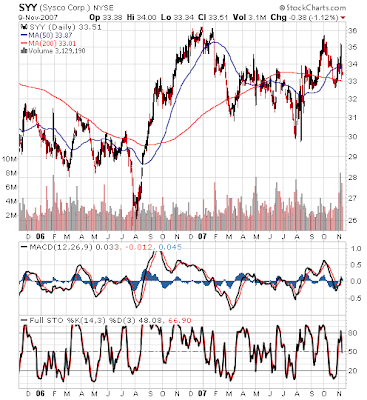
Sysco Corp. Raises Dividend 15.8%

Today Sysco Corp (SYY) announced a 15.5% increase in its quarterly dividend. The new dividend of 22 cents per quarter compares to 19 cents per quarter in the same period last year. As detailed in the company's dividend announcement, Sysco has increased its dividend every year since 1970. It should be noted the projected payout ratio will be 49% based on June 2008 estimated earnings of $1.79. The five year average payout is approximately 40%. The ratio has trended higher in each of the last five years.

(click on table/chart for larger image)

Sysco div
Sysco stock chart November 9, 2007


Thursday, November 08, 2007

Will This Be A "Growth Recession?"

In the Fall 2007 T. Rowe Price Report newsletter, the firm's chief economist, Alan Levenson, is calling for a "growth recession" as a result of the weak housing market. The article describes a growth recession as one in which:
"output and employment grow, but not quickly enough to prevent the unemployment rate from rising. That would mean real gross domestic product (GDP) growth of roughly 2%, a modest diminution of inflation pressures, and flat corporate profits through the end of 2008."
T. Rowe Price (TROW) believes a second phase of new construction cutbacks will be felt over the next 12 months. A result of these cutbacks will be to:
reduce real GDP growth by roughly 0.6% in the year ending June 2008, compared with a full percentage point drag over the four quarters ended in June 2007.
If T. Rowe Price's economist is correct, there will likely be more equity volatilty in the near term.

Source:

A "Growth Recession" Likely Fallout of Credit Downturn (pdf)

T. Rowe Price Report
By: Alan Levenson
Fall 2007
http://www.troweprice.com/gcFiles/pdf/04779-Fall-yr07_final.pdf?scn=2007&rfpgid=7949&ft=GNL_CTT


Bullish Sentiment Declines This Week

What a difference a week makes. The bullish sentiment reading from the American Association of Individual Investors Sentiment Survey saw a decline to 36.19% versus last week's reading of 44.71%. Additionally, the bearish reading jump to 51.43% versus the prior week reading of 36.47%. This is the highest reported level for the bearish reading since May 2007. Keep in mind this sentiment indicator is viewed from a contrarian perspective.

(click on chart for larger image)


Tuesday, November 06, 2007

Emerson Electric Increases Dividend 14%

Today Emerson Electric Co. (EMR) announced a 14% increase in the company's quarterly dividend. The new quarterly dividend increases to 30 cents per share versus 26.25 cents per share in the same quarter last year. The projected payout ratio is approximately 40% based on 2008 year end estimated earnings of $2.98. The 5-year payout ratio is approximately 54%.

(click on table for larger image)

emerson electric dividend analysis table November 6, 2007
emerson electric stock chart November 6, 2007


Monday, November 05, 2007

Supreme Court Hears Oral Arguments in Kentucky v. Davis Municipal Bond Case

The Supreme Court heard oral arguments today in the Commonwealth of Kentucky vs. Davis municipal bond case today. Media reports indicate the justices are leaning towards not disrupting a state's right to tax out of state municipal bond interest. According to The Wall Street Journal:
Justice David Souter was also critical of the challenge and worried aloud about disrupting the municipal bond market. "We have an enormous market, the effect of interrupting which we really as a court cannot tell very much (emphasis added)," Justice Souter said.
Bloomberg led with a story, Muni Bond Tax Breaks Get Support From U.S. Justices. In the article it was noted that:
Samuel Alito questioned whether states should be allowed to give special tax breaks on bonds that finance private construction, rather than a government project. So-called private activity bonds finance mortgages, student loans, small-scale industrial projects and redevelopments.
The bond market will certainly be on the edge awaiting a decision from the Court.

Source:
Supreme Court Hears Challenge To Muni-Bond Tax Exemption
The Wall Street Journal Online
By: Mark H. Anderson
November 5, 2007
http://online.wsj.com/article/SB119426995434382472.html?mod=djemTEW

Muni Bond Tax Breaks Get Support From U.S. Justices
Bloomberg.com
By: Greg Stohr
November 5, 2007
http://www.bloomberg.com/apps/news?pid=20602007&sid=arBGoFUAegdE&refer=rates


Friday, November 02, 2007

Dividend Payers Underperform Non-Payers In October

The dividend paying stocks in the S&P 500 Index underperformed their non-paying counterparts in the month of October. The payers October monthly return equaled 2.34% versus the non-payers return of 2.84%. On a year to date basis, the payers lagged the non-payers as well, 6.01% versus 7.13%, respectively. A large part of the underformance can be attributed to the weak results from the financial sector. The financial sector weighting in the S&P 500 is nearly 19% of the index. During October the financial sector declined -1.99% versus an overall index return of 1.48%.

Additional information on the index performance for October can be found under Standard & Poor's MarketAttributes section of their website.

(click on tables for larger image)

S&P 500 Index dividend payers versus nonpayers October 31, 2007
S&P 500 Index sector performance October 31, 2007


Thursday, November 01, 2007

Bullish Sentiment On A Roller Coaster

The often volatile contrarian individual investor bullish sentiment reading does not surprise this week. The American Association of Individual Investors reported bullish sentiment jumped to 44.71% versus last week's bullishness reading of 31.25%. In an effort to smooth out this volatility from week to week, the below chart contains the 8-period moving average of the bullish indicator. This indicator also saw an increase to 44.1% versus 43.3% in the prior week.

(click on table for larger image)

investor bullish sentiment October 31, 2007