Wednesday, October 24, 2007
Eaton Vance Corp. Increases Dividend 25%
Posted by
David Templeton, CFA
at
7:50 PM
0
comments
Labels: Dividend Analysis
Income Oriented Stock Investments Attractive To Senior Investors
- ...most seniors now favor a heavy allocation to equities.
- Over half of seniors express a high level of confidence in the stock market (53% are bullish).
- A vast majority of seniors (77%) are comfortable with current asset allocations despite recent volatility.
- Only one in three (34%) senior investors says the reduced tax rate on dividends affected how they have structured their portfolio.
- If the dividend tax cut is repealed, more than half of investors say they will not adjust their portfolios. Only one in five (18%) says they will invest less in dividend-payers.
Eaton Vance 2007 Polls of Financial Advisors and Senior Investors Unveil Significant Findings (pdf)
Eaton Vance Corp.
Jeanette Harrison-Sullivan
October 24, 2007
http://www.eatonvance.com/alexandria/pressreleases/200710/Survey%20Equity%20Income%20Release%20FINAL.pdf
Posted by
David Templeton, CFA
at
7:17 PM
0
comments
Labels: Investments
Sunday, October 21, 2007
Is It Time To Invest In Sin Stocks?
Source:
Stocking Up on Sin: How to Crush the Market with Vice-Based Investing
John Wiley & Sons, Inc.
By: Caroline Waxler
February 2004
http://www.wiley.com/WileyCDA/WileyTitle/productCd-0471465135,descCd-tableOfContents.html
Posted by
David Templeton, CFA
at
9:56 AM
0
comments
Labels: Investments
Friday, October 19, 2007
Dividend Aristocrats Outperform In Market Downdraft
Posted by
David Templeton, CFA
at
11:54 PM
0
comments
Labels: Investments
Thursday, October 18, 2007
Large Decline In Bullish Sentiment
Posted by
David Templeton, CFA
at
8:32 PM
0
comments
Labels: Technicals
Tuesday, October 16, 2007
Northern Trust Increases Dividend 12%
Posted by
David Templeton, CFA
at
9:12 PM
0
comments
Labels: Dividend Analysis
Monday, October 15, 2007
The Importance Of Understanding Market Movements
The article notes:
The article is broken down into four categories:
- To be a successful investor, you can't just buy a good stock. You have to buy the very best stocks at the very best time. And it's not enough for you to simply study the stock itself, you also need to analyze the market conditions in which it is trading.
- Successful investing isn't about following pundits' predictions or analysts' estimates or going by how you feel. It is about studying the market itself.
- The Market is as the Market Does
- Listening to opinions about the market is one of the riskiest things you can do as an individual investor. You want facts, not personal opinions. If there's one lesson most learned from the 2000 three year bear market, it's that arguing with the facts and simply hoping for the best is the easiest way to lose your shirt.
- The Interplay of Price and Volume
- Throughout history, the best way to determine the market's health and direction has been to view the daily price and volume action of the three major indexes: the Dow, the S&P 500 and the Nasdaq. Volume bursts in these key indexes show where mutual funds and other institutional investors, the biggest driver of stock prices, are moving. Relying on the primary market indexes and studying their daily price and volume interplay is one of the best possible methods for analyzing the market's behavior and determining its overall direction and health.
- Market Leaders
- Remember that history shows three out of four stocks follow market downtrends. When you see the best and the strongest stocks unraveling one after the other on heavier-than-average volume, that's telling you something about the market. Your job is not to figure out why it's happening, but to recognize that it's happening, and know what you need to do about it.
- What to do Today
- Track the averages and watch the behavior of the better-quality growth stocks with excellent institutional sponsorship, and you should be able to stay in phase with the market.
- Be patient and stay objective in your market and stock analysis. Don't let anyone's opinions or predictions blind you to the facts. Keep your emotions from getting in the way of sound decisions, and keep to the facts.
Source:
The Big Picture: How to Decipher What the Market Is Saying
American Association of Individual Investors
By: William J. O'Neil
2007
http://www.aaii.com/includes/DisplayArticle.cfm?Article_Id=1348&digit=296
Posted by
David Templeton, CFA
at
8:57 PM
0
comments
Labels: General Market
Sunday, October 14, 2007
Stocks With Potentially High Returns From The Dividend Discount Model Output
The site contains a list of stocks with potentially high expected returns.
The top performers list noted below were selected using the following criteria.
- the current dividend yield must be greater than 4%.
- the dividend growth for the previous 5 years must be greater than 3% per year.
- the consensus earnings estimate for the next fiscal year must be at least 25 percent more than the current dividend.
- the stock's expected return must be at least 10%.
- the company's market capitalization must be at least $2.5 billion.
Posted by
David Templeton, CFA
at
10:09 AM
0
comments
Labels: Dividend Analysis
Thursday, October 11, 2007
A Spike In Bullish Sentiment
Posted by
David Templeton, CFA
at
7:47 PM
0
comments
Labels: Technicals
Wednesday, October 10, 2007
Bottom Fishing For Aristocrats
Posted by
David Templeton, CFA
at
7:48 PM
0
comments
Labels: Investments
Monday, October 08, 2007
Stocks Trading Above 50 Day Moving Average
As noted in the first chart below, over 80% of the stocks in the S&P 500 are trading above their 50-day moving average. On a standalone basis this indicator would not be a sufficient reason to eliminate equity exposure. As the second chart of the S&P 500 Index details, stocks ran for an extended period of time (September to December 2006) even though a large percentage of S&P stocks were above their 50-day MA.
Posted by
David Templeton, CFA
at
9:28 PM
0
comments
Labels: Technicals
Rising Dividends Have Greater Impact On Increasing Share Price Than Stock Buybacks
- the average share price rise of companies that have been consistently increasing their payout has been 12.7 per cent a year, outstripping the 10.3% gain achieved by the wider market.
- the average performance of companies that have pursued share buybacks was only 8.2%.
- the only years in which buybacks helped share prices to outperform were 1997, 2001 and 2002, when fierce bear markets were running.
- shares in companies with top-quartile dividend growth rose by 20% a year.
- top-quartile buyback programs – companies that bought back the most shares relative to their stock market value – could manage only a 12% advance.
Source:
Share Buybacks are in Vogue, but keep an Eye on the Dividend
TimesOnline
By: Nick Hasell
May 19, 2007
http://business.timesonline.co.uk/tol/business/markets/article1811503.ece
Posted by
David Templeton, CFA
at
8:20 PM
0
comments
Labels: Dividend Return
Sunday, October 07, 2007
Greenspan's View of Dividends Versus Stock Buybacks
An excerpt from the interview:
Just as importantly is the evidence of the very large swing towards the boards of directors essentially giving back part of corporate cash flow. You can see it obviously not only in dividends, but most importantly in share buybacks and the huge amount of cash that's going back to common shareholders as a result of M&A deals closing.
Cash goes back when you don't have a use for it that is creating a rate of return superior to the average rate of return in the corporate structure (emphasis added). I mean, I served on a lot of boards for a lot of years, and it was fairly universal that you had to indicate to the directors for authorization to get a capital out- rate project going, that the rate of return on a new project was higher than the average rate of existing facilities. If it wasn't, you gave the cash back to the shareholders. So looking at the extraordinary increase in the cash flow back to shareholders, it strikes me that there is an inordinately large proportion of companies who believe that the only places that they can use their monies is either capital investments abroad - and that's actually increasing, but it's still not a big deal - or cash back - cash back to shareholders.
It also implies, if you're not getting rates of return, that the rate of innovation is slowing down. After this big surge we've had, it's not unusual to expect the rates will get some slowing down, and it's the slowdown in the rate of innovation which leads with a lag to a slowdown in the rate of productivity growth, which in turn creates an upward pressure on unit costs, which is a necessary condition for the existence of some form of stagflation.
Source:
Greenspan Says Chances of Recession have "Risen"
Bloomberg.com
October 3, 2007
http://www.bloomberg.com/apps/news?pid=newsarchive&sid=adJUey1lPauE
Posted by
David Templeton, CFA
at
9:12 AM
0
comments
Labels: Dividend Return
Friday, October 05, 2007
Dividend Growth Investing From The Perspective Of A Mutual Fund Manager
Some dividend growth highlights from the article:
- When Ned Davis Research calculated the returns of stocks in Standard & Poor's 500-stock index from January 1972 through August 2007, dividend growers won hands down. This group of stocks returned an annualized 10.9%, good enough to produce a 40-fold gain over the span. The S&P 500, by comparison, returned an annualized 8.5% during the same period; non-dividend payers earned a pathetic 2.4% annualized.
- Here's why Helms likes companies that raise their dividends consistently. He says it demonstrates management's confidence in the company's business model and future cash flows and signals confidence in the outlook.
- Unlike share buy-backs, which may be one-time events, steady growth in dividend distributions encourages companies to be more careful with their cash and shows commitment to shareholders. After all, you need to generate steady cash flows to fund a quarterly dividend commitment. "There's a great deal of information being communicated by companies when they raise their dividends," says Seattle-based Helm.
- He uses a three-step process to fill his portfolio, which currently holds 80 stocks. First, he identifies what he considers the highest-quality companies, with the soundest business models, in each sector.
- Then he analyzes these companies for their dividend profiles. He not only seeks steady dividend growth, but also prefers companies with relatively low payout ratios (dividends as a percentage of earnings; companies with low payout ratios have plenty of room to boost dividends) that are reinvesting enough money to expand their businesses. For instance, a company that yields 10% but grows only 1% a year would not make the cut. An ideal investment might be a company that has completed an aggressive capital-investment program and is scaling back capital expenditures, which is likely to generate more-abundant cash flow.
- One reason a dividend-growth strategy performs over the long term is that companies of quality and consistency tend to hold up well in bear markets. "Our strategy has done well in down, choppy and rising markets," says Helm. However, he says, the strategy will lag in "frothy markets, where quality doesn't hold up."
Source:
A No-Load Clone of a Top-Notch Fund
Kiplinger.com
By: Andrew Tanzer
October 4, 2007
http://www.kiplinger.com/columns/fundwatch/archive/2007/fundwatch1004.htm
Posted by
David Templeton, CFA
at
6:50 PM
0
comments
Labels: Dividend Return , Investments
Thursday, October 04, 2007
RPM International Raises Dividend 8.6%
Posted by
David Templeton, CFA
at
10:27 PM
0
comments
Labels: Dividend Analysis
Investor Bullish Sentiment Continues To Move Higher: October 4, 2007
Posted by
David Templeton, CFA
at
6:39 AM
0
comments
Labels: Technicals
Wednesday, October 03, 2007
Fewer Companies Increase Dividends In Third Quarter
Howard Silverblatt, Senior Index Analyst at Standard & Poor’s notes:
"The decline in dividend growth continued into the third quarter as fewer companies are making a forward commitment to dividends. Standard & Poor’s believes that the explosion in corporate buyback activity is the primary contributor to the slower pace in dividend growth."
Source:
Dividend Growth Continues to Slow; S&P Attributes Deceleration to Increased Corporate Buyback Activity
Standard & Poor's
By: Howard Silverblatt & David R. Guarino
October 3, 2007
http://www2.standardandpoors.com/spf/pdf/index/100307_DividendRecord.pdf
Posted by
David Templeton, CFA
at
9:00 PM
0
comments
Labels: Dividend Analysis
Tuesday, October 02, 2007
Dividend Payers versus Non Payers Performance: September 28, 2007
Posted by
David Templeton, CFA
at
6:21 PM
0
comments
Labels: Dividend Return
Thursday, September 27, 2007
Market Sentiment Sees Jump In Investor Bullishness: 9.27.2007
Posted by
David Templeton, CFA
at
7:36 PM
0
comments
Labels: Technicals
Wednesday, September 26, 2007
Dogs Of The Dow Performance Update: 9.26.2007
Following is an update on the year to date performance of the Dow dogs as of September 26, 2007:
Posted by
David Templeton, CFA
at
9:26 PM
0
comments
Labels: Investments
Sunday, September 23, 2007
Sector Performance In A Declining Fed Funds Rate Environment
Michael King and Scott Martin of the University of North Florida provide some research into market sector returns in a paper titled, Federal Funds Target Rate Changes and Sector Equity Returns (link to paper can be found at bottom of linked page). The study, published May 25, 2007, examines the return of the S&P 500 sectors for the period January 1, 1999 to May 11, 2005. This is a rather short time period; however, it does capture market action during a point in time when the Fed was announcing its policy actions immediately following a Fed meeting. Prior to 1994 the FOMC meeting results were made public 45-days following the FOMC meeting.
During the time period noted above, the FOMC met 54 times. Subsequent to the meetings, the following Fed actions were taken:
- 14 rate increase.
- 13 rate decrease.
- 27 no change in rate.
- on average, in a decreasing Fed Funds rate cycle, Consumer Discretionary, Technology, Materials, Health care and Financial sectors increased in value. The other sectors, Consumer Staples, Utilities, Energy and Industrials declined in value.
- In the "all cycles" column, for a 100 basis point (one full percentage point) decrease in the Fed Funds rate, consumer discretionary stocks rose 1.169%.
- In the "increasing rate cycle" column, for a 100 basis point increase in the Fed Funds rate, consumer discretionary stocks decline .446%
- In the "decreasing rate cycle" column, for a 100 basis point decrease in the Fed Funds rate, consumer discretionary stocks rose 1.49%.
Posted by
David Templeton, CFA
at
10:54 PM
2
comments
Labels: Investments
Dividend Aristocrats Furthest Below 52-Week High
Posted by
David Templeton, CFA
at
11:43 AM
0
comments
Labels: Investments
Friday, September 21, 2007
Dividend Aristocrats Generally Keep Pace With Market: Week Ending 9.21.2007
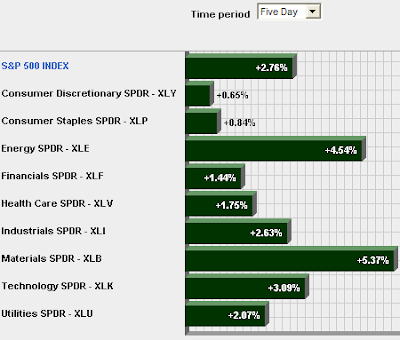
Certainly an interesting week with the Fed lowering both the Fed Funds Rate and the Discount Rate by 50 basis points on Tuesday. The Fed's action added fuel to the fire and propelled the market higher on the week. Standard & Poor's Dividend Aristocrats generally kept pace with the market on the week.
The weakest performing Aristocrats tended to fall into the financial and discretionary sectors. The defensive sectors: staples, health care and financials did underperform the overall market.
Posted by
David Templeton, CFA
at
11:51 PM
0
comments
Labels: Dividend Return
Thursday, September 20, 2007
Market Sentiment: Bears Less Bearish
Posted by
David Templeton, CFA
at
8:18 AM
0
comments
Labels: Technicals
Tuesday, September 18, 2007
Stock Buybacks Accelerate In Second Quarter 2007
- The record buyback activity was fueled by IBM’s landmark $15.7 billion stock buyback during the second quarter.
- Large quarterly buybacks were also reported by Exxon Mobil at $7.6 billion and Microsoft at $7.2 billion.
- Over the past eleven quarters, when the buyback bonanza started, S&P 500 issues have spent approximately $1.12 trillion on stock buybacks compared to (a similar) $1.24 trillion on Capital Expenditures and $594 billion on dividends.
- Standard & Poor’s also notes that the top-ten buyback issues accounted for 35% of all stock buybacks during the quarter with an aggregate amount of over $54 billion.
Source:
S&P 500 2nd Quarter Buyback Activity Sets Record at $158 Billion
Standard & Poor's
By: David R. Guarino & Howard Silverblatt
September 6, 2007
http://www2.standardandpoors.com/portal/site/sp/en/us/page.article/2,3,2,2,1148434843833.html
Posted by
David Templeton, CFA
at
10:44 AM
0
comments
Labels: Dividend Analysis
Saturday, September 15, 2007
Individual Investors Less Bearish
This week the American Association of Individual Investors reported individual investor bullishness increased to 40.00% versus last week's 38.38%. The bearishness level fell by a larger amount with a large part of those surveyed moving to a more neutral stance. This caused the bullish minus bearish level to rise to a +5 versus last week's -4.
Posted by
David Templeton, CFA
at
6:27 PM
0
comments
Labels: Technicals
Thursday, September 13, 2007
Microsoft and Harley Davidson Announce Dividend Increases
Microsoft (MSFT) and Harley Davidson (HOG) both announced dividend increases today.
Microsoft announced a 10% increase in their quarterly dividend. The quarterly dividend increases to 11 cents per share versus 10 cents per share in the same quarter last year. The estimated payout ratio will equal 25% based on June 2008 estimated earnings of $1.73. The 5-year average payout ratio is approximately 23% excluding the $3.00 special dividend in 2005.
Harley Davidson announced a 42.9% year over year dividend increase. The new quarterly dividend increases to 30 cents per share versus 21 cents per share in the same quarter last year. The company did increases its quarterly dividend in the 2nd quarter this year to 25 cents per share. The estimated payout ratio will equal 31% based on estimated 2008 earnings of $3.88. The 5-year average payout ratio is approximately 13%. The payout ratio in 2002 equaled 7%.
Posted by
David Templeton, CFA
at
10:34 PM
0
comments
Labels: Dividend Analysis
Wednesday, September 12, 2007
McDonalds Corp. Raises Dividend 50%
After the market close, McDonalds Corp. (MCD) announced a 50% increase in the company's annual dividend. The new annual dividend will be $1.50 versus $1.00 last year. The company pays one dividend during the year in December. The ex-date will be around November 13, 2007.
- The company stated in the press release announcing the dividend that the increase is an effort to return $15-$17 billion to shareholders through 2009.
- The 5-year historical payout ratio is approximately 34%.
- The estimated payout ratio on estimated 2007 earnings of $2.85 is approximately 53%. Estimated earnings for 2008 are $3.03.
- The company carries an S&P Quality Ranking of A.
Posted by
David Templeton, CFA
at
7:53 PM
1
comments
Labels: Dividend Analysis
Saturday, September 08, 2007
Buybacks To Replace Dividend Payments?
Some facts Skinner details in his research report:
- Skinner shows that the increased volatility of earnings helps explain changes in payout policy over the last 30 years.
- First, Skinner shows that since 1980 there have been three main groups of payers: 1) established firms that have always paid dividends and now also make repurchases on a regular basis; 2) firms that make regular repurchases but do not pay dividends; and 3) firms that make occasional repurchases.
- Skinner finds that firms in the first group have been paying dividends for decades and continue to do so largely because of their dividend history. Over time, managers of these firms increasingly use repurchases to pay out earnings increases, with dividend policy becoming more conservative. This suggests the reluctance to reduce or omit dividends has become stronger in recent years (emphasis added). Skinner also finds that these firms dominate the set of publicly held firms, accounting for more than half of all total earnings and payouts.
- Dividend policies are incredibly sticky once firms have established a dividend amount, they feel as if they have to maintain that level of dividend going forward.
- ...prior research has shown that managers set dividends based on current and past earnings.
From a historical perspective, aggregate buyback amounts now exceed aggregate dividend payments. I noted this in an earlier post, Stock Buybacks Continue At A High Level.
From a cautionary standpoint, Skinner finds, "those firms that both pay dividends and make repurchases have a conservative dividend policy and use repurchases to supplement dividends in years with strong earnings." The issue here is the buybacks are based on past earnings and cash flow results and not on a company's expectations of future earnings prospects.
When evaluating dividend growth aspects of a firm, the growth rate of a dividend is an indication of a company's future earnings growth prospects. This was detailed in a study by Robert Arnott and Clifford Asness titled, Surprise! Higher Dividends = Higher Earnings Growth (pdf).
Source:
The Dividend Puzzle
Capital Ideas
By: Douglas J. Skinner
August 2007
http://www.chicagogsb.edu/capideas/aug07/4.aspx
The Evolving Relation between Earnings, Dividends, and Stock Repurchases
Social Science Research Network
By: Douglas J. Skinner
May 2006
http://papers.ssrn.com/sol3/papers.cfm?abstract_id=906853#PaperDownload
Buyback vs. Payout($)
Barron's
By: Shirley A. Lazo
September 10, 2007
http://online.barrons.com/article/SB118920653164721130.html?mod=9_0031_b_this_weeks_magazine_columns
Posted by
David Templeton, CFA
at
11:00 AM
0
comments
Labels: Dividend Analysis
Friday, September 07, 2007
Second Half Of September The Weakest
Posted by
David Templeton, CFA
at
5:18 PM
0
comments
Labels: Technicals