Friday, May 20, 2016

Equity Market Headwinds Positioned To Subside

One thing investors in equities know is the market has essentially traded sideways for nearly two years. During this two year period, this sideways chop has included sharp pullbacks, one in late 2014, two in 2015 and the latest in February of this year. For long term investors this can be disconcerting for sure, so what headwinds are influencing the equity markets and will they subside any time soon?


For the most part no one factor contributes to the market's ups and downs and I will not touch on all the potential influences, for example, the high level of debt being issued by the public sector, pension under-funding, the presidential election in the U.S., etc. At top of mind though are the following:

The oversupply of oil and the downward pressure it has placed on prices (until recently) has had a negative impact not only on the energy sector, but across other segments of the economy (industrial companies) that sell into the energy space. The energy weakness resulted in a contraction in earnings for companies in these segments. However, since oil price lows reached in February, crude prices are up over 80%. Whether this is sustainable is questionable, but, with higher crude prices, companies in the energy sector, and those that sell into the space, are likely to see better earnings versus last year.


This leads to possibly the largest factor facing the market: earnings. As the below chart clearly details, double digit earnings growth in early 2014 turned into an earnings contraction. Combining the four quarters of 2015, the earnings for the S&P 500 Index were essentially flat. This contributed to a flat equity return for the S&P 500 Index for calendar year 2015. Since stock prices have a tendency to follow earnings over time, the trough in earnings in Q1 2016 may give way to earnings 'growth' into Q4 2016. One then asks, how is this growth possible. Two factors are occurring that may contribute to EPS growth from here.


One, the US Dollar strength that took place from mid 2014 and into 2015 has turned into weakness over the last 12 months. The result is multinational companies should experience less of a headwind from translating non US earnings back to the US Dollar.


Secondly, as noted earlier, the increase in oil prices is anticipated to have a positive impact on S&P 500 earnings. The below table shows quarterly operating earnings by sector for the S&P 500 Index. Evident from the table is the favorable swing in earnings for both the energy and materials sectors and the positive impact on expected earnings growth for the index.


Lastly, the Fed and the future direction of interest rates is impacting market sentiment. With the release of Fed minutes earlier this week, it appears a June rate hike is back on the table. The Fed did move rates higher last December and multiple hikes were expected in 2016. It is looking more likely that one, two at most, rate hikes may occur this year, all else being equal. This move higher in short rates is causing the yield curve to flatten, which could lead to an inverted yield curve (short term rates higher than long term rates.) An inverted curve does not always translate into a recession. However, the interest rate curve has been inverted when the onset of a recession takes place. As the above chart shows though, the curve is far from inverted at the moment.


One result coming out of a Fed that is increasing interest rates is a slowdown in economic growth. Historically though, the initial moves in rate increases by the  Fed is pursued to get rates back to a more normal level. As a result when interest rates are increased from a level below 5% stocks tend to rise. In short, below the 5% level there is a positive correlation between interest rates and stocks.


With investor bullish sentiment at an extremely low level, an expectation of an improving earnings picture and a market that has traded sideways for nearly two years, subsiding headwinds could certainly translate into a positive equity environment in the second half of this year.


Sunday, May 08, 2016

Continued Growth In Oil Supply Likely Leads To Lower Crude Oil Price

WTI Crude has rebounded over 70% to $44.60/bbl from its $26/bbl low reached on February 11th. This price recovery has occurred while supply continues to grow at an unabated pace as can be seen in the below chart.


The U.S. Energy Information Administration's summer 2016 fuels outlook (PDF) is forecasting continued supply growth with the expectation oil prices will average $35/bbl this summer. Driving this supply growth is continued elevated production from OPEC Countries that is in excess of supply cuts in many of the other oil producing countries.


Saturday, May 07, 2016

Broad Based Bearish Market Sentiment

With the 'sell in May' topic seeming to lead much of the commentary over the last few weeks, investors are exiting equities and allocating the funds to money market and fixed income investments. During this first week in May, Lipper notes:
  • For the week fund investors were net redeemers of fund assets (including those of conventional funds and exchange-traded funds [ETFs]), pulling out a net $2.8 billion for the fund-flows week ended Wednesday, May 4.
  • While investors were net sellers of equity funds (-$11.2 billion, the largest weekly net redemptions since January 6, 2016), they padded the coffers of money market funds (+$6.5 billion), taxable bond funds (+$1.1 billion), and municipal bond funds (+$0.7 billion).
As the below chart indicates, equity outflows have been fairly steady since April of last year and accelerated in December.


Monday, May 02, 2016

Dividend Payers Trouncing Non-Payers Through April

If one facet of the market that has become clear this year is that companies paying a dividend are being rewarded. The below table shows data reported by S&P Dow Jones Indices on the average performance of dividend payers in the S&P 500 Index versus their non-paying counterparts. Year to date through April the payers average return return equals 6.51% versus the non-payers return of .89%. The spread is even wider for the 12-month period with the payers returning 1.66% and the non-payers return equaling -7.29%.

Data source: S&P Dow Jones Indices

We have noted the propensity by investors to favor the payers over the non-payers of late. Yesterday's post on the Dogs of the Dow 2016 performance is a version of this theme. Not that all value stocks need to be dividend payers, but the iShare S&P 500 Value ETF (IVE) has a dividend yield of 2.35% versus the iShares S&P 500 Growth ETF (IVW) yield of 1.52%. As can be seen in the below chart, value is leading growth so far this year as well.


In this low rate world it seems dividend paying stocks are gaining some respect by investors. In a slow growth economic environment though, companies that can grow earnings in spite of the economy's anemic growth rate (growth stocks) have historically performed well. Since the end of the financial crisis both growth and value tracked pretty closely up until the end of 2013. For the last two plus years though, growth has led value in performance. Maybe the tide is beginning to turn in favor of value though.


Sunday, May 01, 2016

Dogs Of The Dow Outpacing Broader Market

This year's performance of the Dogs of the Dow is indicative of investor interest in dividend paying stocks. The Dogs of the Dow strategy is one where investors select the ten stocks that have the highest dividend yield from the stocks in the Dow Jones Industrial Index (DJIA) after the close of business on the last trading day of the year. Once the ten stocks are determined, an investor invests an equal dollar amount in each of the ten stocks and holds them for the entire next year.

As can be seen in the below table, the average return of this year's Dogs of the Dow is 8.9% versus the Dow Jones Industrial Average ETF return of 2.8% and the S&P 500 Index ETF return of 1.7% through April 29, 2016. Particular strength is being seen in the energy and industrial Dow Dogs this year. Much of the year has yet to unfold; however, Intel's (INTC) current yield of 3.43% (yield of 2.79% at year end 2015) would qualify it as a Dog of the Dow at the moment. Year to date Intel's stock price has declined 12.1%. Intel would replace Wal-Mart (WMT) where WMT's current yield is 2.99%.


Saturday, April 30, 2016

Sell In May, But It Is A Presidential Election Year

With May just around the corner, articles covering the "Sell in May' phenomenon are not in short supply and this article will add to the list. Sometimes the strategy is referred to as the Halloween indicator as investors are expected to get back into the market after Halloween. On the surface, it seems pretty clear that a Sell in May strategy is one that bears fruit for investors. In an article from Chart of the Day from several years ago, it is noted,
"The stock market is about to enter what has historically been the weakest half of the year. Today's chart illustrates that investing in the S&P 500 during the six months of November through and including April accounted for the vast majority of S&P 500 gains since 1950 (see blue line). While the May through October period has seen mild gains during major bull markets (i.e. 1950-56 & 1982-97), the overall subpar performance during the months of May through October is noteworthy. Hence the saying, 'sell in May and walk away.'"
From The Blog of HORAN Capital Advisors


Tuesday, April 19, 2016

Spring 2016 Investor Letter: A Volatile Quarter

In our Spring 2016 Investor Letter published last week, we highlight aspects surrounding the volatile first quarter. Importantly, we discuss the year ahead and the silver lining of a slow economic expansion. There are newsworthy events on the horizon: the U.K.'s potential withdraw from the European Union (Brexit), timing of future Fed rate hikes and the U.S. presidential election. We discuss these topics and more in the Investor Letter.


For additional insight into our views for the market and economy, see our Investor Letter accessible at the below link.


Friday, April 15, 2016

Investor Sentiment Remains Skeptical And This Could Be Good For Stocks

For the week ending April 8, both the S&P 500 Index and the Dow Jones Industrial Average declined 1.2%. As this week nears a close, the S&P 500 Index is attempting to recover that loss and is currently up about 1.5% for the week.


Wednesday, April 13, 2016

Oil & Plenty

I once raced a Thistle sailboat we named Good & Plenty, after the pink and white licorice candy treat. I digress but that Thistle was one fast boat when the winds were good. With all the focus on oil, and after the morning release of the EIA Petroleum Status report today, it is evident the world is awash in Oil & Plenty of it. The current price of WTI Crude has recovered to a level last seen in November of 2015. The rebound in the price of WTI to the $42 per bbl area has had a positive impact on the stock prices of many of the energy related companies. As the below chart shows, the energy sector within the S&P 500 Index has had the largest positive move off of the February 11, 2016 market low, i.e., up 19.6%.


Monday, April 11, 2016

Small Caps Beginning To Look More Attractive

One aspect of the market over the past two plus years has been the outperformance of large cap stocks relative to their small cap counterparts. The below table compares the performance of the iShares Russell 2000 Small Cap Index (IWM) to the S&P 500 Index, both on a calendar year and annualized basis. The magnitude of the weakness in the Russell 2000 Index performance shows small caps are underperforming large cap as far out as 10-years on an annualized basis.


Sunday, April 10, 2016

Buyback Activity Remains Healthy Excluding The Energy Sector

In a recently released report by S&P Dow Jones Indices, stock buybacks for S&P 500 companies declined 3.1% in the last quarter of 2015 versus Q3 2015. The biggest contributor to the buyback decline was the energy sector. Companies that comprise the energy sector reduced their buybacks by nearly 63% to $15,2 billion in 2015 versus $40.9 billion in in 2014. If the energy sector is excluded, buybacks for 2015 are up 8.7% versus a 3.4% buyback increase for the entire index.

Data Source: S&P Dow Jones Indices

The buyback activity is far from dead as 24% of the index constituents reduced their company share count by more than 4%. Prior to the quarter's start, buyback activity was expected to decline on a year over year basis, yet this was not the case. For investors, the magnitude of the buyback activity by those 24% of companies does serve to artificially inflate earnings growth by 4%. When combining the dividend yield with the buyback yield for the S&P 500 Index, the combined yield is 5.51% at 12//31/2015 versus the 2.29% dividend yield alone. 

Finally, looking at buybacks on a sector and company specific basis, the S&P report notes:
  • "On a sector basis, information technology continued to dominate buybacks even as its percentage of fourth-quarter buybacks decreased to 24.3% from 28.7% in the third quarter."
  • "Energy continued to decline as the sector's expenditure declined 27.7% from the prior quarter. Consumer groups differed greatly as consumer staples increased its expenditure by 65.9% and consumer discretionary reduced its by 15.9%."
  • "For the quarter, Apple Inc. again led with $6.9 billion spent on share repurchases, even though this is down 48.2% from its $13.3 billion third-quarter expenditure (which was the fifth largest ever posted by an index issue). United Technology Corp. came in second with $6.0 billion after buying back $1.0 billion in shares in the third quarter; Microsoft Corp. followed with $3.7 billion, down from $4.8 billion. Oracle Corp. and American International Group Inc. rounded out the top-five buyback spenders. ExxonMobil Corp. ranked 53rd, up from last quarter's 84th, with $0.7 billion (up from $0.5 billion last quarter), paling in comparison to $3.3 billion in the fourth quarter of 2014 when it ranked third."
Absent the energy sector, the silver lining is dividend and buyback activity remains relatively strong. Companies would not continue returning cash to shareholders if they believed business activity was nearing a decline. Certainly, we prefer to see healthy dividend growth versus buybacks as dividends are more of a longer term commitment by a company; however, cash generation continues to look healthy.

Source:

Despite the First Quarter's Shaky Start, the 2016
Market Outlook Remains Constructive
S&P Capital IQ
By: Michael Thompson & Robert Keiser
April 1, 2016
http://ow.ly/10uQdn


Sunday, March 27, 2016

Different Year But Same Story

The blog, The Fat Pitch, published a great article last week highlighting the issues currently impacting investors, Current Investor Concerns. Following is an excerpt from the article:

The US economy is stuck in one of the most sluggish recoveries in history. Growth is just 2% and it will remain slow as consumers and companies work off vast amounts of debt. The country has gotten off track and neither political party has any answers. 
These sentiments were written in Time in 1992, the year one of the biggest growth eras in American history began. But these same words are often used to describe the current economic environment. 
Not helping matters is the Fed, which appears to have boxed itself into a corner. It's policies have been ineffectual and have created record budget deficits. The consensus is that the Fed has overstayed its course. A new way of handling monetary policy is needed.

The year these words were written is 1982, when America was on the threshold of an 18 year bull market. But central bankers and their policies were as hated then as they are today (from the NYT).

As the author of the article notes in the conclusion, "The story in the stock market is almost always the same: the fundamentals of companies and the economy are weak, but central banks, corporate buybacks and earnings manipulation are keeping share prices artificially afloat."

The entire article is a worthwhile read for investors.


Sunday, March 20, 2016

Equity Market Advance: Actions Speaking Louder Than Words

Near the end of February we noted pessimism was being exhibited by both individual and institutional investors. In addition to this pessimistic view of the market, we noted some economic data was looking more favorable and combined, higher equity prices could result in the weeks ahead. True to form investors took advantage of the market pullback and added to their equity positions and the market has moved higher for five straight weeks. At the time of that post, the NAAIM Exposure Index was reported at 31.65. This past week's exposure index reading came in at 62.72 and notes NAAIM member firms have increased long equity exposure.


Thursday, March 17, 2016

Market Advance Does Not Result In Improved Investor Sentiment

Although the S&P 500 Index has bounced significantly higher from the February lows, the market action seems indicative of one where investors were caught on the sidelines. Even with the move higher in stocks, individual investors are indicating their skepticism about the market advance if we look at AAII's bullish sentiment indicator. Today's release showed bullish investor sentiment was reported at 29.96%, a 7.4 percentage point decline from the prior week. A majority of this point decline showed up in the neutral sentiment category. The net result is a nearly 10 percentage point decline in the bull/bear spread to 3.1%.


With the strong move higher in stocks, as can be seen in the below chart, a number of technical indicators are indicating the market is at least short term over bought. The three technical indicators in the below chart, money flow index, MACD and stochastic indicator, are near or at overbought levels. Interestingly, the death cross triggered in early January and it turned out to be a bullish trigger.


Sunday, March 13, 2016

Dividend Paying Stocks Held Up Better In The Market Downturn

An attractive aspect of owning dividend paying stocks, specifically, dividend growth equities, is the fact they tend to hold up better in down market environments. The favorable result from this characteristic is it takes a smaller upside return to make up the losses incurred in a market decline.


As far back as 2010 I wrote about this favorable feature in a post, Comprehensive Review Of The Dividend Aristocrats. As noted in that article, in shorter time frames, the dividend aristocrats did exhibit a higher standard deviation, yet the total return of the aristocrats was higher than the broader S&P 500 Index and resulted in the aristocrats having a higher Sharpe ratio. A part of this is attributable to the favorable compounding impact of reinvested dividends.

As we fast forward to today and the recent downturn in the equity markets from early last year, the favorable performance of dividend paying stocks is once again evident. For the year to date period both the iShares Select Dividend ETF (DVY) and the SPDR S&P Dividend ETF (SDY) are outperforming the S&P 500 Index as seen in the below chart. During the market pullback from 12/31/2015 through February 11, 2016, the dividend focused ETFs held up significantly better than the S&P 500 Index itself. As the market has recovered, the dividend paying indexes are maintaining their outperformance and have recovered the losses incurred in the pullback.


Saturday, March 12, 2016

Is The Value Style Outperformance Sustainable?

Until the market's (S&P 500 Index) recent rebound from the February 11, 2016 low, investors have essentially gone two years with flat returns in stocks. Certainly it has not been a market that has just traded sideways, but one with significant volatility, both up and down. The most recent recovery has pushed the S&P 500 Index back into the trading range in place since late 2014. Technically, this recent rally into the higher range opens up the potential for the Dow to move to the top of this higher range, 18,300 and the S&P 500, 2,130.


Contributing to the improved equity market since the February bottom has been the strength in value and cyclically oriented sectors: energy, financials and industrials. As the below chart shows, energy is up 15.8%, financials are up 14.4% and industrials are up 11%. These three sectors are more heavily weighted in the value oriented indices like the iShares S&P 500 Value Index (IVE). Financials account for over 25% of the value index versus an 8% weighting in the growth index (IVW). Energy represents 12% of the value index versus only 1% in the growth index.


Monday, March 07, 2016

Oil Price Rise Predicated On Potential OPEC/Russia Output Cuts

Oil prices in the first quarter of this year have turned higher, much like the pattern at the beginning of 2015. Since mid February the price of Brent Crude has increased nearly 40%, climbing from the high $20/bbl level to the high $30/bbl level.


Friday's Commitment of Traders Report (COTR) released by the Commodity Futures Trading Commission (CFTC) noted money managers increased bullish bets on oil to the highest level since November. This increased bet on higher oil prices has occurred in spite of a higher than expected increase in oil inventory. The EIA Petroleum Status Report saw crude inventories rise 10.4 million barrels to a record 518 million barrels of oil inventory. The EIA report noted gasoline inventory declined 1.5 million barrels as demand for gasoline increased a strong 6.9% on a year over year basis. The oil inventory in the below chart includes not only crude oil, but gasoline, distillate fuel oil and all other oil related inventory.


As Reuters reported after the market close on Friday,
"U.S. oil prices rose to the highest since late January and Brent jumped to their highest since early January on Tuesday amid hopes that top global producers will agree a coordinated output freeze. That helped to offset growing concerns about the record U.S. inventory. 
"U.S. crude futures ended the week 10 percent higher after settling 4 percent higher at $35.92 a barrel on Friday as strong U.S. jobs data spurred hopes of better demand growth and on technical buying after crude prices breached resistance levels on charts. 
"The price action was impressive this week. Especially getting through $35 a barrel," said John Kilduff, partner at Again Capital, a New York energy hedge fund."
It appears speculators are counting on production cuts by OPEC and Russia. If these cuts do not materialize, the oil price pattern detailed in the first chart above could result in oil prices falling back below the $30/bbl level as too much supply seems to be the main driver of the recent volatility in oil prices.


Saturday, March 05, 2016

Dogs Of The Dow Continue To Exhibit Strength

Through Friday's (3/4/2016) market close, the average return for the Dogs of the Dow of 2016 continues to outperform both the S&P 500 Index and the Dow Jones Industrial Average Index. The average return through Friday for the Dow Dogs totals 3.5% versus the S&P 500 Index return of -1.7% and the Dow Jones Industrial Average Index return of -1.9%. In 2015, the average return of the 2016 Dow Dogs equaled -9.3%.


Of some note in the above table is the estimated earnings growth rate for the two energy stocks, Exxon and Chevron. This higher anticipated growth is partly possible due to the easier comparison for next year's energy company earnings versus this year's. With the market getting closer to a point where energy is no longer a potential detractor from overall index earnings, a resumption in earnings growth for the overall market is certainly achievable beginning in the second half of the year, all else being equal.


Disclosure: Long VZ, XOM, PFE (family)


Tuesday, March 01, 2016

Transports And Cyclical Sectors Leading

The transport index has made a sharp recovery, up nearly 10% since late January. There is some argument that under Dow Theory, a buy signal has been triggered. Jeffrey Saut, of Raymond James, published commentary yesterday, By The Side Of The Road, discussing this Dow Theory buy signal.


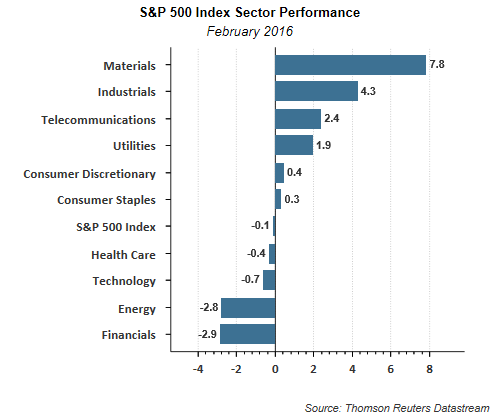
In addition to cyclically exposed transports, several of the more cyclical sectors of the S&P 500 Index have displayed leadership in February to, materials and industrials.


For long term investors, missing the handful of strong equity market up days during a given year will penalize return outcomes for the entire year. Some will comment missing those down draft days enhances returns as well, and that is certainly true. Timing when to get in an out of the market though is one difficult endeavor and the long term bias of the market is a trend that moves higher.


Sunday, February 28, 2016

The FANG Basket Of Stocks Gets Derailed

Investors not owning the basket of stocks know as the FANGs (Facebook (FB), Amazon (AMZN), Netflix (NFLX) and Google (GOOGL aka Alphabet)) in 2015 likely trailed the return of the broader market. The average return of the FANGs in 2015 equalled 83% versus the S&P 500 Index return of 1.4%.


With the emotional propensity for investors to buy what feels good, if they purchased the FANG basket of stocks near year end, the return on these stocks has trailed the overall market return: -12.6% versus -6.4% for the S&P 500 Index since December 4, 2015.


The weakest link in this basket has been Netflix which has declined 27.6% since the December peak of the FANG basket. The best performing FANG stock since their December top has been Facebook returning 1.6% and outperforming the S&P 500 Index return of -6.9%. The S&P 500 Index has outperformed the other three FANGs, Alphabet, Amazon and Netflix.


Disclosure: Long GOOGL and GOOG


Saturday, February 27, 2016

Are Emerging Markets The Trade Of The Decade?

In recent days, more strategists are indicating the emerging market asset class is providing investors with a 'trade of the decade" opportunity. The most recent is Robert Arnott and Christopher Brightman of Research Affiliates when they note in their February All Asset report,
"Many investors mistake a bear market for diminished prospective returns. From the rear-view mirror, the bear market in emerging markets has been painful. When we look out of the windshield, however, these very asset classes offer the highest potential returns (as of 12/31/2015 their 10-year expected return is 7.9%) available to today’s opportunistic investor. So, the exodus from emerging markets is a wonderful opportunity – and quite possibly the trade of a decade – for the long-term investor."
Certainly, the below chart shows the underperformance of the MSCI Emerging Markets Index versus the S&P 500 Index.


For investors interested in increasing emerging market exposure, they will want to evaluate the potential impact of further US Dollar strength due to the negative impact a strong Dollar has on emerging market performance.


Historically, Dollar strengthening moves have trended in a 7-year cycle. As the below chart shows, the most recent Dollar move has been running for about four and a half years. If the seven year pattern holds, continued weakness in emerging market performance may persist. Admittedly, a lot of the Dollar strengthening move has occurred; however, with the Fed interested in continuing to normalize interest rates, higher U.S. rates would likely provide some tailwind for additional Dollar strength.


Bearish Sentiment And Positive Uptick In Economic Reports May Translate To Higher Equity Prices

Evident from the below chart of the S&P 500 Index and the Dow Jones Industrial Average, the start to 2016 has been a difficult one for investors. January saw a sharp decline in the equity markets; however, the month of February is working to repair the January damage.


We noted in a post at the end of the third weak of January, Sentiment Supportive Of Further Equity Gains, that sentiment data seemed overly bearish and the market could recover. Certainly this has been the case, yet institutional and investor sentiment continues to tilt more bearish than bullish.

The chart below displays the NAAIM Exposure Index. The NAAIM Exposure Index consist of a weekly survey of NAAIM member firms who are active money managers and provide a number which represents their overall equity exposure at the market close on a specific day of the week, currently Wednesday. Responses are tallied and averaged to provide the average long (or short) position or all NAAIM managers, as a group. This week's data for the NAAIM Index continues to indicate active managers remain cautious on the equity market and is near levels notable for oversold markets.


Additionally, although individual investors are slightly more bullish based on the Sentiment Survey from the American Association of Individual Investors, bullish sentiment remains at a low level. Last week's AAII report saw investor bullish sentiment increase to 31.19%, the first reading over thirty since the end of November last year. In order to smooth out the week to week volatility in the sentiment reading, we look at the 8-period moving average. As the white line in the below sentiment chart shows, this average continues to track at an extreme level, even lower than that reached at the bottom of the financial crisis in March of 2009.


One data point needing to see improvement is that associated with the consumer and a reasonably strong spending and income report was delivered for January. It appears the benefit consumers receive through low energy prices are beginning to translate into increased spending.


Econoday's commentary on the report:
"Personal income jumped 0.5 percent in January as did consumer spending, both readings higher than expected. Details are solidly positive with components on the income side led by wages & salaries, up a very strong 0.6 percent for the third large gain of the last four months. And year-on-year rates are climbing again with total income up 4.3 percent and with wages & salaries at 4.5 percent, which are far from torrid but the direction is definitely favorable. And consumers didn't draw from savings on their January shopping spree, with the savings rate unchanged at a very solid 5.2 percent. Components on the spending side are led by durable goods which jumped 1.2 percent and reflect strong vehicle sales in the month. Spending on services rose a monthly 0.6 percent. Year-on-year, spending is up 4.2 percent. Again, this isn't great but it does point to a surprisingly strong start to the first quarter which looks to double or triple the fourth-quarter's annualized growth rate of 1.0 percent."
And finally, the improvement in equity returns in February is occurring in some of the more economically sensitive sectors. The below chart shows materials are up 8.5% this month and industrials are higher by 4.9%. At a minimum the market may be beginning to factor in the easier earnings comparisons firms will face as they lap the headwinds from the strong US Dollar and the contraction in energy prices.


One thing we know about the market is it does not move higher in a straight line. The strong recovery over the last two weeks may see some consolidation of these recent gains. However, some glimmer of hope is beginning to surface in a number of economic reports, a revised higher GDP number, an improvement in industrial production and improvement seen in the durable goods report. Everything is not roses as weakness was seen in Markit's Manufacturing PMI and the ISM Manufacturing Index. Investors continue to deal with mixed economic reports, but a number of the reports are beginning to turn positive. If one believes stock prices follow earnings, improvement in earnings reports would be a welcomed outcome. 


Thursday, February 18, 2016

E-Commerce Sales Continue At Double Digit Growth Rate

Yesterday, the U.S. Census Bureau released fourth quarter 2015 e-commerce sales data. The report confirmed the fact individuals are increasingly turning to the internet for their retail purchases. The orange line in the below chart shows as of the end of Q4 2015, e-commerce sales as a percentage of total sales increased to 8.6%. Also notable in the below chart is the blue line representing the YOY change in e-commerce sales: e-commerce sales grew nearly 15% in the fourth quarter last year. The increase in internet retail has come at the expense of brick and mortar retailers as evidenced by the near zero percentage growth rate in overall retail sales less motor vehicles and e-commerce sales (green line).


Saturday, February 13, 2016

Increased Market Volatility Resulting In High Quality Stock Outperformance

Commensurate with the increase in the market's volatility that began late last year, high quality stock outperformance has accelerated this year. As volatility increases it is common for investors to seek the safety of higher quality equity holdings. The below chart displays the ratio of S&P's high quality index to the low quality index.The S&P Quality Ranking System measures growth and stability of earnings and recorded dividends within a single rank.
  • S&P Low Quality Rankings are designed for exposure to constituents of the S&P 500 identified as low quality stocks, i.e., stocks with Quality Rankings of B and below.
  • S&P High Quality Rankings are designed for exposure to constituents of the S&P 500 identified as high quality stocks, i.e., stocks with Quality Rankings of A- and above.

One factor contributing to the underperformance of the low quality index is the large 29% weighting in financials versus 5% in the high quality index. As the last chart below shows, financials have taken it on the chin so far this year.


Friday, February 12, 2016

Ex-Energy Forward Earnings Expectations Look Pretty Good

The list of headwinds facing the equity market seems to be growing longer every day. However, the top concern is the question of whether the economy is headed for a recession or not. In several prior posts, we have noted our view is a recession is not imminent. Certainly slow GDP growth continues to be the constant in this long recovery. Much of the market volatility though seems centered around the energy and material sectors.

At the end of 2014 a barrel of oil was trading for $53.27 and closed today at $27.64. Demand for oil has not been the issue, it has been the continued growth in supply. The low energy prices have resulted in large capital expenditure cuts in the sector and this has spilled over into the industrial sector, especially those firms selling into the energy space either directly or indirectly. The earnings results for energy firms and those firms impacted by the energy contraction have dominated the headlines. In evaluating the fundamental health of companies outside of energy, we believe it is worthwhile noting expected 12-month forward earnings growth, ex energy, is anticipated to be just over 13%. We do believe this is a little optimistic; however, high single digit EPS growth is achievable looking out 12-months.

From The Blog of HORAN Capital Advisors

On an operating earnings basis the energy sector is expected to contribute a negative $7.71 to overall S&P 500 Index reported operating earnings in 2015. In 2016, the energy sector is expected to contribute a positive $7.45 to overall S&P operating earnings. Again, we think the energy earnings contribution is on the high side and is one reason we expect 2016 S&P 500 earnings growth around the high signal digits.

Thomson Reuters excellent weekly earnings report from the end of last week included earnings growth expectations for 2016 broken down by quarter. Evident in the below table is the weakness expected for earnings through Q1 2016. For the last three quarters of 2016, earnings growth improves in each quarter. Some of this improvement will be the result of lessening currency headwinds for multinational firms due to the strong US Dollar. At the end of 2014 the US Dollar/Euro exchange rate was $1.20. Through the end of November of 2015, the Dollar strengthened to $1.05 to the Euro. Subsequent to the end of November, the Dollar has been weakening and traded near $1.13 today. This weaker Dollar will lessen the currency impact for many multinational companies.

From The Blog of HORAN Capital Advisors

Much of the bombardment of negative headlines has weighed on investor sentiment. Today the American Association of Individual Investors reported an 8.31 percentage point drop to 19.2% for the bullish sentiment survey reading. These bullish investors flipped to the bearish side with bearish sentiment increasing 14 percentage points to 48.7%. The net impact is the bull/bear spread is a wide -29.5%, the widest level since October 2008. These sentiment readings are most predictive at their extremes and the AAII Sentiment Survey is a contrarian indicator.

From The Blog of HORAN Capital Advisors

From The Blog of HORAN Capital Advisors

Of course there are other issues impacting the market outside of energy and exchange rates, like always seems to be the case. However, we believe the energy headwinds, and the consequent impact on high yield credit and on bank loans, will have a much smaller impact as compared to the real estate issues in 2008/2009. 


Sunday, February 07, 2016

Weak Investor Sentiment Leading To Negative Fund Flows

The weak equity returns experienced by the markets since the beginning of the year have resulted in a low level of bullish investor sentiment. The Dow Jones Industrial Average Index and the S&P 500 Index are down on a year to date basis 7% and 8%, respectively. The Nasdaq Composite Index has fared even worse and is down 12.9% this year. The lack of positive equity momentum and weak bullish sentiment have led to investors reducing exposure to both stocks and bonds as evidenced by recent mutual fund flow data.

From The Blog of HORAN Capital Advisors

The above chart incorporates data through the end of last year. Below is a table from ICI showing weekly outflows have continued into 2016.

From The Blog of HORAN Capital Advisors
Source: ICI

In mid-January bullish investor sentiment, as reported by the American Association of Individual Investors, came in at 17.90%. The last time bullish sentiment was reported at this low of a level was in April 2005. Subsequent to the mid-January sentiment report, individual investor sentiment began to improve until falling two percentage points to 27.55% last week.

From The Blog of HORAN Capital Advisors
Source: AAII

As we noted earlier this month, we do not believe the U.S. economy is headed for a recession. Given all the pessimistic talk of late though, one would think we are in a recession now. Because sentiment is a contrarian indicator, and given the negative fund flow data, maybe the end of this pullback is nearer the end than investors are anticipating.


Saturday, February 06, 2016

The Dogs Catch A Bid

The Dogs of the Dow theory suggests investors select the ten stocks that have the highest dividend yield from the stocks in the Dow Jones Industrial Index (DJIA) after the close of business on the last trading day of the year. Once the ten stocks are determined, an investor invests an equal dollar amount in each of the ten stocks and holds them for the entire next year. Below is the 2016 Dogs of the Dow.

As the below table shows, year to date through Friday's close, the Dow dogs have outperformed the Dow Jones Industrial Index, -2.5% versus -7.0% . As the below table also shows, the average yield for the 2016 Dogs of the Dow of 3.97% remains higher than the overall DJIA yield of 2.96%. In this market environment where the market is struggling to gain any traction, the income yield on the stocks seems to have enticed investors to purchase, or at least hold these higher yielding stocks.

From The Blog of HORAN Capital Advisors

One aspect of market returns in 2015 was the narrow nature of stock participation. As we noted in our Winter 2016 Investor Letter, the FANG stocks were up over 60% last year on a cap weighted basis. So far in 2016, the average return of the FANG stocks is -12%. The outperformance of the Dow Dogs at the start of 2016 may be a larger indicator of investor interest in more value oriented equities. As the below chart details, growth style equities have been on a strong outperformance trend versus value since the end of the financial crisis. The brief return to value outperformance has occurred during short stints since 2009, but has been unable to gain traction on a longer term basis. Maybe this early trend in 2016 will be the theme for the remainder of the year. We discussed the growth value difference in our post at the end of last year, 2015 Was A Year For Growth Stocks And Only A Handful Were Needed.

From The Blog of HORAN Capital Advisors


Monday, February 01, 2016

Economic Weakness Centered In Energy/Materials Sector: Not A Recession Yet

A significant issue facing investors is determining whether the world is entering into a global recession. Certainly, economic activity in emerging markets has been challenged due in part to the strength of the U.S. Dollar. Global economies are also dealing with the collapse of energy prices and the negative impact energy weakness is having on the broader industrial sectors as energy capital expenditure cuts ripple through the economy. As noted in our post yesterday, historically, energy prices and equities have a positive correlation, that is, they move in the same direction. Intuitively this makes sense as a stronger global economic environment leads to a higher demand for energy resources. Since late 2013 this correlation broke down and energy prices began to move in the opposite direction of stocks. When January 2016 rolled around though, the correlation between oil and stocks once again turned positive.