| From The Blog of HORAN Capital Advisors |
| From The Blog of HORAN Capital Advisors |
Posted by
David Templeton, CFA
at
8:50 PM
1
comments
Labels: Sentiment
Posted by
David Templeton, CFA
at
1:06 PM
0
comments
Labels: General Market
"The equity P/C ratio tends to measure the sentiment of the individual investor by dividing put volume by call volume. At the extremes, this particular measure is a contrarian one; hence, P/C ratios above 1.0 signal overly bearish sentiment from the individual investor. This indicator's average over the last 5-years is approximately .7, indicating the individual investor has been generally mostly bullish and more active on the call volume side"
| From The Blog of HORAN Capital Advisors |
"At HORAN, we believe business fundamentals are contrasting with equity market actions. This divergence is being driven in large part by the lack of confidence in Europe in dealing with its sovereign debt issues and in Washington's inability to deal with its budget deficit. Additionally, the amount of regulatory uncertainty that includes health care reform and potential income tax reform is a factor in business' ability to commit to longer term expansion plans."
But there is a long list of positive offsets this year relative to the past two years:
- Inflation is coming down, especially among commodity prices.
- Credit growth is quite strong, especially for consumers.
- Housing has improved markedly.
- The US manufacturing sector is humming.
- NFIB's small business survey made recent upside breakout.
- Job growth is much better.
- Consumer confidence is improving.
- Private-sector leverage ratios are much improved (debt servicing costs are extremely low).
- Recovery in state/local government spending.
- The US economy somewhat decoupling from rest of world; at least Europe.
- US bank capital/health is much better than Europe's.
- The European Central Bank's Long-Term Refinancing Operations have reduced likelihood of global financial contagion.
- Germany appears more willing to accept higher inflation, opening the door to easier monetary policy for the eurozone.
- Valuations are quite cheap, especially on forward earnings.
- Investor sentiment has improved sharply with the correction to-date (meaning pessimism has kicked back in).
Posted by
David Templeton, CFA
at
2:34 PM
0
comments
Labels: Technicals
| From The Blog of HORAN Capital Advisors |
Posted by
David Templeton, CFA
at
10:06 AM
0
comments
Labels: Sentiment
"Many of you [college graduates] have been reared on the cliché that the purpose of education isn't to stuff your head with facts but to teach you how to think. Wrong. I routinely interview college students, mostly from top schools, and I notice that their brains are like old maps, with lots of blank spaces for the uncharted terrain. It's not that they lack for motivation or IQ. It's that they can't connect the dots when they don't know where the dots are in the first place."
"In every generation there's a strong tendency for everyone to think like everyone else. But your generation has an especially bad case, because your mass conformism is masked by the appearance of mass nonconformism. It's a point I learned from my West Point intern, when I asked her what it was like to lead such a uniformed existence.
Her answer stayed with me: Wearing a uniform, she said, helped her figure out what it was that really distinguished her as an individual."
"The link between earned success and life satisfaction is well established by researchers. The University of Chicago's General Social Survey, for example, reveals that people who say they feel "very successful" or 'completely successful' in their work lives are twice as likely to say they are very happy than people who feel 'somewhat successful.' It doesn't matter if they earn more or less income; the differences persist.
The opposite of earned success is 'learned helplessness,' a term coined by Martin Seligman, the eminent psychologist at the University of Pennsylvania. It refers to what happens if rewards and punishments are not tied to merit: People simply give up and stop trying to succeed.
Learned helplessness was what my wife and I observed then, and still do today, in social-democratic Spain. The recession, rigid labor markets, and excessive welfare spending have pushed unemployment to 24.4%, with youth joblessness over 50%. Nearly half of adults under 35 live with their parents. Unable to earn their success, Spaniards fight to keep unearned government benefits.
Meanwhile, their collective happiness—already relatively low—has withered. According to the nonprofit World Values Survey, 20% of Spaniards said they were "very happy" about their lives in 1981. This fell to 14% by 2007, even before the economic downturn.
That trajectory should be a cautionary tale to Americans who are watching the U.S. government careen toward a system that is every bit as socially democratic as Spain's.
Government spending as a percentage of GDP in America is about 36%—roughly the same as in Spain. The Congressional Budget Office tells us it will reach 50% by 2038. The Tax Foundation reports that almost 70% of Americans take more out of the tax system than they pay into it. Meanwhile, politicians foment social division on the basis of income inequality, instead of attempting to improve mobility and opportunity through education reform, pro-growth policies, and an entrepreneur-friendly economy.
These trends do not mean we are doomed to repeat Spain's unhappy fate. But our system of earned success will not defend itself."
Posted by
David Templeton, CFA
at
12:10 AM
0
comments
Standard & Poor's April performance update for the dividend payers versus non-payers in the S&P 500 Index shows the payers outperformed in April. The outperformance was almost 200 basis points or two percentage points, 1.72% versus -.12%, respectively. In spite of the strong April performance for the payers, the payers trail the non-payers on a year to date basis, 13.35% versus 16.40%, respectively. For the twelve month period, the payers have outperformed by more than 700 basis points though.
| From The Blog of HORAN Capital Advisors |
Posted by
David Templeton, CFA
at
8:34 PM
0
comments
| From The Blog of HORAN Capital Advisors |
"Here's another way of appreciating what has happened in recent years. The private sector has been working very hard to increase its efficiency and its output, and that shows up in the record level of corporate profits, both in nominal terms and relative to GDP. But instead of allowing or encouraging the private sector to plow those profits back into the economy in the form of new plant and equipment, new jobs, and new technologies, the federal government has effectively borrowed all the corporate profits generated since 2009 and distributed the money to the unemployed, to the poor, to favored "green" industries, to unions, to state and local governments, and to "make-work projects," among other things. There's been a lot of money thrown around, but lots of it has been wasted in the process that could have been put to better use; we simply don't have much to show for the $1.25 trillion of after-tax profits generated per year on average by U.S. businesses since 2009. (I'm referring here to the fact that federal deficits in recent years have been roughly equivalent to after-tax corporate profits—actually a bit higher. So on a "sources and uses of funds" basis, the government has effectively used all corporate profits to fund its spending.)"
Posted by
David Templeton, CFA
at
8:35 PM
0
comments
Posted by
David Templeton, CFA
at
5:06 PM
0
comments
| From The Blog of HORAN Capital Advisors |
Posted by
David Templeton, CFA
at
10:02 PM
0
comments
Posted by
David Templeton, CFA
at
7:47 PM
0
comments
Labels: Newsletter
| From The Blog of HORAN Capital Advisors |
| From The Blog of HORAN Capital Advisors |
Posted by
David Templeton, CFA
at
12:49 PM
0
comments
Labels: General Market
Posted by
David Templeton, CFA
at
5:28 PM
0
comments
Labels: General Market
| From The Blog of HORAN Capital Advisors |
| From The Blog of HORAN Capital Advisors |
Posted by
David Templeton, CFA
at
10:07 AM
0
comments
Labels: Dividend Analysis , General Market
| From The Blog of HORAN Capital Advisors |
| From The Blog of HORAN Capital Advisors |
In a market with extraordinarily low nominal yields, the relationship supporting the
risk premium between equity and fixed income is challenged, and stable high quality dividends can be viewed similarly to a bond coupon. Thus it would be logical for the market to value dividends within the prevailing yield structure of the fixed income market:Price/Dividend = f (Interest Rates)
| From The Blog of HORAN Capital Advisors |
| From The Blog of HORAN Capital Advisors |
Posted by
David Templeton, CFA
at
11:10 PM
0
comments
Labels: Dividend Analysis , Dividend Return
| From The Blog of HORAN Capital Advisors |
Posted by
David Templeton, CFA
at
9:05 AM
0
comments
Labels: General Market
| From The Blog of HORAN Capital Advisors |
“Companies appear to have finally gotten it right with average share prices declining 14.3% during the third quarter of 2011, companies poured $118 billion into stock buybacks (the most since the heydays of 2007), buying back shares at reduced prices. With depressed prices, companies were able to scoop up additional shares, which reduced the number needed for year-end employee options. In the fourth quarter, with share prices increasing an average of 11.2%, they pulled back.”
| From The Blog of HORAN Capital Advisors |
Posted by
David Templeton, CFA
at
12:10 AM
0
comments
Labels: Dividend Analysis , General Market
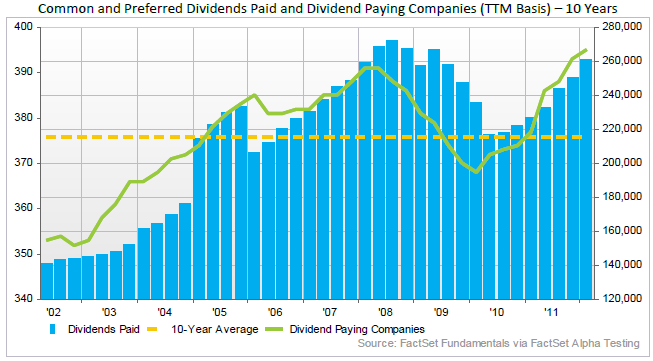
"The number of dividend-paying companies was 393 at the end of Q4 2011 (January 2012), which marks a 12-year high. Aggregate quarterly dividend payments amounted to $260.8 billion over the trailing twelve months. On a per-share basis, the aggregate figure was $26.78 per share, reflecting year-over-year growth of 16.1%. The Financials, Materials, and Information Technology sectors led all sectors in year-over-year growth on a per-share basis (40.0%, 28.4%, and 23.5%, respectively)."
| From The Blog of HORAN Capital Advisors |
"a back test utilizing FactSet’s Alpha Testing application shows that stocks with the highest five-year compound annual growth rates in earnings per share have outperformed stocks with lower growth rates over fifteen years. However, the results for dividend per share (DPS) growth rates show a different relationship. Dividend paying stocks in the top quartile by DPS growth have underperformed the S&P 500 Total Return Index, while the lower three quartiles outperformed (emphasis added)."
| From The Blog of HORAN Capital Advisors |
| From The Blog of HORAN Capital Advisors |
| From The Blog of HORAN Capital Advisors |
Posted by
David Templeton, CFA
at
11:19 AM
0
comments
Labels: Dividend Analysis
"Something about the U.S. economy isn't adding up.
At 8.3%, the unemployment rate has fallen 0.7 percentage point from a year earlier and is down 1.7 percentage points from a peak of 10% in October 2009. Many other measures of the job market are improving. Companies have expanded payrolls by more than 200,000 a month for the past three months, according to Labor Department data. And the number of people filing claims for government unemployment benefits has fallen.
Yet the economy is barely growing. Many economists in the past few weeks have again reduced their estimates of growth. The economy by many estimates is on track to grow at an annual rate of less than 2% in the first three months of 2012. The economy expanded just 1.7% last year. And since the final months of 2009, when unemployment peaked, the economy has expanded at a pretty paltry 2.5% annual rate.
How can an economy that is growing so slowly produce such big declines in unemployment?
TrimTabs thinks the problem lies in the heavily massaged BLS employment data and the highly suspect BEA personal income data.
That said, withholding tax data is also messy and not a perfect measure either, but no matter what I do with the data, I can't get to 200,000+ jobs unless a huge percentage of the workforce is suddenly working for McDonalds."
| From The Blog of HORAN Capital Advisors |
Posted by
David Templeton, CFA
at
10:02 AM
0
comments
Labels: Economy
Posted by
David Templeton, CFA
at
8:14 AM
0
comments
Labels: Investments
| From The Blog of HORAN Capital Advisors |
| From The Blog of HORAN Capital Advisors |
| From The Blog of HORAN Capital Advisors |
Posted by
David Templeton, CFA
at
8:38 PM
0
comments
Labels: Economy , General Market
"For some perspective on the post-financial crisis rally, today's chart illustrates how much of the downturn that occurred as a result of the financial crisis has been retraced by each of the five major stock market indexes. For example, the Dow peaked at 14,164.53 back in October 9, 2007 and troughed at 6,547.05 back on March 9, 2009. The most recent close for the Dow is 12,980.30 -- it has retraced 84.5% of its financial crisis bear market decline. As today's chart illustrates, each of these five major stock market indices have retraced over 78% of their financial crisis decline. However, it is the S&P 400 (mid-cap stocks) and the tech-laden Nasdaq that have recouped all the losses incurred during the financial crisis and currently trade higher than their 2007 credit bubble peak."
| From The Blog of HORAN Capital Advisors |
Posted by
David Templeton, CFA
at
7:50 PM
1
comments
Labels: General Market
| From The Blog of HORAN Capital Advisors |
| From The Blog of HORAN Capital Advisors |
Posted by
David Templeton, CFA
at
8:53 PM
0
comments
Labels: Dividend Return , General Market
| From The Blog of HORAN Capital Advisors |
| From The Blog of HORAN Capital Advisors |
| From The Blog of HORAN Capital Advisors |
| From The Blog of HORAN Capital Advisors |
Posted by
David Templeton, CFA
at
12:38 PM
2
comments
Labels: General Market , Technicals
| From The Blog of HORAN Capital Advisors |
| From The Blog of HORAN Capital Advisors |
| From The Blog of HORAN Capital Advisors |
Posted by
David Templeton, CFA
at
6:46 PM
0
comments
Labels: Economy , General Market
"The Dow made another post-financial crisis rally high Thursday as it approached the 13,000 level. To provide some perspective to the current Dow rally that began back in early October 2011, all major market rallies of the last 111 years are plotted on today's chart. Each dot represents a major stock market rally as measured by the Dow. As today's chart illustrates, the Dow has begun a major rally 28 times over the past 111 years which equates to an average of one rally every four years. Also, most major rallies (78%) resulted in a gain of between 30% and 150% (29.8% to 150.5% to be exact) and lasted between 200 and 800 trading days (9.5 months to 3.2 years) -- highlighted in today's chart with a light blue shaded box. As it stands right now, the current Dow rally (hollow blue dot labeled you are here) would be classified as well below average in both duration and magnitude."
Posted by
David Templeton, CFA
at
11:48 AM
0
comments
Labels: General Market
Posted by
David Templeton, CFA
at
1:12 PM
0
comments
Labels: Technicals
Posted by
David Templeton, CFA
at
9:19 PM
0
comments
Labels: Financial Planning
Posted by
David Templeton, CFA
at
10:36 PM
0
comments
Labels: General Market
| From The Blog of HORAN Capital Advisors |
Posted by
David Templeton, CFA
at
12:07 PM
0
comments
Labels: General Market , Technicals
Posted by
David Templeton, CFA
at
6:32 PM
1
comments
Labels: Economy
| From The Blog of HORAN Capital Advisors |
| From The Blog of HORAN Capital Advisors |
Posted by
David Templeton, CFA
at
11:51 PM
0
comments
Labels: Economy
"...most companies in the S&P 500 index have not been successful in adding value through stock buybacks in the time frames we observed. The positive correlation between buyback activity and price suggests a combination of poor market timing as well as policies that increase repurchases when firms have more free cash flow. This may be partially explained by the need for officers of public companies to make some use of the cash on hand, including keeping less of it due to the possibility of being taken over. The negative correlation between repurchases and forward returns shows that most buybacks did not pay off within the year after purchase."Even for the market (S&P 500 Index) overall, the increased buyback activity occurs at ever increasing price levels.
| From The Blog of HORAN Capital Advisors |
| From The Blog of HORAN Capital Advisors |
| From The Blog of HORAN Capital Advisors |
| From The Blog of HORAN Capital Advisors |
Posted by
David Templeton, CFA
at
11:24 AM
0
comments
Labels: Dividend Return , General Market , Technicals
Posted by
David Templeton, CFA
at
8:37 AM
0
comments
Labels: Newsletter
| From The Blog of HORAN Capital Advisors |
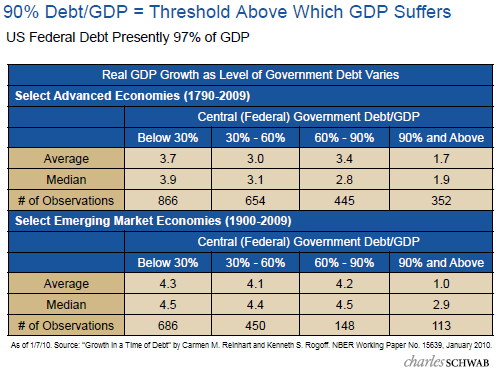
"The simplest connection between public debt and growth is suggested by Robert Barro (1979). Assuming taxes ultimately need to be raised to achieve debt sustainability, the distortionary impact imply is likely to lower potential output. Of course, governments can also tighten by reducing spending, which can also be contractionary. As for inflation, an obvious connection stems from the fact that unanticipated high inflation can reduce the real cost of servicing the debt. Of course, the efficacy of the inflation channel is quite sensitive to the maturity structure of the debt. Whereas long-term nominal government debt is extremely vulnerable to inflation, short term debt is far less so. Any government that attempts to inflate away the real value of short term debt will soon find itself paying much higher interest rates...
...In principle, the manner in which debt builds up can be important. For example, war debts are arguably less problematic for future growth and inflation than large debts that are accumulated in peace time. Postwar growth tends to be high as war-time allocation of manpower and resources funnels to the civilian economy. Moreover, high war-time government spending, typically the cause of the debt buildup, comes to a natural close as peace returns. In contrast, a peacetime debt explosion often reflects unstable underlying political economy dynamics that can persist for very long periods."
| From The Blog of HORAN Capital Advisors |
Posted by
David Templeton, CFA
at
10:00 PM
0
comments
Labels: Economy , International
| From The Blog of HORAN Capital Advisors |
Posted by
David Templeton, CFA
at
1:50 PM
2
comments
Labels: Investments
Posted by
David Templeton, CFA
at
9:47 AM
0
comments
Labels: Economy , General Market
| From The Blog of HORAN Capital Advisors |
Posted by
David Templeton, CFA
at
11:09 PM
0
comments
Labels: General Market , Valuation
Posted by
David Templeton, CFA
at
4:29 PM
0
comments
Labels: Investments