Sunday, January 31, 2016

Understanding The Disconnect In The Correlation Between Oil And Stock Prices

Recently a number of commentators on the weekly business shows have commented oil prices and the stock market have been moving in the same direction during the month of January. On the few days oil and stocks moved in opposite directions, the conclusion was this would be a good thing for the overall market. Not wanting to single out any one specfic strategist, but this past Monday, Bill Stone, chief investment strategist at PNC Wealth Management, noted on CNBC, "it's not clear whether the selling will subside for now because of the tight correlation between stocks and oil prices, which he says should break at some point (emphasis added)." This comment is similar to a number of other strategists.

So what is the point then? As the below chart shows, going back to the mid 1980's the price of oil and the price of stocks have a positive correlation of .66. It only has been since October of 2013 that this correlation broke down and reversed. Since the October 2013 time period, the correlation between oil prices and stock prices has been a negative .74. In other words, market participants should be rooting for higher oil prices and a return to the positive correlation that has been evident over the long run. In all seriousness though, investors should be aware of the fact that there is a high positive correlation between oil and stock price movements.

From The Blog of HORAN Capital Advisors

A number of factors can influence the price of oil, but stronger demand in an environment of stable supply can cause oil prices to rise. This often occurs when stronger economic activity is present. What seems to be occurring today is lower oil prices face downward pressure due to the continued increase in supply in spite of a significant reduction in drilling rig count. The first chart below shows global demand has continued to increase; however, supply growth is greater than the growth in demand. The supply/demand imbalance does not come into balance until late 2016. The second chart shows rig count (maroon line) has declined by more than 60%, i.e., 1,216 rigs, yet supply (green line) has continued to grow.

From The Blog of HORAN Capital Advisors

From The Blog of HORAN Capital Advisors

In conclusion, we believe the recent disconnect in the movement between stock and oil prices is influenced more by excess supply and not a decline in demand. The positive to draw from this one data point is economic activity is not contracting if one evaluates the oil consumption part of the economy. If lower oil prices continue to be realized, at least in the first half of this year, this should be a tailwind that supports consumer spending in other areas besides energy and supports steady economic growth this year.


Sunday, January 24, 2016

Sentiment Supportive Of Further Equity Gains

Two Fridays ago (1/15/2016) I highlighted sentiment readings often associated with an oversold equity market. Two days later, Wednesday of this past week, the S&P 500 index bottomed and staged a turnaround, generating its first weekly gain of the year, up 1.4%. A number of the sentiment measures improved with this turnaround, yet two positive return days does not qualify as a new bull market. Below is a table consisting of a number of sentiment indicators comparing readings from two weeks ago to the just concluded week.

From The Blog of HORAN Capital Advisors

The equity put/call ratio, the Vix and the Vix/10-year Treasury Yield ratio improved. Although improvement was seen in the P/C ratio, the 21-day moving average of the ratio moved higher to .79 versus last week's average level of .76 as can be seen in the below chart. A sustained move lower in this average is associated with increasing equity prices. With the elevated level of this average, a turn lower is a high probability.

From The Blog of HORAN Capital Advisors

One recent concern for investors is the spike in volatility experienced by the market. A part of the heightened awareness has been the lack of downside volatility from 2011 until the August 2015 correction. Since 2011 the Vix index has traded at a lower average level of 15.80 compared to the time period from 1995-2011 when the average was 20.96. As noted in several earlier blog posts, the Vix index is a measure of implied equity volatility. Higher levels in the Vix imply a higher level of market uncertainty or fear.

From The Blog of HORAN Capital Advisors

In an effort to compare the Vix to economic expectations, one can evaluate the Vix divided by the 10-year Treasury Yield. A number of factors can influence Treasury yields, but the perception is lower yields on longer term Treasuries are reflective of a weaker economic environment. As a result, one would want to see a lower Vix to 10-year ratio. As the table above noted, this ratio has declined over the last week.

From The Blog of HORAN Capital Advisors

Of importance is the fact this ratio has traded at a higher average level since 2011 at 7.49 versus 5.34 from 1995-2011. As can be seen in the Vix only chart above, the Vix has traded at a lower level since 2011. Consequently, the Vix/10 year ratio has been higher due to the lower level of the 10-year Treasury, indicating the market has been expecting a weaker economic environment. And the economy has been growing below its long term potential.

Lastly, the NAAIM Exposure Index is trading at a level notable for oversold markets. The NAAIM Exposure Index consist of a weekly survey of NAAIM member firms who are active money managers and provide a number which represents their overall equity exposure at the market close on a specific day of the week, currently Wednesdays. Responses are tallied and averaged to provide the average long (or short) position or all NAAIM managers, as a group.

From The Blog of HORAN Capital Advisors

This lower equity volatility translated into the market moving higher nearly unabated since 2011. August 2015 rolls around and breaks the nearly four year streak without a greater than 10% correction as the market fell 12.4%. A market recovery took hold into year end and another correction unfolded this month.

From The Blog of HORAN Capital Advisors

For a number of reasons I expect the equity market to experience higher volatility going forward. The core of the Federal Reserve's quantitative easing programs has ended and the Fed has embarked on a tightening program with December's rate increase, and this is likely to cause increased market volatility, but not all to the downside. The issues impacting the energy market are also negatively weighing on the market and investor sentiment. A difference between 2008/2009 and now is the fact the 08/09 issues were related to housing and ultimately negatively impacted the consumer. With the issues facing the energy sector, the outcome has been lower oil prices and this serves as a broad benefit for consumers. As Charles Schwab recently noted in a report, it would also be the first time a sharp decline in oil prices led to a recession.

From The Blog of HORAN Capital Advisors

The coming week will contain potentially market moving news. The Fed has a meeting scheduled with an announcement on Wednesday, the first estimate of fourth quarter GDP is reported on Friday and 44 companies report earnings this week. A number of energy, materials and industrial firms are included in the 44 announcements and the market will look to guidance for insight into potential economic growth ahead.


Sunday, January 17, 2016

Ed Hyman And Dennis Stattman On Their International Outlook

Earlier this week Consuelo Mack of WealthTrack conducted Part II  of her interview (Part I highlighted last week) with legendary economist Ed Hyman, Chairman of Evercore ISI, and Dennis Stattman, fund manager on BlackRock's Global Allocation Fund. This interview occurred after the market weakness experienced during the first week of January so both guests were aware of the early year market contraction.

Ed Hyman believes the global issues facing economies are a result of growing too slowly and attributes this to the slowdown in China. This below potential growth rate leads to potential deflation and he cites the issues within the commodity sectors. His favored international market is Europe, but does acknowledge the benefits taking place in Japan after nearly 25 years of no growth in that country. He does believe China is the key for the broader emerging market arena and does think China's economic policies are moving in the right direction, i.e., getting growth in consumer demand and moving away from fixed asset investment. He cites good China sales data from Apple and Alibaba. His biggest worry is the issues in the Middle East as a result of the decline in oil prices and the negative impact this has on revenues for those countries.

Dennis Stattman is a pound the table bull on Japan. He notes that earnings growth and dividend growth for Japanese firms has left price earnings ratios for Japanese companies nearly unchanged. He cites Japan is the only major area where earnings revisions are positive. He does worry about the debt growth in China and the slowing of GDP growth in the country. Dennis' biggest worry is China experiences a large decline in tts currency and that adjustment negatively impacts other emerging markets. He believes a world of quantitative easing, asset prices in the QE countries inflate and economies do benefit. Hedging the currency exposure is an important factor for individuals investing in Japan though.

As with the Part I interview, this is a worthwhile viewing for readers.


Friday, January 15, 2016

Maximum Fear May Be Near

To say the least it has not been a rewarding start for investors in the equity markets so far in 2016. After the volatile downside move in equities today, the S&P 500 Index closed at 1,880, down 8% year to date. Intraday today the S&P 500 Index was down 3.3% and pierced the August low of 1,867 and finally closed down 2.1%. The market action has raised the investor fear level to near oversold levels, if not to a maximum oversold level.

The equity put/call (P/C) ratio spiked above 1.0 to 1.14. As I have noted in earlier posts, P/C ratios above 1.0 are representative of an oversold market. The equity P/C ratio tends to measure the sentiment of the individual investor by dividing put volume by call volume. At the extremes, this particular measure is a contrarian one; hence, P/C ratios above 1.0 signal overly bearish sentiment by the individual investor.

From The Blog of HORAN Capital Advisors

A week ago I wrote about the VIX futures curve being in backwardation. Steeper backwardation has occurred after the market action today. Backwardaion took place near the market bottom on August 25, 2015. VIX backwardation is an indication traders expect volatility in the future to be lower than it is now. Historically, when this occurs, short term market rallies tend to result from this technical event.

From The Blog of HORAN Capital Advisors

Further, individual investor bullish sentiment fell four percentage points to 17.9% as reported by the American Association of Individual Investors earlier this week. The last time the reading was near this level was April 14, 2005 when bullish sentiment was reported at 16.5 and the S&P 500 Index was trading at 1,173. Investor sentiment is a contrarian indicator and this level of market pessimism is another sentiment measure that may mark another interim market bottom.

From The Blog of HORAN Capital Advisors

Scott Grannis, writer of the Calafia Beach Pundit blog and former Chief Economist at Western Asset Management, highlights other fear measures that readers may find useful in reviewing. His recent post includes commentary on the stress in the bond market and notes the higher liquidity in the markets today versus in 2008. As with most market sell offs, elevated fear levels are the fuel to the fire, yet can result in a market that becomes too oversold.


Wednesday, January 13, 2016

The Clarion Call On The Market

On Tuesday The Royal Bank of Scotland's credit chief, Andrew Roberts, made the clarion call to 'sell everything.' He predicts a cataclysmic year faces investors in 2016. A day earlier, a J.P Morgan equity strategist advised investors to sell any rally.

Investors are grappling with an increase in market volatility at the start of the New Year. After celebrating the end of a flat to mostly negative year in 2015, investors least expected the pace of the current January market pullback. As I discussed in this past weekend's post, A Difficult Beginning For The Market To Start The New Year, market swings of greater than 10% have been scarce since 2011. Essentially, the market steadily climbed higher for nearly four years until last August when the S&P 500 Index declined 12.4% from the May high. In other words, investors may have been conditioned to expect lower volatility from stock prices.

Earlier today, Alan Steel, Chairman of Alan Steel Asset Management, a Scotland-based investment firm, wrote the below succinct commentary about the current market environment and the accuracy of strategists' doomsday market predictions:


Tuesday, January 12, 2016

Winter 2015 Investor Letter: Narrow Leadership And Heightened Volatility


In our recently published Winter 2015 Investor Letter we discuss the challenging year faced by investors in 2015. A number of notable events occurred in 2015, the market succumbed to a 10% correction after going nearly four years without one, the Federal Reserve raised interest rates for the first time in over nine years, and 2015 equity market returns were concentrated in a handful of names, those names have been referred to as the FANG stocks, Facebook, Amazon, Netflix and Google (now called Alphabet.) Our Investor Letter contains our thoughts on the coming year. These thoughts include commentary on oil, the US Dollar and recent economic activity.

From The Blog of HORAN Capital Advisors

For additional insight into our views for the market and economy, see our Investor Letter accessible at the below link.


Sunday, January 10, 2016

Ed Hyman: Halfway Through Current Expansion Cycle

Ed Hyman, Chairman of Evercore ISI, and rated the number one economist for 35 consecutive years by Institutional Investor, recently sat for Part One of a two part interview with Conseulo Mack of WealthTrack, which was aired a few days ago. Also participating in the interview was Dennis Stattman, the Portfolio Manager of Blackrock Global Allocation Fund.

Hyman pointed out many positives he has witnessed in his travels around the country and gleaned from Evercore ISI's business surveys. In short, Ed Hyman believes the U.S. economy is only halfway through its current expansion. He believes the consumer, employment and now broadly rising wages are some factors that continue to support slow but steady U.S. economic growth. The interview does point out his concerns as well.

Dennis Stattman on the other hand, believes greater opportunities for investors can be found in non-U.S. markets. His concern is the U.S. economy and market growth have been largely supported by the Fed's quantitative easing programs. The U.S. market began to stumble last year once the Fed pulled back on its QE endeavors. Additionally, Dennis Stattman believes U.S. firms will find it difficult to grow profits in an environment where corporate profits as a percentage of GDP are at historically high levels. Dennis did not say this, but if one believes QE inflated U.S. equity prices, the European Central Bank and Bank of Japan continue to implement QE strategies.

The interview runs about 30 minutes and is a worthwhile viewing for readers. I will post Part Two when available, likely next weekend.


Saturday, January 09, 2016

A Difficult Beginning For The Market To Start The New Year And What Investors Might Now Expect

For stock investors, the poor market performance to start the new year was not what market participants expected. Most readers have seen the statistic that the 5.96% decline in the S&P 500 Index so far this year is the worst market performance to begin a year on record. In an effort to keep things somewhat in perspective,
  • since 1928 there have been 421 worse 5-day periods for the S&P 500 Index. (h/t @RyanDetrick)
  • in August, the 5-day market decline was -11%.
Influencing investor perceptions is the fact not many asset class categories performed well last year. Except for the FANG stocks (Facebook, Amazon, Netflix and Google (now called Alphabet)) diversifying one's investments across asset classes did not generate expected results and we commented on this in our last post of 2015. Coincident to the narrow market leadership has been the fact the S&P 500 Index has moved higher since the end of the financial crisis in a nearly uninterrupted climb. Until mid-year last year, the S&P 500 had gone nearly four years without a greater than 10% market correction.

From The Blog of HORAN Capital Advisors

Prior to the last correction in August, two back to back sizable declines occurred in 2010 and 2011. One factor evident subsequent to 2011 was the lower volatility exhibited by the market, i.e., lower daily price swings in the market. This is seen in the chart below. The two circles on the chart mark  the period around the time of the 2010 and 2011 corrections.

From The Blog of HORAN Capital Advisors

One theme we believe will play out over the course of this year is a market that has a more normal, that is, higher level of volatility on a daily basis. The start of this year is proving this to be the case.

There are several factors at play that are likely to be a catalyst for the higher level of market swings. The first and probably most significant one is the late stage of this economic expansion with our belief the economy is in the early last third of the cycle. This raises the question of how late in the cycle is the economy. At issue is the divergence in the ISM manufacturing and non-manufacturing indexes.

From The Blog of HORAN Capital Advisors

The ISM Manufacturing Index has fallen below 50 and is evidence of contraction in the manufacturing segment of the economy. According to the report, "contraction in new orders, production, employment and raw materials inventories accounted for the overall softness in December." In reviewing some of the respondents comments in the report, many of them referenced weakness in energy and commodities as an issue.

With respect to the ISM Non-Manufacturing Index, Charles Schwab notes, "With the service sector making up roughly 88% of the U.S. economy according to HFE Research, the easy answer is that the manufacturing sector (the other 12%) will be dragged along. But the cautionary tale is that the manufacturing side of the economy in the past has been a leading indicator; so we do not have blinders on to the risk of a recession if services were to falter. But the consumer-oriented services sector does generally benefit from lower energy prices; while the hit to the energy sector would lessen if oil prices were to stabilize." We also believe the consumer is in good financial shape and will benefit from their improved balance sheets and the benefit derived from lower energy costs.

The second factor is the Fed. In December the Fed increased the Fed Funds rate by .25% or 25 basis points. Historically, when the Fed embarks on a tightening cycle, the market stumbles at the first rate hike. A rate increase from this low of an interest rate level historically does not hinder economic growth. The uncertainty with this rate tightening cycle is the fact economic growth since the financial crisis has been highly supported by quantitative easing activities. Subsequent to the Fed rate increase, the yield curve has actually begun to flatten with longer term rates declining in spite of an increase in short term rates.

From The Blog of HORAN Capital Advisors

So where does this lead us with respect to the equity markets? As a backdrop,
  • 240 stocks in the S&P 500 Index are down more than 20% from their 52 week high
  • another 160 stocks are down between 10-20% from their 52 week high
  • in other words 80% of S&P 500 stocks are down greater than 10% from their 52 week high
  • the market is down 9.6% compared to the high reached in May 2015
  • if the market falls just 2.8% it will reach the low of August 25th (1,867)
From a technical and sentiment perspective the market is certainly approaching, if not near, oversold levels. With Friday's market close, the VIX futures curve went into backwardation. This occurred near the market bottom on August 22, 2015. VIX backwardation is an indication traders expect volatility in the future to be lower than it is now. Historically, when this occurs, short term market rallies tend to result from this technical event.

From The Blog of HORAN Capital Advisors

The American Association of Individual Investors' report last week showed, in addition to a decline in bullish sentiment to a level last reached in July 2015, the bull/bear spread came in at -16.1% versus the prior week's level of +1.5%. This week's reading is the most bearish the spread has been since July of 2015 as well.

From The Blog of HORAN Capital Advisors

The equity put/call ratio spiked higher to .93 on Friday. This ratio measures the sentiment of investors by dividing put volume by call volume. At the extremes, this particular measure is a contrarian one; hence, P/C ratios above 1.0 signal overly bearish sentiment by investors. Levels above 1.0 are most associated with an oversold equity market.

From The Blog of HORAN Capital Advisors

The next two charts show the percentage of S&P 500 stocks trading above their 50 and 200 day moving averages. Both charts show the low percentages occur near market levels which have historically been indicative of market bottoms.

From The Blog of HORAN Capital Advisors

From The Blog of HORAN Capital Advisors

Lastly, a look at the market itself. In addition to the above noted technical and sentiment indicators, the below chart shows the market is nearing an oversold level. The technical money flow index (MFI) is nearing the oversold level, less than 20. The caveat is strong market downtrends can result in the MFI remaining below 20 for an extended period of time. The current MFI level is near the level reached at the August market low. On the other hand, both the MACD and On Balance Volume indicators are not indicating a market ready to bounce. For a number of other reasons also, but these two indicators may indicate the market retests the low reached in August, i.e., S&P 500 Index level 1,867. As noted at the outset of this post, to reach the August low, the market would need to decline only 55 points or 2.8% from Friday's close.

From The Blog of HORAN Capital Advisors

In summary, Burt White, Chief Investment Officer at LPL Research, provided good commentary for investors as they navigate this market environment.
"Risks remain, however, as continued declines in energy prices have delayed vital capital investment by a major segment of the U.S. economy, corporate earnings remain muted, and manufacturing remains weighed down by tepid global demand and a stronger dollar. Although the turmoil in the oil markets remains a top concern, the lower prices should help speed up the painful supply adjustment process and may bring about greater stability as the year unfolds. Should the supply-demand imbalance in energy stabilize as we expect, this could be a potential catalyst for additional capital spending and accelerated profit growth as 2016 progresses." 
"Volatility has always been a part of investing and always will be. In fact, over the last 15 years, every calendar year has seen at least one pullback of at least 6% and a median correction of 14%. So while volatility is normal (and even expected), it is always nerve-wracking. These short-term market flare-ups are often quick and severe, but fueled by feelings of fear and concern over perceived risks that may not be actual threats. We expect volatility to remain heightened for the remainder of 2016, which is common as the business cycle ages, and in turn, makes sticking to your long-term investment plans even more important to avoid locking in losses and missing out on opportunities. This current pullback...could continue over the short term as fear and concern trump much of the good news coming from the U.S. economy. What remains as the key to weathering these short-term bouts of volatility is a commitment to a well-formulated plan, a long-term focus, and good headphones to tune out the noise of short-term negativity."


Saturday, January 02, 2016

Tobin's Q Below 1.0 In Q3 2015

As of the third quarter the Tobin's Q ratio declined below 1.0. The Tobin Q ratio was originally formulated by Yale University professor James Tobin. James Tobin is a Nobel laureate in economics. The theory behind the ratio is the combined market value of companies on the stock market should be equal to the replacement cost of company assets. The Q ratio is defined as the ratio of the market value of a firm to the replacement cost of its assets. When the stock market trades at a ‘discount’ to the replacement cost of its assets, the market is inexpensive. This discount is when the ratio is below 1.0. When the ratio is above 1.0, the market trades at a premium to its replacement cost. As the below chart shows, this reading below 1.0 is the first since the Q ratio equaled .986 at the end of Q2 2013.

From The Blog of HORAN Capital Advisors

Since 1990 the average Q ratio level is .94, but certainly skewed by the high Q reached at the height of the technology bubble in 2000. Going back to 1950, the long run average Q ratio is approximately .70. The Tobin Q ratio is not a short term timing indicator; however, it does allow one to evaluate over and undervaluation of the market. In terms of expected returns, the below chart shows future 10-year forward returns at various Q levels. Evident from the chart is lower Q levels are associated with better forward returns.

From The Blog of HORAN Capital Advisors

What are the implications with "Q" values greater than or less than 1.0,? According to the website, Money Terms,
"A Tobin's Q of more than one means that the market value of assets (as reflected in share prices) is greater than their replacement cost. This means it is likely that capex will create wealth for shareholders. This means companies should increase capex, raising more money to do so if necessary, but should not make acquisitions. This should reduce share prices and increase asset prices, pushing Q towards one." 
"A Tobin's Q of less than one suggests that the market value of the assets is less than replacement cost, making acquisitions cheaper than capex; buying cheaper than setting up from scratch. This should increase share prices and reduce asset prices, again pushing Q towards one."


Thursday, December 31, 2015

2015 Was A Year For Growth Stocks And Only A Handful Were Needed

The Dow Jones Industrial Average declined 2.2% in 2015, its first negative return year since 2008. The S&P 500 Index fell .7% and the Nasdaq posted a positive 5.7 return for the year. Several interesting phenomenon occurred in 2015: narrow market breadth, strong outperformance of growth stocks versus value stocks and strong performance of the FANGs (Facebook (FB), Amazon (AMZN), Netflix (NFLX) and Alphabet or Google (GOOG)).
  • For the year the average return of the FANGs equaled 77.2%. 
  • Looking at returns a little more broadly, yet highlighting the narrow market leadership, the average return for the top 10 stocks in the S&P 500 Index by market capitalization were up 25.9%, while the average return of the remaining 490+ were down 1.1%.
As noted at the beginning of the post, there was a large difference in return of large cap growth and large cap value stocks. The S&P 500 Growth Index was up 3.76% while the S&P 500 Value Index declined 5.59%. The growth and value indices do have overlap in the holdings that comprise each of the index. Some key highlights though:

S&P 500 Growth Index (310 names)
  • Average return = 9.1%
  • Average all positive returns 20.2% (212 companies)
  • Average all negative returns -15.0% (97 companies)
S&P 500 Value Index (367 names)
  • Average Return = -8.5%
  • Average all positive returns 12.1% (136 names)
  • Average all negative returns -20.5% (231 names)
Below is a chart noting the 2015 return (not average return) for each respective index.

From The Blog of HORAN Capital Advisors

S&P Dow Jones Indices does use data to construct indexes for "pure" value and "pure" growth parameters.  S&P constructs these indexes with the following parameters in mind:
  • Style Index Series: This series divides the complete market capitalization of each parent index approximately equally into growth and value indices, while limiting the number of stocks that overlap between them. This series is exhaustive (i.e., covering all stocks in the parent index universe) and uses the conventional, cost-efficient, market capitalization-weighting scheme.
  • Pure Style Index Series: This series is based on identifying approximately one quarter (1/4) of the market capitalization of the index as pure growth, and one quarter (1/4) as pure value. There are no overlapping stocks and stocks are weighted by their style attractiveness.
As can be seen in the below chart, the S&P 500 Pure Value Index is down nearly double the S&P 500 Value Index for 2015. The complimentary pure growth index has generated half the return as the S&P 500 Growth Index; however, the absolute magnitude of the difference is not large.

From The Blog of HORAN Capital Advisors

Lastly, the two charts below show the average sector returns for the growth/value and pure growth/pure value styles. Again, because the pure growth and pure value styles eliminate any overlap between the two indexes, the differing sector returns is clearly visible. For the S&P 500 Pure Value sectors, not one sector has an average return that is positive for 2015. This simply speaks to the significant outperformance of growth versus value in 2015.

From The Blog of HORAN Capital Advisors

From The Blog of HORAN Capital Advisors

As 2016 gets under way, the significant disparity in growth versus value will be one factor investors will want to evaluate. Value type equities certainly look attractive from a valuation perspective; however, the slow pace of economic growth, both in the U.S. and abroad, have weighed significantly on value stocks. Additionally, energy oriented equities account for three times as many names in the value index and the weak returns in this space have been well written about this year. In the coming week we will have more perspective on our views for 2016.


Monday, December 28, 2015

Individual Investors Still Liking Apple

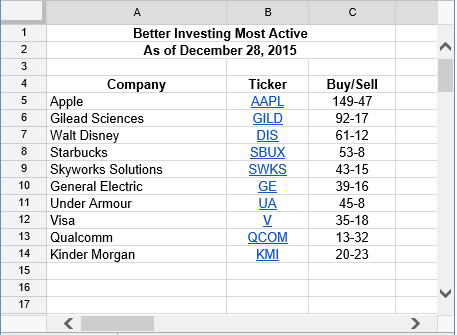
The below list details the most active stocks reported by Better Investing members. Better Investing members continue to show buying interest in Apple (AAPL). Since my last update of this list in November, General Electric (GE) and Kinder Morgan (KMI) are new additions while Netflix (NFLX) and Johnson & Johnson (JNJ) have fallen from the top 10.

From The Blog of HORAN Capital Advisors

Disclosure: Firm long AAPL, QCOM. Family Long AAPL, SWKS, GE


Sunday, December 27, 2015

Midstream MLPs Potential Funding Hurdles

Stocks in Energy Master Limited Partnerships (MLPs) have experienced some of the worst declines of any sector this year. The below chart of the Credit Suisse X-Links Cushings MLP Infrastructure ETN (MLPN) is a clear example of the magnitude of the decline. From the ETN's high to its low this year, the ETN fell over 52%. In less than a month, and mostly the past week, MLPN has rebounded 19% yet remains 43% below its 52-week high.

From The Blog of HORAN Capital Advisors

Given the magnitude of the decline in MLPs investors are evaluating whether this is an opportunity to begin building positions in the asset class. One decision point revolves around technicals while the other is centered in evaluating the fundamentals of many MLPs themselves. Technically, the recent bounce in some MLPs is placing them near short term overbought levels. In my view it will be the fundamentals that drive the future long term returns of the asset class and it is here where the waters become a little murky.

The growth of shale fracking has been a game changer for the natural gas and overall energy market in the U.S. The over supplied levels for both gas and oil has been written about ad nauseum this year, but suffice it to say the U.S. has abundant supplies of energy resources in the near term.

From The Blog of HORAN Capital Advisors

From The Blog of HORAN Capital Advisors

The consequence for exploration and production (E&P) MLPs is the increased supply is resulting in lower prices for their product, thus pressuring margins. Historically, the safe plays in MLPs were the midstream companies that essentially transported the product from the well head and then paid a toll based on the volume of oil/gas transported through their pipelines. Therein lies one question, if the E&P companies produce less, will less be transported by midstream MLPs, thus negatively impacting the revenue of the midstream MLPs?

Two additional issues are facing MLPs broadly that are related. As noted above a part of MLP growth has come from the booming natural gas segment, largely a result of shale fracking. In order to handle the growth, MLPs have increased their capital expenditure budgets and financed the expenditures via both equity and debt funding sources. This has occurred at the same time MLPs have strived to grow their distributions to shareholders.

Given the challenges facing many of the E&P MLPs, a few have cut distributions in order to funnel cash flow to capital expenditures due to the inability to access the credit markets without facing potential credit rating downgrades. Additionally, some of these MLPs have resisted issuing equity at these lower stock price levels due to the increased dilutive impact to existing shareholders. Also, the E&P companies will be facing an increasing need to roll over maturing debt.

From The Blog of HORAN Capital Advisors
Source: Ned Davis Research via Twitter

In reviewing the fundamentals then, one common measure used to evaluate MLPs is the debt to EBITDA ratio. In a 2013 Barron's article, Ned Davis Research opined,
“the debt-to-EBITDA ratio of the Alerian MLP Index goes a long way towards explaining returns. When the median stock in the index trades above 2.6 debt-to-EBITDA, MLPs have lost 10% on average. When it’s been below 2.6, they’ve gained 20%...” 
One midstream oriented MLP index is the Cushing MLP Infrastructure Index and all but one MLP in that index has a debt to EBITDA ratio greater than 2.6. Half of the MLPs have debt/EBITDA ratios greater than 5.0 and several are double digits.

From The Blog of HORAN Capital Advisors

The next question is what level of financing will be needed going forward to fund growth? The above file contains detail on cash flow from operations versus capital expenditures. In total, the gap that needed to be funded in 2015 with debt or equity is in excess of $11 billion. I also included a more detailed quarterly cash flow report for Energy Transfer Partners (ETP) in order to provide readers with insight into the funding sources and uses of cash by the company. A number of midstream MLP's have similar funding source breakdowns between equity and debt issuance.

As noted earlier in this post, debt is likely to be a more restrictive funding source, so equity is the alternative. With MLP prices depressed, MLP’s are less likely to issue equity due to the level of dilution. The alternative is to cut cap ex, cut the dividend or a combination of the two. Given the market’s negative reaction to recent distribution cuts by several MLPs, managements at MLP companies are likely to take a harder look before cutting distributions and more likely focus on cap ex first. Cutting capital expenditures has the potential negative impact of constraining future growth; however, this is likely what is needed given the U.S. energy glut.


Saturday, December 26, 2015

Our Most Read Blog Articles In 2015

Below are links to some of the most read articles on our blog in 2015. Several of the articles written early in 2015 may continue to have relevance as we approach 2016,
  • the first article below on how to profit from a rise in oil prices.
  • article #10, which highlights issues surrounding a strong U.S. Dollar
  • article #5 on the list detailed issues we believed the market needed to resolve in order to generate strong returns this year. Some of the issues we outlined then, like weakness in high yield bonds, have risen to the top of investors minds as the year is coming to a close.
  • the last article in the list evaluated the significance of the death cross and how the trigger might be most useful in one's decision making process.
Over the course of the next several weeks we will provide a more comprehensive review of 2015, and more importantly, our outlook for 2016 which will also be included in our Winter Investor Letter.
  1. How To Profit From An Increase In Oil Prices When It Occurs (1/29/2015)

  2. A Rising Bearish Wedge Pattern Is Developing In the S&P 500 Index (2/10/2015)

  3. Dividend Paying Stocks Struggling Mightily (5/6/2015)

  4. Additional P/E Multiple Expansion Possible Until The First Fed Rate Hike (3/8/2015)

  5. A Market Needing To Resolve Divergences In 2015 (1/2/2015)

  6. Ed Hyman: Bull Market In Early Stage (1/11/2015)

  7. Bullish Sentiment Declines To Level Last Seen In Early 2013 (3/19/2015)

  8. Mega Cap Stocks Driving Market Returns (12/5/2015)

  9. Shale Oil And Gas Production Projected To Increase In February (1/17/2015)

  10. Dollar Strength Continuing Headwind For Emerging Market Equities (10/6/2015)

  11. Anemic Economic Growth Since The Great Recession And Some Causes (5/11/2015)

  12. Market Advance Not Extraordinary In Terms Of Magnitude And Duration (2/27/2015)

  13. Death Cross More Of A Buy Signal? (9/2/2015)


Thursday, December 24, 2015

Retailers Poised To Offer Significant Discounts In The New Year

The business inventory to sales ratio and retail inventory to sales ratio are above or near levels last seen prior to the last recession. In an article in the Wall Street Journal ($) this morning it was noted, "Sales at physical stores fell 6.7% over the most recent weekend, while traffic declined 10.4%, according to RetailNext, which collects data through analytics software it provides to retailers. That is worse than the 5.8% decline in sales and the 8% drop in traffic recorded from Nov. 1 through Dec. 14." This build up in inventory at the retail level as well as in the pipeline, likely results in brick and mortar retailers offering significant discounts after Christmas.

From The Blog of HORAN Capital Advisors

The major challenge for brick and mortar retailers is the consumer's desire to shop online. Data through the third quarter reflects the growth in online purchases.

From The Blog of HORAN Capital Advisors

The continued popularity of online shopping is a challenge brick and mortar retailers will not easily resolve.


Monday, December 21, 2015

Buybacks And Dividends Exceeded Reported Earnings In Third Quarter

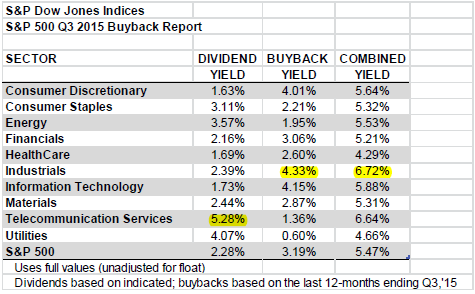
For the third quarter, S&P Dow Jones Indices is reporting that on a quarter over quarter basis buybacks for S&P 500 companies increased 14.5% and increased 3.7% on a year over year basis. The dividend plus buyback yield for the index is 5.53% and is at the highest level since the fourth quarter of 2011. The third quarter total of buybacks and dividends of $245.65 billion exceeded reported earnings of $205.90 billion. This is the fourth consecutive quarter that buybacks and dividends exceeded reported earnings. Highlights from S&P's buyback releases:
  • For the seventh consecutive quarter, over 20% of the S&P 500 issues reduced their year-over-year diluted share count by at least 4%, therefore boosting their earnings-per-share (EPS) by at least 4%.
  • Total shareholder return, dividends plus buybacks, set a 12-month record, at $934.8 billion.
  • “...14.6% of the S&P 500 issues have a current share count level at least 4% lower than their Q4 2014 level, meaning that those issues have already front-loaded at least a 4% tail wind to their Q4 2015 EPS,” according to Howard Silverblatt, Senior index Analyst at S&P Dow Jones Indices.
    From The Blog of HORAN Capital Advisors

    As detailed in the below table, the industrials sector has the highest combined dividend plus buyback yield of all the S&P 500 Index sectors at 6.72%.

    From The Blog of HORAN Capital Advisors

    It seems apparent that companies took advantage of the third quarter market weakness in the third quarter to reduce their share count. Historically, this has not always been the case as I noted in an article a few years ago; however, Q3 seems to be the exception.

    From The Blog of HORAN Capital Advisors

    One key to continued strength in buybacks and dividend growth will be the ability of companies to grow earnings and cash flow. Silverblatt noted in the report, 
    • Silverblatt stated that cash reserves declined 1.4% during the third quarter as S&P 500 Industrial (Old) available cash and equivalent decreased to $1.30 trillion, from the second quarter’s $1.32 trillion, and was 2.1% below the record $1.33 trillion set at the end of 2014.
    • “High levels of shareholder return are now part of norm, with dividend increases almost assumed for non-commodity issues, and buybacks, while receiving bad-press, are expected to continue. Companies continue to have the resources to support these expenditures via cash-flow and still low financing rates. However, given that the Fed has now started to increase interest rates, debt financing will become more expensive, albeit slowly, putting pressure on buybacks. Cutting or limiting buybacks may not be a welcome move for investors, but scaling back dividends is typically a road that management avoids at high costs.”

    Source:

    S&P 500 Q3 Buybacks Increases 14.5% Over Q2 2015, Up 3.7% Year-Over-Year
    S&P Dow Jones Indices
    By: Howard Silverblatt, Senior index Analyst
    December 21, 2015


    Wednesday, December 16, 2015

    Industrial Production Turns Negative

    This afternoon the Fed raised interest rates by 25 basis points, i.e., .25%. Certainly a quarter point hike in rates should not have a significant impact overall. However, the economy does seem to be shifting into a lower gear. One note of caution is the industrial production report this morning. The report shows the first year over year decline since the end of the last recession. As the below chart shows, a negative reading on industrial production nearly always occurs around recessionary periods.

    From The Blog of HORAN Capital Advisors

    Econoday's report on the release contained a couple of highlights.
    • November was another weak month for the industrial economy, in part reflecting unusually warm temperatures that are driving down utility output. Industrial production came in down a very sharp 0.6% in November. This is the biggest drop in 3-1/2 years. Utility output fell a monthly 4.3% after falling 2.8% in October. Mining, reflecting low commodity prices and contraction in energy extraction, has also been week, down 1.1% for a third straight decline.
    • This brings us to the most important component, manufacturing, where October's 0.3 percent bounce higher (revised downward from 0.4 percent) now unfortunately looks like an outlier. Manufacturing production came in unchanged in November reflecting weakness in motor vehicles, down 1.0 percent in the month, and also a dip back for construction supplies which fell 0.2% after a weather-related surge of 2.3% in October. One positive is a slight snapback for business equipment which, after declines in the two prior months, rose 0.2%.
    • All the weakness is pulling down capacity utilization, to 77.0% in November for a heavy 5 tenths dip. Utilization is running more than 3 percentage points below its long-term average. Mining utilization is now under 80%, down 1.1 points in the month to 79.4%. Utility utilization fell 3.4 points in the month to 74.5% with manufacturing utilization down 1 tenth to 76.2%. Excess capacity, though not cited as a major factor behind the lack of inflation in the economy, does hold down the cost of goods.
    This poor reading on industrial production is occurring in an environment where the U.S. economy is growing at a below trend pace. The weak industrial production number could be an indication of slower economic growth ahead. The industrial production and related capacity utilization figures are considered coincident indicators, meaning that changes in the levels of these indicators usually reflect similar changes in overall economic activity, and therefore gross domestic product (GDP). The release will shed light on short-term rates of change and business cycle growth. As the below chart notes, economic growth since the end of the financial crisis has been running  nearly 50% below the average growth rate of the economy since 1950.

    From The Blog of HORAN Capital Advisors


    Monday, December 14, 2015

    Junk Bond Risk Leading To A Potential 'Blood In The Streets' Environment

    Investor attention at the end of last week's trading was focused on the sharp sell off in high yield bonds, better know as junk bonds. This sell off was precipitated by the firm, Third Avenue, restricting redemptions on its Focused Credit Fund. Subsequent to Third Avenue's announcement, Stone Lion Capital Partners L.P. said it suspended redemptions in its credit hedge funds due to the high level of redemption requests it has received. Many stories have been written about the events impacting the high yield bond market, here and here

    In reality, a better classification for the Third Avenue Focused Credit Fund is probably a distressed debt fund or special situation fund. The fund's "focused credit" reference means just that, the fund is highly concentrated with nearly 30% of the fund's assets invested in its top 10 bond holdings. In other words, the fund is not a diversified bond fund. Our clients know we eliminated our high yield bond exposure in July of 2014. One reason we sold the high yield exposure last year was due to the narrow spreads on high yield broadly as reflected by the red dot in the below chart. This tight spread characteristic is an indication of the rich valuation of the high yield asset class at that time.

    From The Blog of HORAN Capital Advisors

    The issues surrounding high yield are being felt in the equity market as high yield bonds and stocks are highly correlated. Last week the Nasdaq declined 4.1% with the S&P 500 Index and the Dow Jones Industrial Average both declining 3.8% and 3.3%, respectively. For the year both the Dow and S&P 500 Index are essentially flat for the year on a total return basis while the Nasdaq remains up a little over 4.0% year to date. On a price only basis the S&P 500 Index is down 5.6% from its high in May.

    The pullback last week has resulted in the CBOE Equity Put Call Ratio spiking higher to .92 as can be seen in the chart below. As I have noted in earlier posts, P/C ratios over 1.0 are representative of an oversold market. The second chart shows the VIX index and this fear measure has also jumped higher to 24.4. Readers can track these fear measures here.

    From The Blog of HORAN Capital Advisors

    From The Blog of HORAN Capital Advisors

    One near term concern we discussed in a mid-November post was the fact the On Balance Volume indicator (OBV) continued to show more trading volume on down days than on up days. This has been the case all year and has resulted in a downward sloping trend for the OBV a noted by the second white line in the below chart. From a positive perspective some technical indicators are beginning to look more favorable (CBOE P/C ratio noted earlier), but also indicators like the Full Stochastic Indicator below.

    From The Blog of HORAN Capital Advisors

    The risk developing in the junk bond market is a consequence of the Fed's extended near zero interest rate policy and investors feeling the need to reach for yield. Similar challenges have developed in the energy Master Limited Partnership (MLP) space. The belief is the Fed desires to begin removing the proverbial bunch bowl and raise interest rates at the conclusion of next week's Fed meeting. I suppose it is possible the recent issues facing the bond market could result in the rate increase being pushed into early next year.

    Many of the headlines over the weekend were bearish ones with valid concerns about the high yield bond issues spreading into other areas of the market. On the other hand, this week's Barron's cover story highlighted 2016 forecast by ten strategists and all ten predicted higher equity returns for next year, with the average equaling 10%. With the issues facing the high yield bond market and a potential Fed rate hike around the corner, higher volatility in equities could face investors as the year nears its end. If this volatility is on the downside, Baron Rothschild, a member of the Rothschild banking family, is created with saying, "Buy when there’s blood in the streets, even if the blood is your own."


    Thursday, December 10, 2015

    The Facts Behind A Disappearing Middle Class

    Today, a number of media outlets have been discussing the disappearing middle class. The report was released by the Pew Research Center and notes, in 2015 21% of households comprise the top two income tiers, with Pew defining as more than twice the nation’s median income or at least $126,000 a year for a three-person household, which is up from 14% in 1971. For the bottom two income tiers, a three-person household earning $42,000 a year or less, in 1971 25% of households were in the lower two earning tiers versus 29% in 2015. The media outlets failed to provide detail around the cause behind this change.

    Below is select commentary from the website Political Calculations and the author's article, Solving the Mystery of the Disappearing U.S. Middle Class, which provides detail behind this shrinkage in the middle class. With the ranks of both the lowest and highest income earning American households simultaneously increasing as the ranks of middle income earning Americans have become depleted. But who were the biggest winners and losers?"
    • "The biggest winners since 1971 are people 65 and older. This age group was the only one that had a smaller share in the lower-income tier in 2015 than in 1971. Not coincidentally, the poverty rate among people 65 and older fell from 24.6% in 1970 to 10% in 2014. Evidence shows that rising Social Security benefits have played a key role in improving the economic status of older adults. The youngest adults, ages 18 to 29, are among the notable losers with a significant rise in their share in the lower-income tiers."
    "What the Pew Research Center's analysts were seeing in the 'hollowing out' of the U.S. middle class wasn't the result of some nefarious cause, but rather the inevitable result of the changing age demographics of the U.S. population. More specifically, the differences in the size of the living population of the U.S. by generation. The chart below shows the number of Americans born, whose births were registered, in each year from 1909 through 2004, while also indicating their generational grouping."

    From The Blog of HORAN Capital Advisors

    The next chart below provided by Political Calculations shows the income distribution by the last three generational groups.

    From The Blog of HORAN Capital Advisors

    The article notes,
    • "What we see is that Baby Boomers, who would be Age 51 to Age 69 in 2015, occupy the ranks of the highest income earners in the U.S., while Millennials, who would be Age 16 to 33 in 2015, occupy the ranks of the low end of the income earning spectrum."
    • "Meanwhile, we see that the much smaller Generation X finds itself sandwiched between these two larger generations in the ranks of the middle class."
    • "Is it really any wonder then that the number of middle class households has shrunk as it has while the apparent income inequality among U.S. households has increased?"
    "The mystery of the disappearing U.S. middle class is solved - the apparent movement of Americans toward the "economic extremes" is primarily the result of the changing age demographics of the U.S. income earning population (emphasis added)! Now, if we could just get a better class of journalists to dial down their overly excited and poorly considered emotional hyperbole...."

    Additional detail can be found by reading the entire Political Calculations article.