Wednesday, July 31, 2013

Equity Valuation by Country

Thomson Reuters (TRI) prepared  a chart that displays the equity valuation by country. Most country equity valuations are trading at their 10-year average valuation or lower. However, a few countries like Mexico, Sweden and Switzerland are trading at levels above their respective 10-year valuations.

From The Blog of HORAN Capital Advisors

Disclosure: Our firm holds a long position in TRI


Sunday, July 28, 2013

Mutual Fund Cash Levels Are Increasing

In my earlier post this week I noted investor money market assets as a percentage of all mutual fund assets were at a low level on a historical basis. If investor cash levels are at a low level, then where will the funds come from to propel equities to higher levels?

Interestingly, as the below charts indicate, various types of mutual funds have seen their cash levels increase. Either the cash is coming into mutual funds at a faster pace than fund managers can get it invested or fund managers are making a conscious decision to hold higher levels of cash. At the end of the day fund managers are evaluated on how their fund's performance compares with other funds and the fund's stated benchmark. As a result, it is likely this cash will find its way into investment assets other than cash. Although individual investors may have lower cash levels, it does appear, from a technical perspective, mutual fund cash levels are such that deployment of the cash can push equity prices higher. At a minimum, this cash may act as support for equities in the near term.

From The Blog of HORAN Capital Advisors

From The Blog of HORAN Capital Advisors

The coming week is loaded with potential market moving data.
  • Consumer Confidence on Tuesday
  • GDP reported Tuesday
  • Chicago PMI on Wednesday
  • FOMC interest rate decision on Wednesday. Additionally, the ECB and Bank of England are meeting as well.
  • Jobless claims reported on Thursday
  • ISM Manufacturing PMI on Thursday
  • A lot of earnings reports too. During the week of July 29th,  131 S&P 500 companies are expected to report earnings.


Wednesday, July 24, 2013

Investors Running Out Of Cash Available For Investments

With investors being paid virtually zero percent interest on money market cash for what seems an eternity, data suggests investors are buying almost any investment asset. Broadly speaking, all the talk has been how poorly emerging market investments have performed over the past few years. At HORAN Capital Advisors we even discuss the weak emerging market performance in our just released Investor Letter. Looking at fund flows though, the all equity, all bond and emerging markets mutual funds have been the beneficiaries of fund inflows this year.

From The Blog of HORAN Capital Advisors

The question often arises about mutual fund flow data not being comprehensive enough given the popularity of exchange traded products. Below are a couple of links to recent comments from Lipper about ETF flows.
The strong buying interest exhibited by investors during this bull market run since the end of the recession in 2009 is confirmed by the declining percentage of cash assets in money market mutual funds dividend by equity mutual fund assets. This declining trend is detailed in the below chart.

From The Blog of HORAN Capital Advisors

Investment Company Institute flow data also confirms flows out of money market mutual funds.

From The Blog of HORAN Capital Advisors

A curious question then is where will the additional investment dollars come from that can find away into equity investments? Avondale Asset Management posted a summary of the conference call notes from TD Ameritrade (AMTD). During the call TD Ameritrade mentions a number of details about the individual investor, one of which is the firm is seeing the start of a "mini" rotation out of bonds. Maybe this will be that source of cash that supports higher equity prices. On the other hand, the equity market does seem in need of rest, if only a brief one so one maybe does not need to be in a rush at the moment.

Disclosure: No position in AMTD


Tuesday, July 23, 2013

Investor Letter: Thoughts On The Second Half

Our firm's Second Quarter 2013 Investor Letter provides a review for the first half of the year. In our Letter we discuss our current investment position, as well as recent changes to our client portfolios. Our recent investment biases have served our clients well. Strategically we have favored U.S. equities and shorter maturity bonds while at the same time avoiding gold (broad commodities for that matter), preferred stocks and long-term bonds. The table below details the returns for various asset classes as of June 30, 2013.

Our contention for some time has been U.S. equities looked favorable relative to other equity investments due to valuation, strong balance sheets and the largest stimulus program in U.S. history. Our overweight bias in U.S. equities and underweight in foreign equity has been rewarded with significant outperformance of U.S. stocks over multiple time periods as illustrated above.

The complete Letter can be accessed directly from our website at this link: 2nd Quarter Investor Letter.

From The Blog of HORAN Capital Advisors


Friday, July 19, 2013

Warren Buffett On The Markets

In the below video Warren Buffett provides his take on stocks and the market. A couple of key points he mentions are:

  • A stock doesn't know you own it, and
  • Ones feeling about the market is not reciprocated by the market.


H/T: Abnormal Returns


Dow Rally Following Prior Market Contractions

The Chart of the Day charting service's recent report on Dow rallies following market declines of at least 30% shows the current rally is below average in both magnitude and duration. The report notes,
"The Dow just made another post-financial crisis rally high. To provide some further perspective to the current Dow rally, all major market rallies of the last 112 years are plotted on today's chart. Each dot represents a major stock market rally as measured by the Dow with the majority of rallies referred to by a label which states the year in which the rally began. For today's chart, a rally is being defined as an advance that follows a 30% decline (i.e. a major bear market). As today's chart illustrates, the Dow has begun a major rally 13 times over the past 112 years which equates to an average of one rally every 8.6 years. It is also interesting to note that the duration and magnitude of each rally correlated fairly well with the linear regression line (gray upward sloping line). As it stands right now, the current Dow rally that began in March 2009 (blue dot labeled you are here) would be classified as well below average in both duration and magnitude. However, when compared to the most recent post-major bear market rally (i.e. the rally that began in 2002), the current rally is significantly greater in magnitude and accomplished this feat in less time."

From The Blog of HORAN Capital Advisors


Thursday, July 18, 2013

Foreign Sales Increase For S&P 500 Companies

S&P Dow Jones Indices recently reported foreign sales data for S&P 500 companies for 2012. In the report, S&P 500 Foreign Sales Edge Up, it is noted there is some difficulty in obtaining foreign sales data since companies are not required to provide a breakdown when providing financial reports. Nonetheless, S&P explains the procedure used in reporting the information. In the final analysis the data shows foreign sales increased to 46.6% in 2012 versus 46.1% in 2011. Some highlights of the foreign sales breakdown are as follows:
  • In 2012, European sales represented 9.2% of all S&P 500 sales, down from 11.1% in 2011 and 13.5% in 2010.
  • The U.K. represented 1.7%, down from 2.4% in 2011, which had risen from 1.4% in 2010. The result is that European ex-U.K. sales represented 7.5% of all S&P 500 sales in 2012, down from 8.7% in 2011 and 12.0% in 2010.
  • Asian sales increased to 7.7% from 7.2% in 2011 and 6.1% in 2010.
  • Canadian sales continued to be volatile, even as Canada boasted a larger portion of sales than any other single country. Accounting for 4.0% of S&P 500 sales, Canadian sales are down from 4.3% in 2011, but up from 1.9% in 2010.
  • Information technology continued to be the most successful (and exposed) sector in terms of foreign sales. In 2012, 58.6% of its declared sales were foreign.
The breakdown by sector is displayed in the below table.

From The Blog of HORAN Capital Advisors

Given the large percentage of foreign sales by S&P 500 companies, investor should be mindful of the impact of currency exchange rates as the foreign sales are converted back to the U.S. Dollar. The country with the largest portion of foreign sales is Canada at 4.0%. Regionally, Europe accounts for 9.19%, Asia 7.66%, North America 4.73% and Africa 3.71%.

Source:

S&P 500® Foreign Sales Edge Up (page 15)
S&P Dow Jones Indices Insight Newsletter
By: Howard Silverblatt
Summer 2013
http://us.spindices.com/documents/education/insights-newsletter-201307.pdf?force_download=true


Wednesday, July 17, 2013

Dividend Payers Underperforming Non-Payers For First Six Months Of The Year

It seems much of the focus around the stock market this year has centered around investors chasing the dividend paying stocks. The theme of the discussion has been bond investors have been buying "bond like" stocks in an attempt to enhance the yield on their investments. The thinking has been bond yields are so low, one can buy dividend paying stocks with higher yields than a bond of the same company.

The downside to this investment approach is equities are more volatile than bonds. The other downside is dividend paying stocks have underperformed the non payers for the first six months of the year through June 30th. Some of the higher yielding stocks in the S&P 500 Index fall into the materials (metals and coal), utility and telecumminucations sectors of the market and these stocks have been weak performers year to date. As the below chart from S&P Dow Jones Indices shows, the average return of the non payers has exceeded the payers for the time periods listed below during the past twelve months.

From The Blog of HORAN Capital Advisors

A list of the company yields and returns can be found at this link: Return and Yield File.

In spite of the payers underperformance, investors in dividend paying stocks have enjoyed nice growth in the income generated through the growth in a company's dividend. Howard Silverblatt, Senior Index Analyst at S&P Dow Jones Indices, noted recently of the approximately 10,000 U.S. traded issues,
“Dividends continued to increase in the second quarter with actual cash payments increasing 15.5% and the forward indicated dividend setting another all-time high. Payout rates, which historically average 52%, continue to remain near their lows at 36%. At this point, year-to-date dividend payments are up 13.9%, with 2013 easily expected to surpass the 2012 record dividend payment.”


Saturday, July 13, 2013

End Of Low Interest Rate Environment: Where To Invest

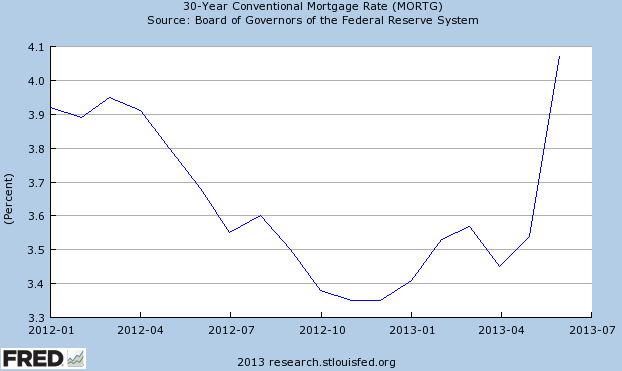
The recent market focus has been centered on Ben Bernanke's comment that the end is near for a very accommodating Federal Reserve, i.e., quantitative easing (QE) tapering is near. The market's reaction was one where the 10-year Treasury rate shot higher (prices declined) as evidenced in the below chart. This rise in rates also influenced mortgage rates as detailed in the second chart below.

From The Blog of HORAN Capital Advisors

From The Blog of HORAN Capital Advisors

Consuelo Mack of WealthTrack noted prior to her interview (link below) with Richard Bernstein and Dan Fuss that investors pulled $60 billion out of bond mutual funds. As a point of reference, in the four years (2009 - 2012) investors poured $1.1 trillion into the fixed income or bond asset class. Trim Tabs reports investors are now putting these funds into stock or equity funds. As an aside Trim Tabs notes historically the individual investor has been extraordinarily bad at market timing.

In Consuelo Mack's recent interview with Richard Bernstein, a top-ranked strategist, turned portfolio manager, and Dan Fuss, a Loomis Sayles’ bond fund manager, both provide their contrarian views as to whether the 30-plus years of falling interest rates may be winding down. Bernstein favors the US domestic equity market and particularly mid-cycle companies. Mid cycle firms tend to be industrials, manufacturing, some technology companies and some financials. They are not commodity and energy related companies.

As it relates to manufacturing in the U.S., WealthTrack has provided a report prepared by Nancy Lazar's new firm, Cornerstone Macro. Lazar was a co-founder of her former firm, the highly rated ISI Group, one of the top economic/strategy firms on Wall Street. This new report notes that Cornerstone's favorite emerging market is Middle America. Cornerstone believes a decoupling is taking place between the US and emerging market economies due to competitive labor cost in the US and favorable energy costs in the US.


Monday, July 08, 2013

Equal Weighted S&P 500 Outperforming Cap Weighted S&P 500 Index

The equal weighted S&P 500 Index ETF, RSP, continues to outperform the capitalization weighted S&P 500 Index on a year to date basis. The equal weighted index maintains a higher weighting in the smaller cap companies in the S&P 500 Index and small cap stocks (IWM) have been outperforming the larger cap issues this year.

A part of this outperformance may be attributable to the fact small cap companies have less exposure to the international markets, both developing and emerging. Developed and emerging markets have been weaker performers this year as the economic growth rates in emerging markets is slowing. Developed market economies are dealing with the ongoing effects of eurozone issues.

From The Blog of HORAN Capital Advisors


Sunday, July 07, 2013

Women And Investing

Consuelo Mack of WealthTrack recently aired two interview segments that focused on women and their investing and retirement needs. American women control $8 trillion in assets and this figure is expected to grow to $22 trillion by the end of the decade. Yet the traditional wealth management approach doesn’t necessarily work for women’s needs. In the first video Consuelo Mack's guests, Morgan Stanley’s Ami Forte, and GenSpring’s Senior Strategist, Jewelle Bickford, discuss how women can start taking ownership of their financial power.

Importantly, only 1 in 5 women have determined how much money they will need in order to maintain their lifestyle in retirement. From a longevity perspective, on average women will live 5 years longer than a man. Today, 75% of the population age 85 years old or over is comprised of women.

In the second video below (Part II), Consuelo Mack notes, "Women worry about becoming bag ladies in their old age and men focus too much on performance numbers, which isn’t always the best way to plan for the future."  Her guests are Mary Beth Franklin, a contributing editor for InvestmentNews as well as an expert on social security, and Erin Botsford, founder and CEO of the Botsford Group, where they explain why women are so different from men in their approach in planning for the so-called “Golden Years”.


In the first video the guests note investments today are more than simply allocating ones investment funds between stocks, bonds and cash. At HORAN our investment approach incorporates other asset classes as well. Our alternative allocation is an effort to enhance a client's investment returns without taking the same level of risk as equities, but generate a return better than fixed income or bonds. As Ami Forte notes in the first video, bonds were traditionally known as safe asset class, however, the recent rise in interest rates has exposed just how risky the bond asset class can be.


Friday, July 05, 2013

Elevated Number Of Part Time Workers

Today's release of the non-farm payroll report noted one troubling aspect of this recovery following the recession that ending mid year 2009. The job market strength during this recovery seems more centered in part time employment.

From The Blog of HORAN Capital Advisors

From The Blog of HORAN Capital Advisors

There are a number of reason for why this might be the case, but the impact on economic growth is not generally positive. Part time workers are less likely to feel secure in their jobs so may limit their personal expenditures. And with consumers accounting for nearly 70% of economic growth (GDP), this tighter reign on spending is likely keeping the economy from growing at a potentially higher rate that is more typical following recessionary periods. Additionally, this low rate of employment growth has kept the job market from recovering to levels reached prior to the beginning of the recession as noted in this chart from the Calculated Risk website.


Sunday, June 30, 2013

A Look At The Emerging Markets Asset Class

One area of the global equity markets that has experienced a significant correction this year is the emerging markets. As the below charts of one, five and ten year returns indicate, the emerging market space (EEM, VWO) has significantly underperformed the U.S. market (S&P 500 Index) for one and five years, but maintains a large performance edge for ten years. Importantly for investors then is determining whether this recent correction is an opportunity to increase exposure to the emerging market space or not.

From The Blog of HORAN Capital Advisors

A recent research report published by Fidelity Investments, Secular Outlook for Global Growth: Challenges and Opportunities, outlines some key factors for investors to evaluate for various countries. A large part of the long term future growth potential within a particular market is based on a country's GDP growth expectations.

From The Blog of HORAN Capital Advisors

Population growth and productivity growth are key factors that contribute to a country's overall GDP growth potential. With respect to population growth, the report notes difficulties in comparing one country to another due to differing life expectancies. In summary though, Fidelity notes:
"Working-age populations have risen rapidly for several decades, but almost all countries will experience slower growth and receive less of a direct demographic benefit over the next 20 years. Mature countries such as Japan and parts of Europe—with the U.S. as a notable exception—will experience outright declines in working-age population. In general, growth will be faster in the developing world—Latin America, Africa, emerging Asia, and the Middle East—although China’s demographics are not as constructive (emphasis added)."

From a productivity standpoint the report notes three categories that are key drivers of productivity growth: people, structure and catch-up potential.
  • People: "The greater the human capital, the more productive the economy. According to our human capital index, which incorporates measures of educational and scientific achievement as key drivers of future innovation and adoption of new technologies, human capital accumulation over the past two decades should boost global growth in the next 20 years. Human capital tends to be higher in the world’s wealthiest regions, such as the U.S., Japan, and northern Europe. South Korea has the highest human capital ranking, and several emerging economies—including China, Turkey, Thailand, and Vietnam—have also made great strides..."

    "On balance, young populations in the developing world—such as Mexico, Colombia, and the Philippines—will benefit from a maturing phase. Formerly maturing countries—such as China, South Korea, and Thailand—will be disadvantaged as their populations enter the aging phase. Already aging societies—such as Russia, Germany, and Japan—will feel the most negative effects on productivity as their demographics deteriorate further (as noted in the below chart)."
From The Blog of HORAN Capital Advisors
  • Structure: "Complex economies tend to be more competitive, use technology more effectively, and have better business climates and more nurturing institutions (source: Hausmann, Hidalgo, et al.). As a result, higher complexity typically means higher productivity. Greater variety and more sophisticated products in a country’s output signal a more complex economic structure. For example, Japan has the highest complexity ranking, while a number of African countries rank very low. Complexity should contribute slightly to higher global growth over the next 20 years as increasingly complex emerging economies—such as South Korea, China, Hungary, and Thailand—offset stagnating complexity in the most advanced economies."
  • Catch-up Potential: "In theory, less advanced economies should grow faster than more mature economies, thanks to their ability to grow off a lower base, adopt existing technologies, and catch up or converge to the higher income levels of developed countries. In practice, however, this convergence does not occur automatically but is conditional on other factors, such as the people and structure of an economy."

    "Once we account for these other growth determinants, catch-up potential has been—and will continue to be—a positive contributor to global GDP growth. After the rapid growth in recent decades of larger developing economies, such as China, India, and South Korea, higher per capita incomes now leave less catch-up potential for the next 20 years. While smaller poor economies in Africa and other regions will still benefit, catch-up potential will generally contribute much less to global growth."
    If an investor's time horizon is three to five years (or longer), data would seem to support that some emerging or developing economies will be leaders in global growth. As with individual stocks, the direction of the growth rate plays a key role in a country's potential return as well. As the GDP charts earlier in the post show, GDP growth in countries like China and India having been slowing recently. This decrease in the growth rate can cause short term market disruptions. Also, as the ten year performance chart above shows, emerging markets have done quite well relative to U.S. equities, but are emerging market indices mean reverting?If so, the dangers of catching a falling knife are certainly present.

    From The Blog of HORAN Capital Advisors

    There are many additional factors one most consider, such as financial data quality, the political stability or lack there of, etc. However, it does appear some of the emerging economies do offer return opportunities for investors, albeit, these markets are likely to remain more volatile than developed market equities. It is estimated that the emerging markets will continue to capture a larger share of the world's GDP and at some point this will likely have a positive impact on emerging equities.

    From The Blog of HORAN Capital Advisors

    Source:

    Secular Outlook for Global Growth:
    Challenges and Opportunities

    Fidelity Investments
    By: Irina Tytell, PhD, Senior Research Analyst
    Lisa Emsbo-Mattingly, Director of Asset Allocation Research
    Dirk Hofschire, CFA, SVP, Asset Allocation Research
    June 2013
    http://tinyurl.com/ka9gqvx


    Sunday, June 16, 2013

    Interest Rate Policy To Impact The Dollar And Commodity Related Industries

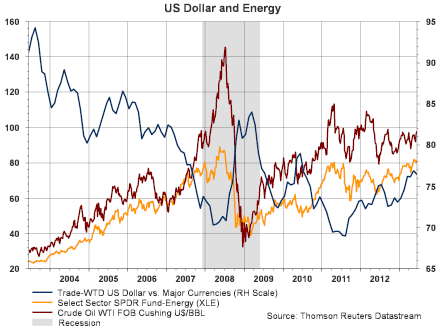
    All eyes have been on the Federal Reserve recently as talk of tapering of the quantitative easing programs was introduced by some Fed governors. An outcome of reducing the QE influence on the economy would likely be a move higher in interest rates. In fact, the yield on the 10-year Treasury recently moved higher from the 1.60% area to the 2.20% level as a result of the tapering comments. If this gradual reduction in QE is implemented, interest rates are likely to normalize at a higher level. Rising yields are not necessarily bad for the economy; however, higher rates are likely to have an impact on the value of the U.S. Dollar and commodity prices. There are a number of factors that influence the value of a currency, interest rates though, have a direct impact on a country's currency. As interest rates rise, the dollar tends to strengthen.

    From The Blog of HORAN Capital Advisors

    With this strengthening, downward pressure is placed on commodity prices. Some commodities, like oil, are impacted more by the strengthening of the US Dollar as oil is transacted in Dollars around the world. As an example, an oil company in say Norway would receive more Krone for every Dollar converted back to the Norwegian currency in a strong Dollar environment. Because the Norwegian oil company is getting a currency benefit in the exchange, downward pressure is placed on the price of oil. Certainly a country's fiscal situation, along with other factors (Purchasing Power Parity), will impact a currency's value.

    From The Blog of HORAN Capital Advisors

    For an investor then, a question becomes what is the impact of a potential rise in interest rates on commodities and commodity centric firms. Also, why is the dollar strengthening? Is the economy strengthening thus resulting in a higher demand for oil? Is this placing downward pressure on energy and commodity supplies which would translate into higher energy prices? The yellow colored line in the above chart represents the energy sector exchange traded fund XLE. It is pretty clear that energy firms are highly correlated with the move in energy prices. If U.S. Dollar strengthening translates into lower oil prices, the energy space could come under downward price pressure.

    As the below chart shows from a technical perspective oil prices have moved into a tight pendant pattern. Technically, it isn't clear from the chart in what direction oil prices might move, only that it could break hard in one direction or the other.
    From The Blog of HORAN Capital Advisors

    Other direct commodity plays have come under significant price pressures this year as well. Many differing variables are impacting these commodity prices. For the coal related industries (KOL), the significant discoveries of natural gas in the U.S. due to fracking is lessening the demand for coal. Also, lower commodity prices may be indicative of slowing economic growth rates in some of the emerging economies.

    From The Blog of HORAN Capital Advisors

    Both the materials sector and the energy sector have been some of the weaker performing sectors in the market this year. Up until last month, the better performing sectors had been the more defensive and higher yielding ones like health care and consumer staples. We discussed the potential rotation out of these sectors several weeks back with materials and energy beginning to outperform the broader market at that time.

    From The Blog of HORAN Capital Advisors

    Be it right or wrong, the market will be laser focused on the Fed's statement Wednesday in an effort to gain a better understanding of the future direction of interest rate policy. As noted in the link to Scott Grannis' article at the beginning of this post, higher rates are not necessarily a bad omen for the economy. However, future interest rate policy will likely influence these commodity related sectors.


    Friday, June 14, 2013

    Where Does A Top Bond Manager Invest His Personal Funds?

    Note, Google Reader shuts down for good on July 1st. If you read our content via Google Reader the following link outlines RSS reader alternatives.

    http://lifehacker.com/5990456/google-reader-is-getting-shut-down-here-are-the-best-alternatives
     
    Many of the readers of our content receive an email notification when we publish articles. You can sign up for these emails at the following link: Email Notification
    Now the article:

    In a recent interview between Stephen S. Smith, co-portfolio of the Legg Mason B.W. Global Opportunities Bond Fund (GOBAX), and Consuelo Mack of WealthTrack, Steve explains where he has allocated his personal investments over the past few years. His investment of choice has not been bonds.


    Wednesday, June 12, 2013

    Emerging Market Investments Unable To Find A Bottom

    One investment asset class that seemed to be favored by many investment advisers at the beginning of the year was emerging markets. When the crowd highly favors a certain type of investment, investors should be wary of following this crowd behavior. At the beginning of this year, InvestmentNews surveyed advisers and found the following,
    "...more than half the advisers surveyed by InvestmentNews at the beginning of the year said they planned to increase their allocation to emerging market stocks. No other equity asset class was cited as often. About a third of the polled advisers said they planned to increase allocations to emerging market bonds, the most of any fixed-income asset class."
    From The Blog of HORAN Capital Advisors

    Since the beginning of the year, emerging market investments have generated poor returns for investors as noted in the above chart. The chart shows the divergent spread between the performance of the emerging markets index (EEM) versus the S&P 500 Index (SPX). The S&P 500 has outperformed EEM by nearly 24 percentage points on a year to date basis.

    As the InvestmentNews article notes, emerging market bonds were another favored asset class at the beginning of 2013. I suppose the investing community thought if investors like emerging market equities, they will certainly be attracted to emerging market high yield bonds. So Blackrock's iShares came out with an emerging markets high yield bond index, EMHY. As the below chart details, the performance has been anything but stellar. The top three countryweightings for EMHY are:
    • Turkey: 16.75%
    • Venezuela: 14.75%
    • Philippines: 9.93%
    From The Blog of HORAN Capital Advisors

    The recent protests in Turkey have raised questions about the future growth opportunities in that country and investors have sold investment assets tied to Turkey.

    The options trading firm, Schaeffer’s Investment Research, Inc., recently noted in their trading floor blog the  divergent views surrounding EEM's recent "death cross" chart formation.

    The "pro" view: Emerging Markets Are Ready To Show Some Strength
    The "neutral" view: Is this the End of Emerging Market Underperformance?

    Given the recent underperformance of emerging markets, this may present an attractive entry point into this asset class. However, investors need to keep in mind, emerging markets have a large performance advantage over the broader U.S.equity market (S&P 500 Index) over the past ten years. I only note this in the event investors believe in the "reversion to the mean" theory

    From The Blog of HORAN Capital Advisors

    At the end of the day, the growth in the emerging markets will be tied to the economic growth prospects for these emerging market countries relative to the developed markets. What makes these allocation decisions more difficult today are the currency influences that are being manipulated by the central banks' around the globe and their respective quantitative easing programs. The article, The Currency Carry Trade, DBV and Risk, provides some insight into these currency issues.


    Chasing Yield Has A Downside When Interest Rates Rise

    As interest rates have moved higher, as evidenced by the below chart of the 10-year treasury yield, yield related investments have come under significant downward pressure. The below chart shows the 10-year treasury yield rising from 1.63% in early May to 2.19% at today's close.

    From The Blog of HORAN Capital Advisors

    Rising rates have had a negative impact on REITs. Investors that were chasing yield in this low interest rate environment are now experiencing the downside in these investments when market interest rates rise.

    From The Blog of HORAN Capital Advisors

    The above chart was sourced from the website, Institutional Imperative, and the article examines the valuation metrics of REITs. It is a worthwhile read for investors that are searching for yield.

    The spike in interest rates has also resulted in investors selling their investments in bond funds. The below chart shows bond funds experienced their first weekly outflow of the year. EPFR and Deutsche Bank report this outflow was the largest outflow ever.

    From The Blog of HORAN Capital Advisors
    Source: Quartz

    Below is a chart collection of other yield sectors that have been negatively impacted by the recent rise in market interest rates.

    From The Blog of HORAN Capital Advisors

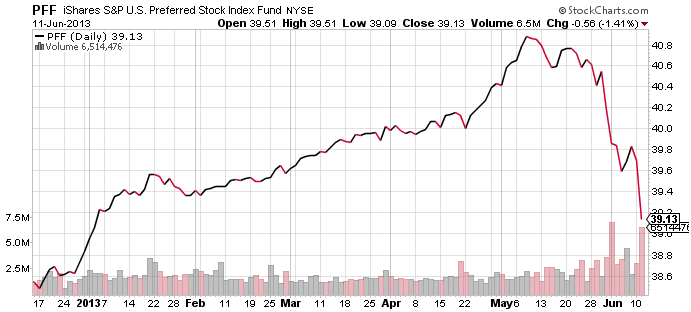
    Updated (6/12/2013. 9:03 AM): Including chart of preferreds:

    From The Blog of HORAN Capital Advisors

    It would appear the market might be sending the Fed a message that it wants QE to continue unabated. The recent hawkish tone from some Fed members and the comments about "tapering" of the QE programs seems to have certainly spooked the investors.


    Sunday, June 09, 2013

    Fickle Investor Sentiment

    One common trait of individual investors during the equity bull market run since November is restraint. Based on the American Association of Individual Investors sentiment survey, investor bullish sentiment fell over six percentage points to 29.47% for the weekly period ending June 6th. This follows a thirteen point decline in the prior week after moving up by over ten points during the week of May 23rd. This two week decline in bullish sentiment occurred during a period when the S&P 500 Index experienced a 5% correction on an intraday price basis.

    From The Blog of HORAN Capital Advisors

    Equity prices began turning higher at the end of the day on Thursday once the market (S&P 500) hit the technically important 1,598 level. The positive momentum carried through to Friday following the nonfarm payroll report. It seems the individual investor is anything but "all in" with their equity exposure.


    Sunday, June 02, 2013

    The Hindenburg Omen Is Triggered Again

    Friday afternoon one technical indicator, the Hindenburg Omen, seemed to dominate the discussion of a number of market pundits.


    The blog at stockcharts.com provides the following criteria in order for the indicator to be triggered,
    "Hindenburg Omen: Created by James Miekka, the Hindenburg Omen warns of potential weakness in the stock market. There are three criteria to activate the omen. First, NYSE new highs and new lows must both be more than 2.8% of advances plus declines. Second, the NY Composite is above the level it was 50 days ago. Third, the number of new highs cannot be more than double the number of new lows. The activation period is good for 30 days. Once active, a sell signal is triggered when the McClellan Oscillator moves below zero and negated when the McClellan Oscillator moves back above zero."
    Below is the chart detailing the criteria triggering the Omen.

    From The Blog of HORAN Capital Advisors

    Although the analyst in the CNBC video implies the Hindenburg Omen hasn't been triggered in a few years, it was last triggered in April. We wrote a post on our blog in August of 2010, The Real Facts About The Recent Hindenburg Omen Trigger, when it was triggered then. Since that August 2010 date, the market has enjoyed one of its better bullish advances. 

    From The Blog of HORAN Capital Advisors

    I believe Chip Anderson's comment at the conclusion of his chart analysis is appropriate for investors to take to heart.
    "Given that this is the second time in two months that this signal has occurred, ChartWatchers would be well advised to look for additional signs of technical weakness in this market."


    Saturday, June 01, 2013

    Remember Those Two Week Market Declines?

    A seemingly rare occurrence has taken place with the close of trading on Friday. The S&P 500 Index has declined for two weeks in a row. The last time this occurred was in November of last year. This is a testament to how strong the market advance has been so far this year.

    From The Blog of HORAN Capital Advisors

    The sectors that have been the weaker performers during this pullback or consolidation have been the traditionally more defensive ones, e.g., consumer staples, utilities, telecommunications. Also, the indices that are focused on dividend paying stocks have underperformed the broader market (S&P 500) as well.

    From The Blog of HORAN Capital Advisors

    From The Blog of HORAN Capital Advisors

    From The Blog of HORAN Capital Advisors

    As noted in several prior blog posts, investors seem to be chasing the higher yielding dividend paying stocks, viewing them as potential bond substitutes. This heightened interest in the dividend payers has pushed the valuations of many of them to stretched levels. With a little market weakness it appears these investors are finding out these dividend payers can be volatile also and they are reducing their position sizes.