Saturday, August 26, 2017

DowDupont Will Be Included In Dow Jones Industrial Average Index

As many readers know, effective September 1, Dow Chemical (DOW) and DuPont (DD) will merge into one company, DowDupont (DWDP). Effective that same day, S&P Dow Jones Indices will replace DuPont, a component of the Dow Jones Industrial Average Index, with DowDuPont. S&P notes,
"Replacing du Pont with the new DowDuPont allows the Dow Jones Industrial Average to maintain its exposure to the Materials sector....The change won’t cause any disruption in the level of the index. The divisor used to calculate the index from the component’s prices on their respective home exchanges will be changed prior to the opening on September 1. This procedure prevents any distortion in the index’s reflection of the portion of the U.S. stock market it is designed to measure."


Friday, August 25, 2017

Large Decline In Bullish Investor Sentiment

This week's AAII Sentiment Survey reported a 6.1% decline in bullish investor sentiment to 28.1%. The bullish sentiment level is now near one standard deviation below the long term average. Nearly all of the decline in the bullish sentiment showed up in the bearish number which increased 5.5%. The bull/bear spread is now -10.4 percentage points.


Sunday, August 20, 2017

Dr. KOSPI's Protocol For Global Growth Diagnosis

It has been about two weeks and market sentiment seems to have quickly turned decidedly bearish and the S&P 500 Index is down only 2.2% from its high. I will not list all the bearish commentary over the last few days, but we even pushed out some thoughts this weekend on our Twitter account (@HORANCapitalAdv) that leaned a little bearish. A couple of reasons for the increased bearishness might be the fact the market has gone over a year without a pullback of more than 5% and stock valuations do appear elevated on an absolute basis. Lastly, with the increase in technical and computerized trading, readers should know the S&P 500 Index acquired a significant target price that was triggered over four years ago and was formed out of a 16 year trading range for the market. Once significant levels like this are reached, it is not uncommon for the market to at least consolidate gains.


Friday, August 18, 2017

No Slowdown In Growth Of e-Commerce Sales

It seems nearly every company reporting earnings now references a strategy to deal with Amazon (AMZN) due to Amazon's command of e-commerce sales. Beyond the simple delivery of packages and hard goods, AMZN is moving into many other areas like grocery, air transportation, etc. I discussed this in a post a few months ago. In that post I highlighted the profitability of Amazon's cloud business (AWS) and the company using AWS profits to fund growth in other industries.

Yesterday, the U.S. Census Bureau reported quarterly retail e-commerce sales for the second quarter of 2017. Not a surprise to many now, e-commerce sales continue to grow at a high rate, i.e., up 16.2% on a year over year basis for Q2. Traditional brick and mortar sales were up a small 2.9% year over year. The other notable highlight from the Census Bureau report, e-commerce sales now account for 8.9% of total retail sales. This is nearly three times larger than ten years ago.


The Economy May Not Be At Full Employment

One economic conundrum has been the sub-par growth rate in average hourly earnings in spite of what appears to be an economy operating at full employment. In a fully employed economic environment, wages generally see fairly strong upside pressure and this becomes a concern with the Federal Reserve due to the upward pressure placed on the inflation rate. As the below chart does show, average hourly wages have grown at about a 2% annual rate since the end of the financial crisis. Prior to the onset of the last recession, wage growth was in the range of 3% to 4%. From a positive perspective though, wages have been growing faster than the rate of inflation for most of the last four years. Additionally, the differential wage growth and inflation in this cycle is on par with prior economic expansions.


Sunday, August 06, 2017

Investor Fund Flows Favoring Bonds And Not Equities

The equity market has gone over a year without a pullback of at least 5% or more. The last 5% decline occurred in mid-June 2016 when, over a two week period, the market fell 5.5%. Even in the run up to the election last year, the equity market did not close down over 5%. This lack of volatility is showing up in popular volatility measures like the VIX, but the VIX may not be a good measure of expected future volatility.  Also, this lower level of volatility has some strategists suggesting investor's have become to complacent about the equity market and have willingly taken on more equity exposure as a result.

A recent post by Dr. Ed Yardeni, Ph.D., and he puts out some great research, noted individual investors may have become too optimistic as well. In that post, Investors Hearing Call of the Wild, he included the below chart of U.S. equity ETF flows.


Saturday, August 05, 2017

The S&P 500 Index Is Expensive And Has Mostly Been So Since The Early 1990's

One can cite any number of stock valuation measures and conclude U.S. equities look expensive or are at least trading above their long term average valuation measures. In this environment one might conclude stocks are priced for perfection with little margin for error. Of course this might certainly be the case, but is this an uncommon position for the equity market? As the shaded areas in the below chart show, investors would have had a difficult time buying or holding onto stocks at valuation levels that were below their long term average valuation since the early 1990s.


Tuesday, August 01, 2017

Dividend Payers Are Underperforming

A year ago dividend paying stocks were significantly outperforming the non payers in the S&P 500 Index and the S&P 500 Index itself. If investors were chasing performance back then and loading up on the payers, today they would be disappointed. Below is a chart of the year to date performance of two dividend paying exchange traded funds, SPDR Dividend ETF (SDY) and iShares Select Dividend ETF (DVY). The return of the dividend focused ETFs is nearly half that of the S&P 500 Index.  The return difference is similar for one year. My year ago post contains some details on both ETFs.


Sunday, July 30, 2017

Equity Valuations No Longer Matter?

One benefit to writing blog content is it serves as a record of ones past thinking and the results of any decisions made from the prior analysis. With that in mind I reviewed some of the topics written over a year ago, that is, in June/July of 2016. A few of the topics at that time had to do with valuations, PEG ratios and the fact the market was trading at an all time record high. In fact one article was titled, Is It Right To Be Bullish Near A Record Market High? The conclusion at that time was to stay invested in equities as I wrote then,


Saturday, July 22, 2017

Strong Earnings Growth And Favorable Valuations Lead To Weak Stock Returns

One factor utilized in uncovering potential investment opportunities is to evaluate companies and sectors that are projected to generate strong earnings and cash flow growth over the course of the next year or more. The risk associated with simply reviewing earnings growth rates is the fact other variables often influence the future price performance of a company's stock. A good case in point at the moment can be found in evaluating energy companies and the associated sector. For calendar year 2017 and 2018, the energy sector is expected to exhibit the highest earnings growth rate among all the S&P 500 sectors. For 2017 the year over year earnings growth rate for the energy sector is estimated to equal over 300%. In 2018 the YOY growth rate is projected to equal 41.3%.


Even reviewing the sector PEG ratios (P/E to earnings growth rate), the energy sector looks very attractive and is the only sector that has a PEG below 1.0.


Thursday, July 20, 2017

Jump In Investor Bullish Sentiment But Remains Below Long Run Average

Today the American Association of Individual Investors released their Sentiment Survey results for the week ending 7/19/2017. These results show individual investors' bullish sentiment increased 7.3 percentage points to 35.5%. This is the highest reading since early May when bullish sentiment was reported at 38.1%. This jump in bullish sentiment still has the level below the long run average of 38.5%. The increase in the bullish reading came almost equally from a reduction in those investors indicating they were bearish and those reporting a neutral view of the markets.

This is a contrarian measure and remains at a fairly low level. On the other hand, the market continues to achieve record highs with very little downside volatility. A pullback of 5-10% would not be a surprise given the market's recent strength.

Source: AAII


Wednesday, July 05, 2017

Summer 2017 Investor Letter

Our Summer 2017 Investor Letter reviews the strong equity market performance thus far in 2017.  As of quarter end, the S&P 500 is up 9.34%, the Nasdaq is up 14.07%, and the MSCI EAFE Index is up 14.23% year to date. As investors become increasingly worried about the first significant market decline since early 2016, stocks continue to climb the proverbial “wall of worry.”


For more of our thoughts on everything from the FANGs to the Fed, see our Investor Letter available at the below link:


Monday, June 26, 2017

Market Pullbacks Should Be Expected

There have been plenty of reasons to sell stocks since the end of the financial crisis in 2008. The drumbeat seems to be getting louder as the postwar market advance approaches one of the longest on record.


Also contributing to some angst about the market's advance is the fact the last pullback/correction of greater than 10% occurred in February 2016. In other words the market has gone more than 16 months without a >10% pullback. As the below chart shows, market pullbacks of nearly 10% are a fairly common occurrence. The market's average intra-year decline equals 14.9%.


Sunday, June 18, 2017

Dogs Of The Dow Underperformance Gap Widening

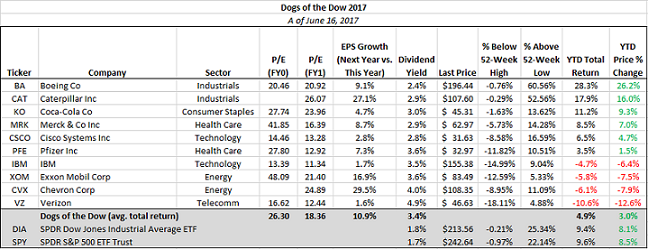
The first six months of the year are nearly behind us so I thought it appropriate to provide an update on the performance for the 2017 Dogs of the Dow. As noted in the past, the strategy is one where investors select the ten stocks that have the highest dividend yield from the stocks in the Dow Jones Industrial Average Index (DJIA) after the close of business on the last trading day of the year. Once the ten stocks are determined, an investor invests an equal dollar amount in each of the ten stocks and holds the basket for the entire next year. The popularity of the strategy is its singular focus on dividend yield. The strategy is somewhat mixed from year to year in terms of outperforming the Dow index though. Over the last ten years, the Dogs of the Dow strategy has outperformed the Dow index in six of those ten years.

Since my last update a few months ago, the Dow Dogs performance has fallen further behind the Dow Jones Industrial Average Index. As can be seen in the below table, the average return of the Dow Dogs through 6/16/2017 is 4.9% versus the DJIA return of 9.4%.


Interestingly, in the top ten performing stocks in the DJIA index this year, only two are Dow Dogs, Boeing (BA) and Caterpillar (CAT). Boeing is the best performing Dow stock, up 28.3%. So far this year, energy has been a drag on the both the DJIA index and the Dow Dogs, while at the same time, industrial stocks have been performing well. In short, the sole focus on dividends in the Dow Dog strategy has yet to pay off this year.


Amazon: Selling And Delivering Groceries Is Not A High Margin Endeavor

Of course the big news last week was Amazon (AMZN) announcing it was acquiring Whole Foods Market (WFM) in a deal valued at $13.7 billion. The deal is an all cash one, but with Amazon's stock trading at a trailing price earnings multiple of 185 times one might think funding the purchase with stock might make more sense. Nonetheless, this acquisition announcement had ripple effects on many other consumer product companies and not just grocery retailers. One question that arises is whether Amazon's purchasing leverage will put downward pressure on prices for products manufactured by the likes of Procter & Gamble (PG), McCormick & Company (MKC), Kellogg (K) and many other packaged consumer product companies. Friday's stock market reaction to this broad category of companies suggests the AMZN/WFM merger will be a significant headwind for other companies in this space or to those selling into the space.


Selling and delivering groceries is not the same as selling and delivering books and non-perishable products. As the picture at the beginning of this post shows, consumers have had home delivery options historically. Home delivery of milk, for instance, was a common practice years ago before the popularity of large grocery stores. Still today, consumers have home delivery of grocery options. One firm that has been delivering groceries since 1952 is Schwan's. Schwan's website notes the delivery options it provides to consumers,
  • Personal Delivery: Our knowledgeable Route Sales Representative will deliver your food to your home at a time that is convenient for you.
  • Drop-Off Delivery: No need to be home for delivery. We'll drop off your order at your scheduled delivery time in a reusable freezer bag that keeps your food frozen for hours.
  • Mail Order: Mail Order delivery is available anywhere in the continental United States. It's a convenient option if our delivery service is not available in your area or if you want to send our food to family or friends.
More background on Schwan's can be found at this link.

At the end of the day, the success of any retail store is centered on the customer having a positive experience and the store or business executing on its business plan. And to this end, brick and mortar retailers need to make 'positive customer experience' an overriding aspect of their business model if they want to compete with the Amazon's of the world. I could, but won't in this post, list a number of procedures retailers have implemented that do not contribute to a customer having a positive experience.

I am skeptical of how successful the delivery of groceries can be. As I stated earlier, home delivery of groceries is not the same as leaving a non perishable package on the doorstep. A benefit Amazon is getting with the Whole Foods acquisition is access to 400 plus brick and mortar locations. Is Amazon then saying brick and mortar is a necessity in order to continue its growth?

And finally, much of what Amazon has been able to do in its pursuit of growth is a direct result of the profitability of Amazon Web Services or AWS. AWS accounts for less the 10% of Amazon's revenue but accounts for 74% of Amazon's operating income. AWS is made up of many different cloud computing products and services. The division provides servers, storage, networking, remote computing, email, mobile development and security. AWS's two main products are Amazon’s virtual machine service and Amazon’s storage system. AWS is now at least ten times the size of its nearest competitor and hosts popular websites like Netflix Inc (NFLX) and Instagram (a subsidiary of Facebook Inc.(FB))


So long as the market continues to give Amazon a pass on generating a decent profit from its businesses outside of AWS, AMZN's retail competitors could continue to face challenges. However, I do believe that the AMZN/WFM acquisition may not work out as well as AMZN anticipates. Selling groceries and adding delivery cost on top of a low margin business, is not a recipe for fast growth in my view.


Tuesday, June 13, 2017

Growth Style Returns Dominating Value Style Returns

Over a long enough period of time, value stocks tend to outperform growth stocks and this fact is causing some pain for the value oriented investor during this market cycle. In a Fidelity article that compares value versus growth performance, this has indeed been the case when going back over 25 years. The Fidelity article shows, however, that on a risk adjusted basis the growth style wins out. The value style tends to have a large weighting in financial and economically sensitive sectors and most investors know these types of sector positions experienced headwinds in the 2008/2009 economic downturn.


Wednesday, June 07, 2017

NIPA Earnings Weakness Leads IBES S&P 500 Earnings Weakness

The equity market seems to know only one direction and that is up. The result of this type of pattern has been a downward trend in volatility with the VIX trading at a near single digit level. One characteristic of a low VIX reading and a higher trending market has been the absence of any significant equity market pullback. As Urban Carmel, author of The Fat Pitch blog notes,
"SPX [S&P 500 Index] has now avoided a 5% drawdown since November 4, a period of 139 days. Since 2009, there have been only two uninterrupted uptrends that have lasted longer: 142 days (ending January 2014) and 158 days (ending September 2014). If past is prologue, then SPX appears likely to have a 5% correction before June 23 (158 days)."
I am not sure time in and of itself is a predictor of a 5% equity market correction, but the data is confirmation of the lower downside volatility recently experienced by the equity market as can be seen in the below chart.


Friday, June 02, 2017

Equity Market Climbing The Proverbial Wall Of Worry

The individual investor continues to express concerns for stocks when looking at their sentiment response. Yesterday's Sentiment Survey report from the American Association of Individual Investors showed a nearly six percentage point decline in the bullish sentiment reading to 26.92%. This pushes the bullishness reading one standard deviation below the average bullishness reading.


Monday, May 29, 2017

The Unfortunate Rise Of The Misleading 'Scary Chart' Comparisons Again

In early 2014 charts were circulating around the internet comparing the 2014 market to 1928-1929. One such chart is shown below. The below chart was taken from an article that highlighted the fallacy of these comparisons. In fact, this type of scare tactic infiltrated the main stream media where a MarketWatch.com article warned about the similarity of the '28/'29 market to that of 2014 and that “trouble lies directly ahead.” Since that 2014 article was written, the S&P 500 Index is up over 30%.


Sunday, May 28, 2017

Momentum Strategy Needs A Breather

One aspect of the S&P 500 Index return in 2017 is the fact a handful of stocks have generated a large portion of the return. Historical evidence suggests narrow market leadership is not an uncommon occurrence in bull markets. Interesting this year, however, is the fact this leadership has been centered in technology stocks. I discussed this in a post a few weeks ago when I looked at detail surrounding the Momentum Index (MTUM) strategy performance and its similarity to 2015. At the time of the prior post, the RSI of MTUM versus the S&P 500 Index was below 80. In the last few weeks though, the relative strength index (RSI) has pushed above the overbought level of 80, actually reaching above 85.

As the below graph shows, the top ten holdings of the iShares MSCI Momentum Factor ETF (MTUM) is comprised largely of technology stocks. The weighting of these top 10 positions equals nearly 40% of the overall index itself. The performance begins at the first of December, the time when momentum began its outperformance.


In spite of the fact the momentum strategy may continue to lead in 2017, the leadership does not produce higher returns in a straight line. Given the overbought level of the RSI and the strength of the move since December, a near term pullback in these larger technology positions, and the momentum strategy itself, would not be a surprise.