Saturday, November 28, 2015

Gold And The Equity Markets

Gold prices have not been immune to the broader issues facing the overall commodity market. Year to date, the price of gold is down 10.8% while the broader CRB Commodity Index is down 20.3%. A part of the issue negatively impacting the price of gold is output is outpacing demand. With the decline in the price of gold the cost to extract gold exceeds the market price in many cases.

From The Blog of HORAN Capital Advisors

More importantly though, gold is mostly transacted in US Dollars and the strength in the Dollar is a headwind for the price of the metal. The light blue line in the below chart represents the trade weighted Dollar Index compared with gold prices (yellow line). The lines show gold price weakness as the Dollar strengthens. Gold has a negative .65 correlation to the trade weighted Dollar index. With the Federal Reserve nearing lift off for U.S. rates, additional Dollar strength will likely be an outcome into 2016.

From The Blog of HORAN Capital Advisors

Additionally, the red line in the above chart shows the ratio of the S&P 500 Index to the price of gold. This ratio has a positive correlation to the trade weighted dollar and is partly a result of weaker gold prices as the Dollar rises. Another important factor that contributes to the upward sloping red ratio line is a rising S&P 500 Index. The obvious factor that contributes to higher equity prices is the growth in earnings and therein lies the issue for equity prices. As the below chart shows, earnings growth for the S&P 500 Index will be negative for two successive quarters if earnings are negative for the fourth quarter. This would be the first back to back quarterly earnings decline since 2009. The second chart below shows 12-month forward earnings estimates for the S&P 500 Index and the negative growth expectations are weighing negatively on recent S&P 500 returns.

From The Blog of HORAN Capital Advisors

From The Blog of HORAN Capital Advisors

A large part of the earnings weakness is being attributed to the stronger Dollar and its negative impact on multi national companies as they convert foreign earnings back to the Dollar and the negative earnings issues impacting much of the energy sector. As the calendar rolls into 2016, both the currency and energy comparisons should be less of a headwind on a year over year basis.

Absent some type of shock or fear event, gold prices, like many commodities, are likely to remain pressured due to a stronger Dollar and an excess gold supply. For the S&P 500 Index, and equities broadly, a resumption of earnings growth going into 2016 will be necessary for equities to move higher. 


Friday, November 27, 2015

Replacing Federal Reserve Rate Decisions With A Mathematical Formula?

Natixis Global Asset Management recently published a white paper, Can the Federal Reserve Be Replaced by a Mathematical Formula?, highlighting the Fed Oversight Reform and Modernization act approved by the Financial Services Committee of the House of Representatives. This Act would require the Fed to establish a mathematical formula in setting interest rate policy. Not surprisingly, the Fed is not in favor of this type of proposal.

Several highlights in the Natixis paper:
  • The positive side is that it could force the Federal Reserve to monitor developments that it has completely overlooked in the past: credit, asset prices, liquidity, external deficit; it would then need a more complex formula than a Taylor rule;
  • One negative side is obviously that a mathematical formula cannot take into account the complexity of an economic situation: dozens of variables would have to be included (real growth, labour costs, longterm interest rates, savings rate, detailed situation of the labour and real estate markets, etc.);
  • Another negative side is that in contemporary economies, central banks have - and will probably increasingly have - instruments other than the short-term interest rate: purchases and sales of financial assets (bonds, ABS), quantitative easing when interest rates become zero, banks’ prudential ratios, etc. Should each instrument be determined by a mathematical formula?
  • This plan will in all likelihood be abandoned. However, we should not forget that the Federal Reserve’s choices, not guided by a mathematical formula, have quite often been catastrophic over the past 20 years (by accepting asset price bubbles, external deficits, excessive debt levels, etc.). Automating these choices would not have only drawbacks.
The Taylor Rule is one mathematical formula that gets attention and is used by some to determine what the Fed Funds rate should be. The Taylor Rule looks at inflation and employment levels, which today suggests the Fed Funds rate should be near 3%.

From The Blog of HORAN Capital Advisors

The paper notes that today the Fed uses other monetary tools other than adjustments to short term interest rates:
"purchases or sales of financial assets, generally as part of a quantitative easing programme; in the future, increasingly, banks’ prudential ratios (capital ratios, required reserves, etc.). This makes it possible to markedly increase the effectiveness of monetary policy compared with a situation where only the short-term interest rate is controlled, especially by also controlling long-term interest rates"
By not using a formula and,
"By freely setting monetary policy over the past 20 years without being constrained by the use of a mathematical formula, the Federal Reserve has let the following appear:
  • A huge US external deficit from 2002 to 2008;
  • Recurrently, excessive private-sector debt levels;
  • Asset price bubbles;
  • Useless excess liquidity.
"A more complex mathematical formula than a Taylor rule could have forced the Federal Reserve to react to these developments and to not let excessive indebtedness and asset price bubbles develop, which led to the subsequent financial and banking crises."
One conclusion from the white paper notes a formula alone may not serve as the only solution; however,
"But we should not forget that a complex formula that takes into account credit, asset prices, external deficits, etc. would prevent the errors of judgement and monetary policy choices that for the last 20 years have led to - particularly in the United States - crises linked to excessive indebtedness and bursting asset price bubbles."

Source:

Can the Federal Reserve be replaced by a mathematical formula?
Natixis Global Asset Management
By: Patrick Artus
November 27, 2015


Thursday, November 26, 2015

E-Commerce Sales Growth Challenging Traditional Retailers

Brick and mortar retailers continue to face the challenge brought about by the continued growth in e-commerce sales. As the below chart shows, e-commerce sales as a percentage of total retail sales has grown to 7.4% from just under 3% at the beginning of 2006. From a growth perspective, year over year growth in e-commerce sales remains steady at over 15%. 

From The Blog of HORAN Capital Advisors


Wednesday, November 25, 2015

Thankful For The Market Action So Far In 2015

In the spirit of Thanksgiving, investors and readers can be thankful the market has weathered the news headlines headwinds coming out of Europe and the Middle East. Looking at the positives and not sweating the small stuff can certainly make for a happier investor. A recent opinion article in the New York Times, Choose to Be Grateful. It Will Make You Happier, touches on this issue.

The S&P 500 Index ended the pre-Thanksgiving Holiday trading day essentially unchanged, closing at 2,088.87. This unchanged outcome is what the market has delivered to investors for most of the eleven months of the year. As the below chart shows, the S&P 500 Index has been stuck in a 6% trading range (maroon box) except for the decline between August and September. This August and September period resulted in the market contracting 12.3% from its May high to the August low. The quick recovery from the double bottom reached in September has simply taken the market back into its year long trading range. On a price only basis, the S&P 500 Index is up just under 2% so far in 2015.

From The Blog of HORAN Capital Advisors

As investors return to the market following the Thanksgiving Holiday, they will face the uncertainty surrounding the Fed's rate decision in mid December. Until then though, the market's trading range may persist until the rate uncertainty is resolved.


Saturday, November 21, 2015

Better Investing Most Active As Of November 21, 2015

Periodically I detail the most active stocks reported by Better Investing members. Apple (AAPL) continues to be a favorite of Better Investing members, while Qualcomm (QCOM) is the only stock in the top 10 that is showing greater selling interest versus buying interest. New to the list since I list provided an update in August is Under Armour (UA), Visa (V) and Johnson & Johnson (JNJ). Dropping off the list is Southwest Airlines (LUV), General Electric (GE) and Ambarella (AMBA).

From The Blog of HORAN Capital Advisors


Disclosure: Firm or Family Long: AAPL, QCOM, SWKS, JNJ


Thursday, November 19, 2015

Bullish Investor Sentiment Takes A Hit

Today's Sentiment Survey release by the American Association of Individual Investors saw bullish investor sentiment fall 3.5 percentage points. This follows a decline in bullish sentiment of 4.7 percentage points in the prior week. Also, during this two week period, bearish sentiment has increased from 18.6% to 38.68% this week.

From The Blog of HORAN Capital Advisors
Source: AAII

The individual investor sentiment indicator is a contrarian one and is most predictive at its extremes. Bullish sentiment readings near 20% are generally associated with an oversold market. As we noted in our post this morning regarding potential near term market technical headwinds, if a pullback ensues, bullish sentiment is likely to decline further. If this does occur, this could position the market for a rally into year end.


Market Potentially Facing Near Term Technical Headwinds

After the S&P 500 Index pullback on Thursday and Friday last week, the market's advance on Monday and Wednesday has taken the S&P back into positive territory for November. This is impressive given the 8% gain in October. With this month and a half recovery though, the market seems to be facing some technical headwinds.

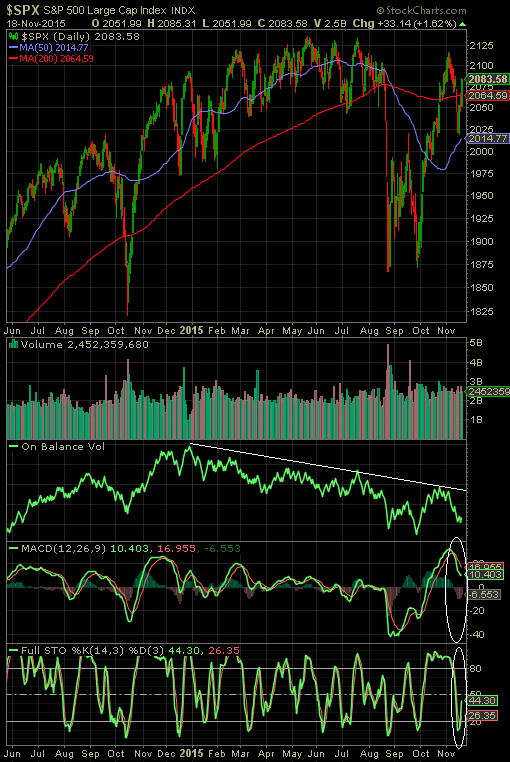
Of particular interest is the fact the Onbalance Volume Indicator (OBV) has been trending lower this year. Even with the positive market returns the past six week, the OBV is not suggesting conviction on up market days. The OBV indicator measures buying and selling pressure as a cumulative indicator adding volume on up days and subtracting volume on down days. The OBV measures positive and negative volume flow and the trend of the indicator is what is important. A downward sloping trend indicates more volume on down market days versus up market days. As the below chart shows, the OBV indicator is firmly in a downtrend.

From The Blog of HORAN Capital Advisors

Also, as noted in a number of posts in the past, computer algorithms are having a greater influence on the market. These computer algorithms need to trade on specific patterns which are created by price points traced out by the patterns themselves. As the below weekly chart of the S&P 500 shows, one pattern that remains in play is the inverse head and shoulders pattern. The potential downside price target for this pattern is S&P 1,599.

From The Blog of HORAN Capital Advisors

As we noted in our post last week, the high level of the equity put/call ratio was suggestive of a market bounce which investors have enjoyed this week just as the elevated VIX at the beginning of September was a technical indication of a potential market recovery from the ultimate low reached in August. However, as can be seen in the below chart, the VIX has fallen back into the high teens and may indicate a market that is becoming a little too complacent. The OBV certainly is suggestive of a potentially skittish investor as more volume is trading on the down days versus the up days and the right shoulder of the H&S patterns is becoming more distinctive. The market's recovery this week has provided some short term positive support; however, this head and shoulder pattern above remains in play.

From The Blog of HORAN Capital Advisors


Sunday, November 15, 2015

Low Bond Yields Heighten Bond Return Risk When Rates Rise

Although the rate of interest currently paid on high quality bonds today is at levels last seen in the early 1950's, investors generally allocate a portion of their investment portfolio to bonds. One reason for having a portion of an investment portfolio in bonds is the fact bonds tend to hold up well when equity prices decline. Proof of this can be seen in the below chart comparing various stock returns to different bond category returns during the financial crisis. During the worst of the financial crisis that began in October 2007, U.S. stocks fell 56.8% while the Barclay's Aggregate Bond Index and Barclay's U.S. Treasury Bond Index were up 7.2% and 15.4% respectively.
From The Blog of HORAN Capital Advisors
Source: Vanguard

One near certainty is the Fed will increase interest at some point with it simply a question of when not if. When interest rates are moved higher (some believe a December liftoff), bond prices will decline and bond investors may be in for a bit of a surprise. A unique characteristic facing investors today is the rate of interest paid on high quality bonds is at extremely low levels. Historically, bond investors obtained some support when rates increased due to the income support provided by bonds. The below chart from Nuveen highlights the high percentage contribution to return that income has provided to overall bond returns since the end of the financial crisis and since 1976.

From The Blog of HORAN Capital Advisors
Source: Nuveen

The below table from Vanguard is maybe a bit dramatic, but the table shows the impact on a bond's price return given a three percentage point increase in interest rates. One takeaway from the table is the amount of time it takes to recover the principal loss through the interest payment: over three years. This extended recovery is a result of the low interest rate starting point, 2.1% in the example and not far from today's rate.

From The Blog of HORAN Capital Advisors
Source: Vanguard

T. Rowe Price recently opined on this same issue in a recent report. The firm notes,
"Rising rates generally result in principal declines in bond securities, and that risk is exacerbated with rates so low because investors have less of a yield cushion to offset price declines. Overall, though, the firm concluded that "since 1979, bonds have generally not done well during tightening cycles." In fact, that has been the pattern in every tightening cycle since 1963." 
"In the last Fed tightening cycle from 2004–2006, when the Fed rate increased from a multi-decade low of 1.00% to 5.25%, longer-term yields barely budged. This cycle, T. Rowe Price managers expect the bulk of future rate increases to unfold in the short- to intermediate term bond sectors, causing a flattening in the Treasury yield curve (with short term rates rising more than long rates). 'I expect rates to stay fairly low even after the Fed starts raising them,' Mr. Huber says. 'Longer-term rates should stay under control because they are driven by inflation and global growth expectations, which are very modest.'" 
Mr. McGuirk adds, "We don’t see any big move in long rates, and with the Fed moving gradually, you have a long time to earn the extra income to offset any principal loss."
One way to shorten the time period it takes to recover the principal loss is to invest in bond's with higher coupon yields. However, given the extended length of time the Fed has kept rates at the near zero level, higher yielding bond supply is down significantly. As can be seen in the below chart, the percent of bonds that yield more than 4% is far below what was available prior to the onset of the financial crisis.

From The Blog of HORAN Capital Advisors
Source: Blackrock

For investors, the low level of interest rates does pose a potentially higher risk to overall bond returns when the Fed does commence with a higher rate policy. The silver lining is the fact the Fed is most likely to move slowly while pushing rates higher and in small increments. A low trajectory in the rate increases reduces the downside that results from a decline in a bond's price. And lastly, as noted in the above T. Rowe Price highlight, with the low level of inflation and slow global economic growth, the longer end of the interest rate curve may increase at a much lower pace than the short end. And it is long term bonds that can experience the largest price declines when rates rise.


Saturday, November 14, 2015

Narrow Market Breadth And Companies With Negative Earnings Are Leading

Although this past week took the S&P 500 Index return for the year into negative territory (down 3.2%) any positive stock returns have been led by only a handful of stocks. For the week, the S&P 500 Index declined 3.7% and was the first weekly decline after six weekly gains.

From The Blog of HORAN Capital Advisors

As a recent Goldman Sachs report notes,
"five S&P 500 firms – Amazon (AMZN), Google (GOOGL), Microsoft (MSFT), Facebook (FB), and General Electric (GE) – account for more than 100% of the index total return YTD prompting client inquiries regarding narrow market breadth. The Goldman Sachs Breadth Index currently equals 1, one of the lowest readings in the 30-year series. Our index has experienced only 11 narrow breadth periods since 1985, including three during the late 1990s that share several characteristics with the current narrow breadth episode. The typical episode lasted 4 months and strong balance sheet, mega-cap, and high momentum were factors that outperformed. The current period is one month old and may last into early 2016."
In addition to the narrow leadership in the large cap space, T. Rowe Price notes small cap stocks without any earnings have been outperforming those companies that have earnings as represented by stocks in the small cap Russell 2000 Index.

From The Blog of HORAN Capital Advisors

This narrow market leadership along with the outperformance of companies with no earnings has contributed to some of the market's recent volatility. Additionally, the recent volatility is playing a part in the spike in bearish sentiment. As can be seen in the below chart, the CBOE equity put/call ratio jumped to .98 as of Friday's market close.

From The Blog of HORAN Capital Advisors

As noted in prior posts, put/call ratio readings above 1.0 are most predictive of overly bearish sentiment and is indicative of a market that has the propensity to rally.


Sunday, November 08, 2015

Social Security Benefit Increases Do Not Keep Pace With Retiree Costs

Many retirees receiving a social security benefit know their monthly benefit will not receive a cost of living adjustment in 2016. This is the third time in the last six years where social security benefits did not increase due to the low inflation environment. ICMA-RC recently compared the growth in social security benefits to the growth in some standard costs faced by retirees. As the below chart shows, some of the basic costs retirees face have far outpaced the growth of their social security benefit.

From The Blog of HORAN Capital Advisors
Source: ICMA-RC

As noted in the ICMA-RC article, it is important retirees, and really future retirees, do not put themselves in a situation where social security is their only source of retirement income. Further, retiree investment funds should be invested in a way that provides the opportunity for the funds to grow in excess of the rate of inflation. Even in a low inflation environment basic costs are likely to increase. Additionally, with the Federal Reserve approaching lift off for the Fed Funds rate, a rate increase can have a negative impact on the performance of interest sensitive investments. In a post we wrote in 2013, Chasing Yield Has A Downside When Interest Rates Rise, we detailed the performance of a few categories of interest sensitive assets during a period of rising interest rates. Some investors believe "yield" investments are safer since they pay interest or a higher dividend. As noted in the previously mentioned article, these yield type investments can generate poor returns when interest rates do rise.


Sunday, November 01, 2015

Market Looks Overbought Short Term, Longer Term Could Be More Promising

Historically, the equity markets have been known to experience some of their largest declines in the month of October. Equity market returns in the just completed October did not fall prey to this statistic though. The S&P 500 Index and the Dow Jones Industrial Average had their best monthly returns in four years, both up by more than 8%.
From The Blog of HORAN Capital Advisors

The recent strong equity market returns have pushed the market into short term over bought territory. However, looking at longer term technical indicators the market and its technicals resemble the October 2011 time period.

First, looking at shorter term technicals, the below daily chart of the S&P 500 Index shows the index's MACD and stochastic indicators have moved into overbought territory. Both indicator levels are similar to levels reached in October 2011. The market return subsequent to 2011 has been resilient.

From The Blog of HORAN Capital Advisors

In comparing the same indicators on a weekly chart though, one can see the October 2015 and October 2011 levels are nearly identical as well with the MACD indicator experiencing a bullish crossover at both dates.

From The Blog of HORAN Capital Advisors

In terms of individual stock movement, the below chart shows nearly 80% of S&P 500 stocks are trading above their 50 day moving average as of Friday's market close. In comparison, at the end of August, only 5% of stocks were trading above their 50 day moving average.

From The Blog of HORAN Capital Advisors

Only 52% of stocks are trading above their respective 150 day moving average. This is certainly an improvement over the 13% level in late August. The current level though remains below prior peaks in the mid 80% range.

From The Blog of HORAN Capital Advisors

Lastly, the 21-day moving average of the equity put/call ratio is now trending lower and stands at .68. Near the end of September, we noted in a post, A Few Positive Equity Market Technicals, that the moving average of the P/C ratio appeared to peak around .79 and was beginning to turn lower. Equity put/call ratios over 1.0 are indicative of oversold markets. By looking at the 21-day moving average of the P/C ratio, a potentially more sustainable trend can be seen. Declines in this ratio are generally associated with a market that trends higher on a forward looking basis.

From The Blog of HORAN Capital Advisors

A significant difference between 2011 and 2015 is the earnings growth of S&P 500 companies. In 2011 operating earnings were growing at a double digit rate. Today, as the market digests third quarter corporate earnings reports, earnings growth is expected to be negative on a year over year basis. Secondly, the Dollar:Euro exchange rate was nearly $1.40 in late 2011 and now the exchange rate is $1.10. This Dollar strength is serving as a headwind for multinational companies. We expect further Dollar strength; however, not of the same magnitude as experienced from 2011 to 2015.

In conclusion, the equity market does appear overbought in the near term. However, in evaluating longer term technical measures, the market appears to want to move higher in spite of the potential for a short term pullback. As we have noted in several recent posts and our most recent Investor Letter, for reasonable equity market returns to be achieved over the next twelve months, a lot will hinge on earnings growth in the fourth quarter and first half of 2016. At worst, the currency headwind should lessen and the consumer should benefit from lower energy prices.


Saturday, October 24, 2015

S&P 500 Death Cross Update

In early September I wrote a post that examined prior instances where the S&P 500 Index moving averages triggered the death cross signal. In the article I concluded the death cross generally has triggered near market bottoms versus signalling further market weakness. The death cross is where the 50 day moving average crosses the 200 day moving average from above.

The most recent death cross was triggered on August 27th and as the below chart shows, this was only two days after the s&p 500 Index bottomed. Subsequent to the death cross, the S&P 500 index is up 4.4% and appears to be replaying those "V-shaped" recoveries investors are becoming accustomed to of late. In hindsight, had investors simply bought stocks when the market was down over 10%, they obviously would have enjoyed a more significant bounce off the bottom. The significance of the double digit decline in this cycle is the fact the market had not experienced one for nearly four years until this August.

From The Blog of HORAN Capital Advisors

For investors then, some technical indicators are more predictive of future stock or index movements than others. In the case of the Death Cross, it is an interesting conversation topic; however, it appears not to be a reliable sell indicator and in fact may be a signal to buy.


Dogs Of The Dow Slightly Underperform Year To Date

The Dogs of the Dow theory suggests investors select the ten stocks that have the highest dividend yield from the stocks in the Dow Jones Industrial Index (DJIA) after the close of business on the last trading day of the year. Once the ten stocks are determined, an investor invests an equal dollar amount in each of the ten stocks and holds them for the entire next year.

With the first 10-months of the year nearly behind us, the Dow Dogs for 2015 are trailing both the Dow Jones Industrial Index and the S&P 500 Index on a price basis. The below table shows the performance of this year's Dow Dogs compared to the DJIA. For reference, the S&P 500 Index is up .79% through the market's close on Friday. The weak links in the Dow Dog strategy this year are the energy stocks, ExxonMobil  (XOM) down 10.2% and Chevron (CVX) down 18.7%. The industrial stock Caterpillar (CAT) has also contributed to the underperformance as the stocks is down 21.6% YTD.

From The Blog of HORAN Capital Advisors


Thursday, October 22, 2015

Expected Consumer Holiday Spending Highest Since 2007

A recent survey by Gallup suggests consumers expect to spend more this holiday and the highest since 2007. The Gallup survey notes:
  • the majority of Americans routinely say they will spend about the same as they did the previous year, the 20% saying they will spend less is down from 24% in October 2014, and is the lowest Gallup has recorded for any October since 2007.
From The Blog of HORAN Capital Advisors
  • a third of U.S. adults plan to spend $1,000 or more on gifts and another quarter say they will spend between $500 and $999, while about a third will spend between $100 and $499. Another 3% plan to spend less than $100, while 8% say they will not spend anything.
From The Blog of HORAN Capital Advisors


Tuesday, October 20, 2015

Crude Oil Inventories Continue To Rise

At mid-year of 2014 West Texas Intermediate (WTI) crude oil prices were trading over $100 per barrel. Just over a year later, WTI is now priced at just under $50 per barrel. This steep fall in crude prices has confounded the market from the standpoint of the magnitude of the price decline. Is the price decline simply a reaction to elevated supply due to the growth of fracking or has worldwide oil demand fallen as a result slowing global growth? We briefly address this issue in our Fall Investor Letter, but following is a closer look at oil supply and the performance of energy related investments.

An important data point will be the release of the weekly Petroleum Status Report by the Energy Information Administration (EIA) on Wednesday's at 10:30 am. Last week's EIA report noted "U.S. commercial crude oil inventories (excluding those in the Strategic Petroleum Reserve) increased by 7.6 million barrels from the previous week. At 468.6 million barrels, U.S. crude oil inventories remain near levels not seen for this time of year in at least the last 80 years (emphasis added.)

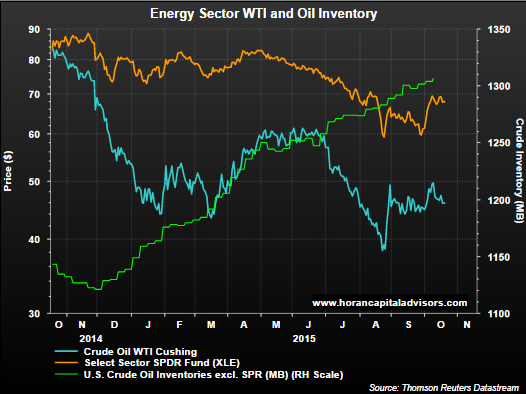
The first two charts below compare the performance of the SPDR Energy Sector ETF (XLE) to the percentage change in the price of WTI. As the first chart shows, the SPDR Energy Sector Fund ETF held up better as WTI's price began to fall beginning in 2014. One question for investors is whether the relative outperformance of XLE is justified or might it resumes its decline in order to catch up to the fall in WTI's price. The second chart compares the same two assets but on a shorter six month time frame. In this chart both XLE and WTI are once again trading in sync with one another.

From The Blog of HORAN Capital Advisors

From The Blog of HORAN Capital Advisors

At HORAN we do believe the issues impacting oil are more supply related, yet acknowledging the continued "bump along the bottom" economic growth rate around the world. Iran indicates it will increase supply at any cost and Saudi Arabia continues with the desire not to reduce production levels. The green line in the below chart shows the rig count in Saudi Arabia and the chart clearly shows they have not reduced rig levels unlike in the U.S. and globally.

From The Blog of HORAN Capital Advisors

Finally turning to supply, the green line in the below chart shows the unabated oil inventory growth in the U.S. since late 2014. The currently high inventory levels seem not suggestive of an oil market where crude prices are likely to move higher in the near term. And this downward pressure on oil prices will likely be a continued headwind for energy related investments.

From The Blog of HORAN Capital Advisors


Investor Letter Fall 2015: The Third Quarter Correction

In our recently published Fall 2015 Investor Letter we discuss the long awaited third quarter market correction and issues issues facing companies in the fourth quarter and the first half of 2016. Prior to the market decline that began in May, the S&P 500 Index climbed higher for nearly four years without incurring a greater than 10% correction; however, based on current price to earnings multiples, U.S. large company stocks are trading at average valuation levels compared to historical data.

From The Blog of HORAN Capital Advisors

U.S. company earnings are expected to decline 4.8% in the third quarter compared to the third quarter of 2014. Excluding the greater than expected 60% year-over-year decline in energy sector earnings, the balance of companies are expected to report an increase in earnings of about 2%. A decline in earnings is generally associated with the onset of recessions; however, as noted in the newsletter, an earnings recession does not always precede economic recessions. U.S. company earnings reports are facing the headwinds from a stronger U.S. Dollar while energy and materials company earnings are being pressured by low oil prices. The newsletter notes this earnings weakness is expected to be transitory with growth resuming in the first half of 2016 when year over year earnings comparisons to prior quarters become easier. Based on current price to earnings multiples, U.S. large company stocks are trading at average valuation levels compared to historical data. Additionally, it seems reasonable to believe recent earnings weakness is temporary and concentrated in the commodity and energy sectors.

While worldwide growth has slowed and the risk of a global recession is heightened, we believe a U.S. recession is unlikely at this time; however, investors should be prepared for a higher level of market volatility in this environment. While short-term volatility can rattle investor confidence, it is important to maintain a view of the horizon and the opportunities and rewards of longer term investing.

For additional insight into our views for the market and economy, one can read our Investor Letter accessible at the below link.

From The Blog of HORAN Capital Advisors


Tuesday, October 06, 2015

Dollar Strength Continuing Headwind For Emerging Market Equities

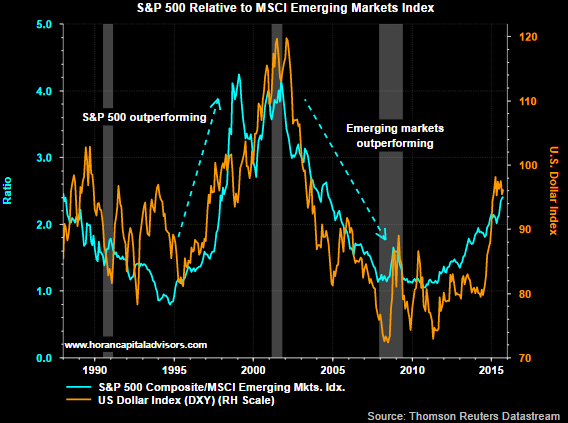
Since mid 2011 emerging market equities began to underperform the U.S. equity market (S&P 500 Index). Earlier this year we noted in a post, Emerging Markets Not Out Of The Woods Yet, the headwind a stronger U.S. Dollar can have on emerging market equity performance. The updated chart below continues to show the accelerated strengthening of the Dollar (orange line) and the underperformance of the MSCI Emerging Markets Index relative to the S&P 500 Index.

From The Blog of HORAN Capital Advisors

The U.S. Dollar tends to move in an average cycle of about seven to eight years and this cycle is about four years old. A number of factors can contribute to a stronger Dollar. One factor is a higher interest rate trend in the U.S. and the Fed's desire to raise rates continues to place an upward bias on the Dollar. 

Investors seem to be taking note of the headwind facing the emerging markets as ETF fund outflows have accelerated. Today, in a Bloomberg report, it was noted,
  • Outflows from U.S. exchange-traded funds that invest in emerging markets more than doubled last week, with redemptions exceeding $12 billion in the third quarter.
  • Withdrawals from emerging-market ETFs that invest across developing nations as well as those that target specific countries totaled $566.1 million compared with outflows of $262.1 million in the previous week.
  • The losses marked the 13th time in 14 weeks that investors withdrew money from emerging market ETFs and left the funds down $12.4 billion for the quarter, the most since the first quarter of 2014, when outflows reached $12.7 billion. For September, emerging market ETFs suffered $1.9 billion of withdrawals.
As difficult as it can be to predict currency moves, getting the directional call correct will likely be a factor that influences emerging market returns over the next several years. A stronger Dollar will serve as a headwind and a weaker one could be a positive for emerging market equities.


Saturday, October 03, 2015

Will The Equity Market Finish The Year In Positive Territory?

A portion of the recent equity market volatility can be attributed to the fact a number of factors seem to be at critical turning points. At top of mind seems to be the focus on the timing of the Fed's move to begin increasing/normalizing interest rates. Historically, a tightening of interest rates has led to a slowdown in economic activity. Added to this is the fact corporate profit growth is forecast to be negative as we noted in a recent post, A Few Positive Equity Market Technicals. These two issues alone, a Fed wanting to tightening and weak corporate profit growth, both are playing a part in the market's recent pullback.

Just for grins, if one were to dismiss these fundamental issues and simply look at the history of the equity market itself, are there stats that would suggest the market could finish the year in positive or negative terriory? A couple of articles over the past week addressed this issue. The first article was written by Ryan Detrick. He notes in the article,
  • "...going back to 1928, the S&P 500 has never been positive year-to-date after being down more than six percent after the third-quarter. The S&P 500 was down 6.74% after the third-quarter in 2015."
In the article, he notes the average decline through the third quarter in the 23 years the S&P 500 Index was down was a negative 16%. For this year though, he notes the three quarter decline is -6.74% and is the best starting point for for any of those years. He goes on to note, for the S&P to finish the year in positive territory, the fourth quarter return would need to equal about 7.23%. More insight can be gained by reading his article.

The second article was written by Dana Lyons. his article notes,
  • "going back 140 years, every year ending in a "5" has posted a positive return since 1875. In other words, the last 13 years ending in "5" have left stock investors "high-fiving" each other. It is likely mainly due to coincidence, with a healthy dose of positive Presidential Cycle “Year 3″ tailwind mixed in for several of the years. Nevertheless, it is a consistent and compelling track record."
From The Blog of HORAN Capital Advisors
Source: Dana Lyons

So there you have it, computer algorithms might just force the continuation of the year 5 winning streak or they might decide to force the negative year streak noted in Ryan Detrick's article. Fortunately, as noted in Ryan's article, the market is at the best starting point for negative returns through three quarters.


Friday, October 02, 2015

Bearish Sentiment Is Spreading

Since mid March the AAII bullish sentiment reading has been below its long term bullish average. As a contrarian indicator, low levels of bullish investor sentiment typically point to equity markets that are near their bottom. Keeping in mind though, this sentiment reading is most predicative at its extremes. Earlier this week, the AAII bullish reading declined 4 percentage points to 28.1% and the bearishness reading jumped 11 percentage points to 39.9. The bullishness level is now more than one standard deviation below its long run average.

From The Blog of HORAN Capital Advisors
Data Source: AAII

In addition to a low level of bullishness for individual investors, the recent release of the NAAIM Exposure Index declined to 16.39%, down from 21.34% in the prior week. The NAAIM Exposure Index represents the average exposure to US Equity markets reported by NAAIM members. NAAIM member firms who are active money managers are asked each week to provide a number which represents their overall equity exposure at the market close on a specific day of the week, currently Wednesdays. Responses are tallied and averaged to provide the average long (or short) position or all NAAIM managers, as a group. As noted in the below chart, low NAAIM Exposure Index levels have generally coincided with equity market turning points.

From The Blog of HORAN Capital Advisors

These various sentiment measures seem to be coming together at the same time to indicate a bearish view of the markets. Since these sentiment readings are contrarian ones, possibly the market is nearing a turning point with stronger returns through the fourth quarter. As we have noted numerous times in prior posts, sentiment measures alone must be evaluated in the context of other market and economic fundamentals.


Thursday, October 01, 2015

Buyback Strategy Continues To Lag Broader Market Return

Although S&P Dow Jones Indices reported second quarter 2015 buybacks declined 8.7% versus the first quarter of 2015, the twelve month total increased 3.8% versus the prior twelve month total that ended June 2014. As the below chart shows, this reduction in buybacks on a quarter over quarter basis might be tied to the declining trend developing in as reported earnings (blue line.) In spite of the declining trend in operating earnings, Howard Silverblatt notes, "company cash reserves increased to $1.32 trillion versus the first quarter total of $1.23 trillion." Also, Silverblatt noted in the S&P report,
"Higher levels of shareholder return are now part of the market expectation, with many investors anticipating continued high payouts. While companies currently have the resources and low-cost access to funds to continue this trend, once interest rates increase, the higher costs will eventually influence the decision making process for corporate expenditures. Buybacks may be more susceptible to an interest rate hike, given that they are more discretionary and dividend cutbacks are typically seen as a last resort action. Based on the current data, the Q3 actual dividend payment is expected to be the sixth consecutive quarter of new record payments, with Q4 2015 expected to be the seventh."
From The Blog of HORAN Capital Advisors

It may simply be a spurious relationship, but the buyback index return began to trail the broader market return since the beginning of the first quarter. This can be seen in the below chart comparing the S&P 500 Index to the Powershares Buyback Index (PKW).

From The Blog of HORAN Capital Advisors

Given the decline in equity prices since the market peaked in late May, companies would benefit from increasing buybacks with their share prices at these lower levels. Unfortunately, companies have a tendency to increase buybacks when their shares are near highs. If buybacks do slow in the coming quarters, this will likely be a headwind for an already weak near term earnings growth picture.