| From The Blog of HORAN Capital Advisors |
| From The Blog of HORAN Capital Advisors |
| From The Blog of HORAN Capital Advisors |
| From The Blog of HORAN Capital Advisors |
| From The Blog of HORAN Capital Advisors |
| From The Blog of HORAN Capital Advisors |
Posted by
David Templeton, CFA
at
6:46 PM
0
comments
Labels: Economy , General Market
"The Dow made another post-financial crisis rally high Thursday as it approached the 13,000 level. To provide some perspective to the current Dow rally that began back in early October 2011, all major market rallies of the last 111 years are plotted on today's chart. Each dot represents a major stock market rally as measured by the Dow. As today's chart illustrates, the Dow has begun a major rally 28 times over the past 111 years which equates to an average of one rally every four years. Also, most major rallies (78%) resulted in a gain of between 30% and 150% (29.8% to 150.5% to be exact) and lasted between 200 and 800 trading days (9.5 months to 3.2 years) -- highlighted in today's chart with a light blue shaded box. As it stands right now, the current Dow rally (hollow blue dot labeled you are here) would be classified as well below average in both duration and magnitude."
Posted by
David Templeton, CFA
at
11:48 AM
0
comments
Labels: General Market
Posted by
David Templeton, CFA
at
1:12 PM
0
comments
Labels: Technicals
Posted by
David Templeton, CFA
at
9:19 PM
0
comments
Labels: Financial Planning
Posted by
David Templeton, CFA
at
10:36 PM
0
comments
Labels: General Market
| From The Blog of HORAN Capital Advisors |
Posted by
David Templeton, CFA
at
12:07 PM
0
comments
Labels: General Market , Technicals
Posted by
David Templeton, CFA
at
6:32 PM
1
comments
Labels: Economy
| From The Blog of HORAN Capital Advisors |
| From The Blog of HORAN Capital Advisors |
Posted by
David Templeton, CFA
at
11:51 PM
0
comments
Labels: Economy
"...most companies in the S&P 500 index have not been successful in adding value through stock buybacks in the time frames we observed. The positive correlation between buyback activity and price suggests a combination of poor market timing as well as policies that increase repurchases when firms have more free cash flow. This may be partially explained by the need for officers of public companies to make some use of the cash on hand, including keeping less of it due to the possibility of being taken over. The negative correlation between repurchases and forward returns shows that most buybacks did not pay off within the year after purchase."Even for the market (S&P 500 Index) overall, the increased buyback activity occurs at ever increasing price levels.
| From The Blog of HORAN Capital Advisors |
| From The Blog of HORAN Capital Advisors |
| From The Blog of HORAN Capital Advisors |
| From The Blog of HORAN Capital Advisors |
Posted by
David Templeton, CFA
at
11:24 AM
0
comments
Labels: Dividend Return , General Market , Technicals
Posted by
David Templeton, CFA
at
8:37 AM
0
comments
Labels: Newsletter
| From The Blog of HORAN Capital Advisors |
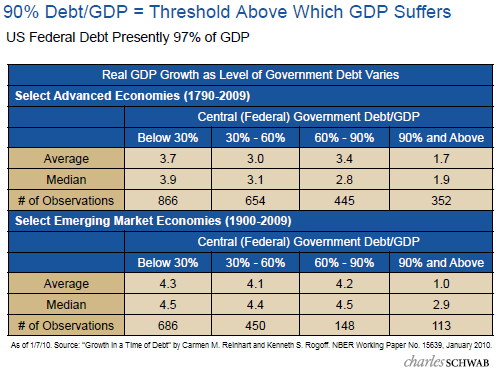
"The simplest connection between public debt and growth is suggested by Robert Barro (1979). Assuming taxes ultimately need to be raised to achieve debt sustainability, the distortionary impact imply is likely to lower potential output. Of course, governments can also tighten by reducing spending, which can also be contractionary. As for inflation, an obvious connection stems from the fact that unanticipated high inflation can reduce the real cost of servicing the debt. Of course, the efficacy of the inflation channel is quite sensitive to the maturity structure of the debt. Whereas long-term nominal government debt is extremely vulnerable to inflation, short term debt is far less so. Any government that attempts to inflate away the real value of short term debt will soon find itself paying much higher interest rates...
...In principle, the manner in which debt builds up can be important. For example, war debts are arguably less problematic for future growth and inflation than large debts that are accumulated in peace time. Postwar growth tends to be high as war-time allocation of manpower and resources funnels to the civilian economy. Moreover, high war-time government spending, typically the cause of the debt buildup, comes to a natural close as peace returns. In contrast, a peacetime debt explosion often reflects unstable underlying political economy dynamics that can persist for very long periods."
| From The Blog of HORAN Capital Advisors |
Posted by
David Templeton, CFA
at
10:00 PM
0
comments
Labels: Economy , International
| From The Blog of HORAN Capital Advisors |
Posted by
David Templeton, CFA
at
1:50 PM
2
comments
Labels: Investments
Posted by
David Templeton, CFA
at
9:47 AM
0
comments
Labels: Economy , General Market
| From The Blog of HORAN Capital Advisors |
Posted by
David Templeton, CFA
at
11:09 PM
0
comments
Labels: General Market , Valuation
Posted by
David Templeton, CFA
at
4:29 PM
0
comments
Labels: Investments
| From The Blog of HORAN Capital Advisors |
| From The Blog of HORAN Capital Advisors |
| From The Blog of HORAN Capital Advisors |
Posted by
David Templeton, CFA
at
12:37 PM
0
comments
Labels: Economy , General Market
| From The Blog of HORAN Capital Advisors |
Posted by
David Templeton, CFA
at
4:44 PM
0
comments
Labels: General Market , International
| From The Blog of HORAN Capital Advisors |
Posted by
David Templeton, CFA
at
9:02 PM
0
comments
Labels: Dividend Analysis
| From The Blog of HORAN Capital Advisors |
| From The Blog of HORAN Capital Advisors |
| From The Blog of HORAN Capital Advisors |
Posted by
David Templeton, CFA
at
5:42 PM
1
comments
Labels: Bond Market , Economy , General Market
The improvement in the unemployment rate earlier this month was certainly positive on the surface. The rate declined to 8.6% from the previously reported 9%. The improvement though came largely from the 300,000 individuals that simply stopped looking for a job. As a result, these additional people are not counted among the unemployed. As the below chart shows, the number individuals not in the labor continues to rise.
| From The Blog of HORAN Capital Advisors |
| From The Blog of HORAN Capital Advisors |
Posted by
David Templeton, CFA
at
10:08 AM
0
comments
Labels: Economy