Tuesday, April 26, 2011

First Quarter 2011 Investor Letter

First quarter corporate earnings results reported to date continue to be indicative of a sustained economic recovery. Our 1st Quarter Investor Letter provides our insight on the past quarter and a further look into 2011.

HORAN Capital Advisors' complete Investor Letter can be accessed at the following link: 1st Quarter Investor Letter.


Sunday, April 24, 2011

Invest In Emerging Markets Via High Quality Multinational Companies

In this week's WealthTrack video, Consuelo Mack talks with Jason Trennert of the research firm Strategas and Chuck Lahr, manager of PIMCO's Pathfinder World Fund (PATHX). Both are positive on the equity markets over the next 12-18 months. Chuck says the best value is in European companies that do business in the emerging markets. Jason favors high quality U.S. multinational companies that have dividend growth characteristics.


Thursday, April 21, 2011

The U.S. Government Deficit On An Unsustainable Path

The issue of the U.S. federal government's deficit has been a front and center issue over the course of the last several months. Congress' and the Obama administration's effort to reach an agreement on the FY 2011 federal budget touted the $38 billion reduction in spending. As the below chart shows, the current deficit stands at $1.4 trillion. Cutting $38 billion will have little impact on what ultimately needs to be accomplished. Even if revenues returned to levels in early 2008 (black line in below chart), the deficit would still be equal to about $900 billion. The widening gap between spending and receipts is an unsustainable one. The second chart details the rapid increase in the governments overall debt which has ballooned along with this widening gap between receipts and outlays.

From The Blog of HORAN Capital Advisors

From The Blog of HORAN Capital Advisors


Tuesday, April 19, 2011

Even A Little Inflation Is Dangerous

In the below video, James Grant of the Interest Rate Observer, provides an interesting interview with Consuelo Mack of WealthTrack. In the interview, Grant points to the dangers of even a little inflation and this policy's impact on inflating asset prices. He believes the Fed's policy of targeting a 2% inflation rate is misguided and provides his rational in the interview. Mr. Grant's views of the market come from the bearish perspective; however, investors are wise to look at the market from the perspective of both the bulls and the bears so as to have a well formulated view of the market.


Thursday, April 14, 2011

Sentiment Not Overly Bullish And Inverted Head and Shoulders Set Up

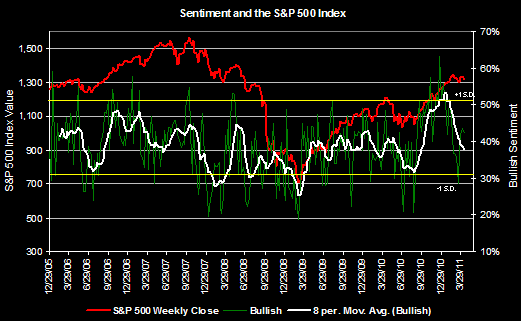
After the strong returns for the market in the first two months of the year, March appeared to served as a digestive phase for the market. Not surprisingly, since the beginning of March, the S&P 500 Index seems stuck in a trading range. From a pure technical perspective, the chart pattern that appears to be unfolding is a bullish inverted head and shoulders pattern. In order to complete this pattern, formation of the right shoulder is necessary with a sell off in the S&P 500 Index down to around 1,300. The market closed today at 1,314 so it is not far from this point. Additionally, a sell off with higher down volume would be positive as well. With tomorrow being an option expiration day, one could envision a higher volume down day occurring and completing the bottom of the right shoulder.

From The Blog of HORAN Capital Advisors

Individual investor sentiment does not seem overly bullish either, which is a positive contrarian indicator. This week's sentiment survey reported by the American Association of Individual Investors reported bullish sentiment of 42.2%. This is down 1.4% from last week's bullishness reading. As the below sentiment chart shows, individual investor bullish sentiment has not reached an extreme level. As an observation, these sentiment indicators tend to be most accurate at extreme levels.

From The Blog of HORAN Capital Advisors

In short, the market seems poised to move higher in a "climb the wall of worry phase". In July 2009, I discussed this wall of worry phase in a post, Where Are We In The Market Cycle that readers may find of interest.


Saturday, April 09, 2011

Buybacks Signaling Improved Business Confidence

Stock buybacks in 2010 came roaring back, increasing 117% over 2009 buybacks. According to Standard & Poor's Howard Silverblatt,
"Approximately $299 billion was spent by S&P 500 companies on share repurchases last year which represents a whopping 117% increase over the $138 billion spent in 2009. At this point the practice is not as deep as it was in the heydays of 2006-2007, but companies are certainly back in the buyback business. While 2010 expenditures are still just half of what was seen in 2007, last year’s activity resulted in a record year-over-year percentage and dollar increase for stock buybacks."
From The Blog of HORAN Capital Advisors

Below is a table highlighting companies that had significant buybacks last year.

From The Blog of HORAN Capital Advisors

Source:

S&P 500 Stock Buybacks Up 117% in 2010;Share Repurchases
Increase for the 6th Quarter in a Row

Standard & Poor's
By: Howard Silverblatt
March 23, 2011
http://tinyurl.com/3wsopb7

Disclosure: Long MSFT, XOM


Monday, April 04, 2011

Dividend Payers Underperforming Through First Quarter

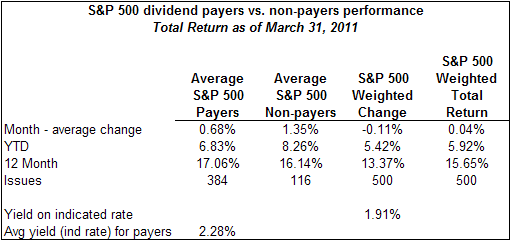
The equal weighted performance of the dividend payers in the S&P 500 Index trails the non payers through the first quarter of 2011, 6.83% versus 8.26%, respectively. For the 12-months though, the payers have a slight edge over the non payers, 17.06% versus 16.14%, respectively. The payers and non payers performance is calculated on an equal weighted basis and both are outperforming the market cap weighted S&P 500 Index for each of the time periods below.

From The Blog of HORAN Capital Advisors


Tuesday, March 29, 2011

Consumer Confidence Remains In An Uptrend

Although today's consumer confidence report indicated a worse than expected decline to 63.4 versus the expected 65, the index remains in an uptrend. The part of the index that measures how consumers currently feel about the economy improved to 36.9 from 33.8 in February. It would be highly unusual for the index to move higher each and every month. As the below chart shows, consumer confidence and the market's performance are linked at the hip given the consumer's importance to economic growth.

From The Blog of HORAN Capital Advisors


Sunday, March 27, 2011

The Dow Remains In Long Term Uptrend

The below chart analysis by Chart of the Day shows the inflation adjusted Dow remains in a long term uptrend. Will it continue to advance to the upside?
For some long-term perspective, today's chart illustrates the Dow adjusted for inflation since 1900. Of interest is that the inflation-adjusted Dow has traded within the confines of an extremely long-term upward sloping trend channel over the past 111 years. It is also of interest that the secular bear market that concluded in the early 1980s was almost as severe as the one that concluded in the early 1930s. Also, while the market action from the inflation-adjusted record high of 1999 to the financial crisis lows of 2009 was severe, the magnitude of this decline was much less than what occurred with the bear markets that concluded in the early 1930s and early 1980s. More recently, the Dow has retraced 74% of the financial crisis bear market with the inflation-adjusted Dow currently trading 19% off its 1999 record high -- a rather dramatic turnaround considering the magnitude of the recent financial crisis.
From The Blog of HORAN Capital Advisors


Sunday, March 20, 2011

S&P 500 Index Short Term Oversold

The recent decline in the S&P 500 Index has resulted in the percentage of stocks trading above their 50-day moving average to decline to 38%. This is down from over 85% just a few months ago. The percentage trading above their 150-day moving still remains elevated at 80%: however, the market's recovery on Thursday and Friday last week pulled these percentages higher and could be indicative of a continued recovery in the market.

From The Blog of HORAN Capital Advisors

From The Blog of HORAN Capital Advisors

Investors need to be mindful that these are simply technical indicators and support for the market is around 1,230 for the S&P 500 Index.

From The Blog of HORAN Capital Advisors


Friday, March 18, 2011

Investor Bullish Sentiment Suggesting Market Move To The Upside

One aspect of the individual investor sentiment reading is it tends to be more predictive at extreme reading levels. In that regarding the American Association of Individual Investors reported that this week's individual investor bullish sentiment reading was 28.49%. This is the lowest bullish sentiment level since August of last year when the bullish sentiment level was reported at 20.74%.

From The Blog of HORAN Capital Advisors

Several external factors are undoubtedly impacting investor sentiment at this point in time, i.e., instability in the Middle East and fallout from the earthquake in Japan. The issues in Japan, especially the nuclear crisis, will likely be resolved one way or another within several weeks. The instability in the Middle East will most likely be an ongoing factor that influences market volatility.

At the end of the day, company fundamentals continue to remain attractive. Attractive valuations and low levels of bullish sentiment are suggestive of a market rebound near term.


Tuesday, March 15, 2011

The Market and Nuclear Crises

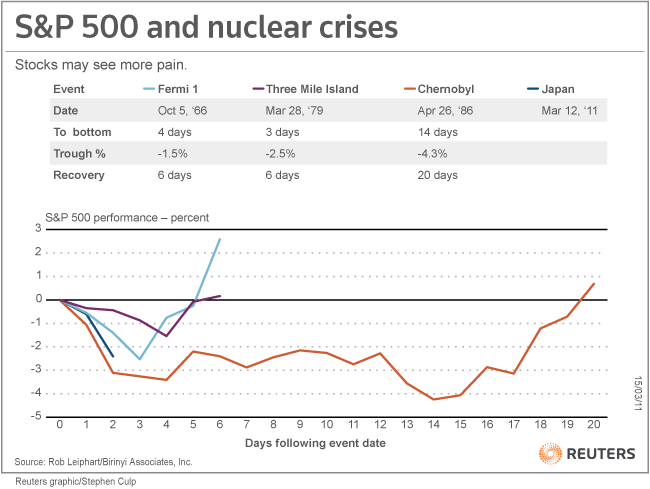
The tragic events in Japan are having an impact on market activity over the past several days. The issues surrounding the reactors at the Fukushima Daiichi power plant make new headlines throughout the day. As the below graphic shows, the S&P 500 index has contracted during past nuclear crises. The largest impact was Chernobyl in 1986 and the trough was reached 14 days after the Chernobyl event. The market recovered its losses within 20 days of the Chernobyl accident.

From The Blog of HORAN Capital Advisors
The nuclear crises events in Japan are certainly far from over; however, history seems to indicate the market has a tendency to overreact to these events in the short run.


Saturday, March 12, 2011

Gold And Silver Used In Evaluating Direction Of Economy

Given what seems like a parabolic increase in gold and silver prices, many investors are attracted to these metals as investment opportunities. At HORAN Capital Advisors, we have a difficult time evaluating whether these metals are overvalued or undervalued. The difficulty arises from the fact these metals do not generate any cash flow. At HORAN, we value investments we make for our client accounts based in large part on the cash flows generated by particular investments. Consequently, at this point in time we do not have a direct allocation to either gold or silver for our client accounts.

On the other hand, we do evaluate gold and silver prices as they are an important input into our analysis of the future direction of economic growth. Gold tends to be a safe haven investment for investors with events like those occurring in the Middle East impacting the price of gold. During times of improving economic activity though, silver tends to outperform gold due to silver's wider industrial use compared to gold; hence, driving up the price of silver. Since mid-2010 silver has outperformed gold. The first chart below shows gold and silver prices along with the gold/silver ratio. In the second chart, the gold/silver ratio is plotted with U.S. industrial production.

From The Blog of HORAN Capital Advisors

From The Blog of HORAN Capital Advisors

As of March 11, the gold/silver ratio stood at 39.3 and this is below the support level of 43 that has held since February 1998. Additionally, the above chart that includes industrial production shows a declining ratio along with improved industrial production activity. For investors then, if they want to use gold and silver prices as an input in their economic forecast, evaluating the gold/silver ratio can be a useful indicator to track.

Source:
Gold and Silver: What a Pair! ($)
Thomson Reuters
By: Radhika Kamath
March 10, 2011
http://www.trpropresearch.com/archive/file/952/


Sunday, March 06, 2011

Oil Price and GDP Calculator

Reuters has produced an interactive calculator showing the impact on global GDP of oil prices at various levels. Click the below chart for the link to the calculator.

From The Blog of HORAN Capital Advisors


Friday, March 04, 2011

Employment Report: Watch Participation Rate

Today's Bureau of Labor Statistics release of the employment situation report saw the unemployment rate decline to 8.9%. This rate was better than the consensus expectation of 9.1%. Today's stock market reaction to this supposedly improved report was less than positive. Aside from the heightened focus on oil prices, the report was not as positive as it may have seemed on the surface.

One factor in the report worth watching is the participation rate. As the below chart shows, the participation rate has been on a steady decline since the end of the recession in early 2009. This rate has fallen to 63.9% and is below the 66.8% just prior to the beginning of the recession. An improvement in the unemployment rate could be the result of more individuals not pursuing jobs and dropping out of the labor force since they are unable to find employment.

From The Blog of HORAN Capital Advisors

h/t: CNBC


Oil Price Spikes Often Preceded Or Coincided With A U.S. Recession

According to Chart of the Day:

"The decline in crude oil prices that began in mid-2008 was historic -- plunging over $90 per barrel in just eight months. Over the past two years, however, crude oil prices have increased by over $60 per barrel. Today's chart provides some perspective on the historic decline and recent spike with a long-term view of inflation-adjusted West Texas Intermediate Crude. Today's chart illustrates that most oil price spikes were a result of Middle East crises and often preceded or coincided with a US recession. It is also interesting to note that the recent spike in oil prices has brought the price of oil back to a historically high level -- a level that was surpassed only briefly during the tail-end of the major price spikes of 1980 and 2008."
From The Blog of HORAN Capital Advisors


Pickens On U.S.'s Energy Situation

Feb. 28 (Bloomberg) -- T. Boone Pickens, the billionaire chairman of BP Capital LLC, talks about the impact of turmoil in the Middle East on oil prices and the need for new U.S. energy policy. He speaks with Tom Keene on Bloomberg Television's "Surveillance Midday." (Source: Bloomberg)

From The Blog of HORAN Capital Advisors


Sunday, February 27, 2011

Francois Trahan: The Dollar And Macro Factors Are Key For The Market This Year

Several weeks ago Consuelo Mack of WealthTrack featured an interview with Francois Trahan, Vice Chairman, Head of Portfolio Strategy and Quantitative Research at Wolf Trahan. Francois has been selected as the #1 portfolio strategist for the last three years by Institutional Investor Magazine.

In the below video Francois states his views on the equity markets, gold and commodities more broadly. He notes the dollar's influence on equities and commodities and likens the current environment to the the 2006 - 2008 time period. In '06 - '08 he notes the price of a barrel of oil at $95 per barrel was a key inflection point for the markets and could be an important one in this market cycle.


Saturday, February 26, 2011

Berkshire Hathaway's Profit Not As Strong As Appears On The Surface

Berkshire Hathaway (BRK.A) turned in nice results for the year ending 2010, but, on an apples to apples basis, organic results are not as strong as many in the media are reporting. Even in Warren Buffett's must read annual shareholder letter he warns the media not to focus on net income due to the ease in which it can be manipulated. Mr. Buffett notes on page 20 of his annual letter:
"Let’s focus here on a number we omitted, but which many in the media feature above all others: net income. Important though that number may be at most companies, it is almost always meaningless at Berkshire. Regardless of how our businesses might be doing, Charlie and I could – quite legally – cause net income in any given period to be almost any number we would like...We have that flexibility because realized gains or losses on investments go into the net income figure, whereas unrealized gains (and, in most cases, losses) are excluded."
In fact, these realized investment gains did inflate net income for 2010 by nearly $1.5 billion (net of est. taxes). Below is a summary of some key items in Berkshire's cash flow statement.

From The Blog of HORAN Capital Advisors

The other item investors need to factor into the company's earnings is the contribution of the Burlington Northern (BNSF) acquisition. In the company's full financial statement, it is noted on page 75 that BNSF contributed $2.2 billion to consolidated earnings in 2010, not an insignificant amount. From a cash flow growth perspective then, BRK saw cash operating flow increase 12.9% ($17,895 versus $15,846).

An important point for investors is the cash flow statement offers important insights into a firm's operations that sometimes are hidden in the income statement. It is important for investors to understand from where the company is achieving its cash flow growth. For the year, BRK saw its cash increase to $38 billion from $30 billion. New borrowings of $8 billion accounted for all of the increase.

For future growth at Berkshire, Mr. Buffett indicates in his letter, "...We will need both good performance from our current businesses and more major acquisitions. We’re prepared. Our elephant gun has been reloaded, and my trigger finger is itchy."

From an investment perspective, Berkshire anticipates future growth to come from future "major" acquisitions, likely not to dissimilar to the BNSF transaction. For BRK, growth by acquisition has become a mainstay of its operation and investors historically have been rewarded with strong stock price performance. As Mr. Buffett warns, don't look at net income or earnings per share in a vacuum.


Sunday, February 20, 2011

Public Employee Cost Driving Discontent

Wisconsin seems to be ground zero in the debate on public employee cost versus private sector employees. The issue has moved to the forefront due to most states needing to deal with significant budget deficits. And these deficits have been magnified due to the persistently high unemployment rate experienced even as the economy has come out of the last recession.

As the below chart shows, the salaries of state and local government workers, as well as benefits, have grown out a faster pace than for the private sector.

From The Blog of HORAN Capital Advisors

In a severe economic slowdown like recently experienced, the rate of growth in government sector pay and benefits is not sustainable; hence, the debates taking place in many states like Wisconsin. Additionally, the unemployment rate differential between the public and government sector continues to remain wide. The issue then becomes, who pays for the government sector employees if private sector employment levels remain stubbornly low. At the federal level, the government can print more currency (not without risk however), but at the state and local level, currency printing is not a viable option.

From The Blog of HORAN Capital Advisors

At the end of the day, the issue of public employee cost versus the private sector will need to be addressed. Also, this is not simply a short term problem between public and private sector wages/benefits. As more and more baby boomers enter retirement, the cost associated with entitlements as currently structured, like social security and Medicare, is not sustainable and will need to be adjusted. This will likely put an additional spotlight on the benefit differences between the public and private sector.