Sunday, February 27, 2011

Francois Trahan: The Dollar And Macro Factors Are Key For The Market This Year

Several weeks ago Consuelo Mack of WealthTrack featured an interview with Francois Trahan, Vice Chairman, Head of Portfolio Strategy and Quantitative Research at Wolf Trahan. Francois has been selected as the #1 portfolio strategist for the last three years by Institutional Investor Magazine.

In the below video Francois states his views on the equity markets, gold and commodities more broadly. He notes the dollar's influence on equities and commodities and likens the current environment to the the 2006 - 2008 time period. In '06 - '08 he notes the price of a barrel of oil at $95 per barrel was a key inflection point for the markets and could be an important one in this market cycle.


Saturday, February 26, 2011

Berkshire Hathaway's Profit Not As Strong As Appears On The Surface

Berkshire Hathaway (BRK.A) turned in nice results for the year ending 2010, but, on an apples to apples basis, organic results are not as strong as many in the media are reporting. Even in Warren Buffett's must read annual shareholder letter he warns the media not to focus on net income due to the ease in which it can be manipulated. Mr. Buffett notes on page 20 of his annual letter:
"Let’s focus here on a number we omitted, but which many in the media feature above all others: net income. Important though that number may be at most companies, it is almost always meaningless at Berkshire. Regardless of how our businesses might be doing, Charlie and I could – quite legally – cause net income in any given period to be almost any number we would like...We have that flexibility because realized gains or losses on investments go into the net income figure, whereas unrealized gains (and, in most cases, losses) are excluded."
In fact, these realized investment gains did inflate net income for 2010 by nearly $1.5 billion (net of est. taxes). Below is a summary of some key items in Berkshire's cash flow statement.

From The Blog of HORAN Capital Advisors

The other item investors need to factor into the company's earnings is the contribution of the Burlington Northern (BNSF) acquisition. In the company's full financial statement, it is noted on page 75 that BNSF contributed $2.2 billion to consolidated earnings in 2010, not an insignificant amount. From a cash flow growth perspective then, BRK saw cash operating flow increase 12.9% ($17,895 versus $15,846).

An important point for investors is the cash flow statement offers important insights into a firm's operations that sometimes are hidden in the income statement. It is important for investors to understand from where the company is achieving its cash flow growth. For the year, BRK saw its cash increase to $38 billion from $30 billion. New borrowings of $8 billion accounted for all of the increase.

For future growth at Berkshire, Mr. Buffett indicates in his letter, "...We will need both good performance from our current businesses and more major acquisitions. We’re prepared. Our elephant gun has been reloaded, and my trigger finger is itchy."

From an investment perspective, Berkshire anticipates future growth to come from future "major" acquisitions, likely not to dissimilar to the BNSF transaction. For BRK, growth by acquisition has become a mainstay of its operation and investors historically have been rewarded with strong stock price performance. As Mr. Buffett warns, don't look at net income or earnings per share in a vacuum.


Sunday, February 20, 2011

Public Employee Cost Driving Discontent

Wisconsin seems to be ground zero in the debate on public employee cost versus private sector employees. The issue has moved to the forefront due to most states needing to deal with significant budget deficits. And these deficits have been magnified due to the persistently high unemployment rate experienced even as the economy has come out of the last recession.

As the below chart shows, the salaries of state and local government workers, as well as benefits, have grown out a faster pace than for the private sector.

From The Blog of HORAN Capital Advisors

In a severe economic slowdown like recently experienced, the rate of growth in government sector pay and benefits is not sustainable; hence, the debates taking place in many states like Wisconsin. Additionally, the unemployment rate differential between the public and government sector continues to remain wide. The issue then becomes, who pays for the government sector employees if private sector employment levels remain stubbornly low. At the federal level, the government can print more currency (not without risk however), but at the state and local level, currency printing is not a viable option.

From The Blog of HORAN Capital Advisors

At the end of the day, the issue of public employee cost versus the private sector will need to be addressed. Also, this is not simply a short term problem between public and private sector wages/benefits. As more and more baby boomers enter retirement, the cost associated with entitlements as currently structured, like social security and Medicare, is not sustainable and will need to be adjusted. This will likely put an additional spotlight on the benefit differences between the public and private sector.


Thursday, February 17, 2011

Recent Company Actions Support Strong Market Advance

The recent financial actions by companies provide verification that corporate fundamentals have continued to strengthen. Howard Silverblatt of Standard & Poor's notes on his Bloomberg BusinessWeek blog, Investing Insights, that:
  • Dividend increases so far in Q1 2011 are very strong with the average increase equaling 22.65% and the median increase totaling 12.20%.
From The Blog of HORAN Capital Advisors
  • Cash has set 8 consecutive quarters of record cash levels: Q4 2008 – Q3 2010. Cash in Q4 2010 is coming in 3.6% ahead of Q3 2010.
From The Blog of HORAN Capital Advisors
  • 2011 sales estimates have been increasing over the past three weeks, with 2011 estimated to post a 12.1% gain 2010.
  • Earnings per share in Q4 shows a 29.5% gain over Q4 20’09. On a sequential basis Q4 EPS is only up 2.5% versus Q3 2010.
Source:

A Few Preliminary Q4 Stats, And Observations
Investing Insights Blog
By: Howard Silverblatt
February 12, 2011
http://www.businessweek.com/investing/insights/blog/archives/2011/02/a_few_preliminary_q4_stats_and_observations.html


Saturday, February 12, 2011

Markets Retrace Financial Crisis Losses

Many segments of the U.S. stock market have retraced a large portion of the losses that occurred from October 2007 through March 2009. Chart of the Day provides the below detail on this recovery.

"For some perspective on the post-financial crisis rally, today's chart illustrates how much of the downturn that occurred as a result of the financial crisis has been retraced by each of the five major stock market indexes. For example, the Dow peaked at 14,164.53 back in October 9, 2007 and troughed at 6547.05 back on March 9, 2009. The Dow currently trades at 12,229.29 -- it has retraced 74.6% of its financial crisis bear market decline. As today's chart illustrates, each of these five major stock market indices have retraced over 70% of their financial crisis decline. However, it is the Russell 2000 (small-cap stocks), the tech-laden Nasdaq, and the S&P 400 (mid-cap stocks) that have recouped nearly all or (in the case of the S&P 400) more than all of the losses incurred during the financial crisis."
From The Blog of HORAN Capital Advisors


Is The Market Being Irrational On The Upside?

In a severe stock bear market it is often said that the market can remain irrational longer than an investor can remain solvent. In a market like investors are experiencing at this moment, some believe the market is being irrational on the upside. At what point in time will we see investors react by jumping in because they fear being left behind and missing out on significant upside gains? Year to date through February 11, 2011 the S&P 500 Index is up 5.9%. On a 12-month basis the S&P is up over 22%.

As the below chart of the S&P 500 Index shows, the market has almost steadily moved higher since the end of March last year. In the last half of 2009 the market's increase occurred on steadily declining volume on both up and down days. A similar pattern seems to be repeating itself this year. In other words, a spike in volume on up days does not seem evident; thus, suggesting the individual investor has not capitulated from sitting on the sidelines. The one spike in volume on an up day occurred in early December when the chart pattern completed its cup and handle pattern.

From The Blog of HORAN Capital Advisors

Additionally, the solid green line in the above chart shows 93% of S&P 500 company stock prices are trading above their 150 day moving average. Strategist often cite this as a sign the market is overbought. Keep in mind though, as highlighted in the chart, this variable can stay elevated for an extended period of time as it did in late 2009 into early 2010.

Certainly the market is not likely to advance at a 6% pace every succeeding six weeks. However, from a valuation perspective, many high quality large cap U.S. stocks are trading at attractive valuations. There are challenges ahead for a number of firms, like the need to pass on higher commodity prices. A pullback in the market would be healthy, and many investors seem to be waiting for that to occur. In the end, the market will trade on fundamentals.


Wednesday, February 09, 2011

Municipal Bond Fund Flows Strongly Negative

Investors are speaking with their feet as municipal bond fund flows are strongly negative. The below chart includes flow data through December. Updated data for January is available at the Investment Company Institute's website. January fund flow data shows strong negative flows continued for municipal investments at the start of this year.

From The Blog of HORAN Capital Advisors


Tuesday, February 08, 2011

Unemployment By Education Level: Education Matters

The below chart shows the unemployment level in the U.S. by an individual's education level. Individuals that have obtained a college degree find themselves less likely to be unemployed.

From The Blog of HORAN Capital Advisors

The higher rate of unemployment for those with less than a bachelors degree may be the result of a structural shift in the composition of the type of jobs now available to individuals. As the following chart details, the steady decline in the number of people employed in manufacturing jobs provides some evidence of this structural shift in the U.S. job market. The Reuters report, Is America the Sick Man of the Globe?, provides more insight into this structural change.

From The Blog of HORAN Capital Advisors


Friday, February 04, 2011

Dividend Payers Underperform In January

For the month of January, the average return for the dividend payers in the S&P 500 Index slightly underperformed the non-payers, 2.08% versus 2.10%, respectively. On a weighted basis the S&P 500 Index total return equaled 2.37% while the equal weighted return for the index was 2.22%. This is an indication that the larger capitalization stocks may be gaining favor with investors. On a 5 and 10 year basis, the S&P 500 Index has lagged the performance of the midcap and small cap indices.

From The Blog of HORAN Capital Advisors


Sunday, January 30, 2011

Money Velocity A Key To Potential Inflation

Inflation pressures have been finding their way into commodity prices. Much of this commodity price inflation may be the result of investor speculation; however, commodity price pressures are having an impact on some of the emerging market economies. Inflation has not shown in the U.S. consumer price index, but an increase in the velocity of money may provide investors with insight into future inflation.

From The Blog of HORAN Capital Advisors

From The Blog of HORAN Capital Advisors

The importance of the relationship between money velocity and inflation is explained by the quantity theory of money. One concern we have at HORAN is the fact banks are sitting on large amounts of deposits/cash at the federal reserve.

From The Blog of HORAN Capital Advisors

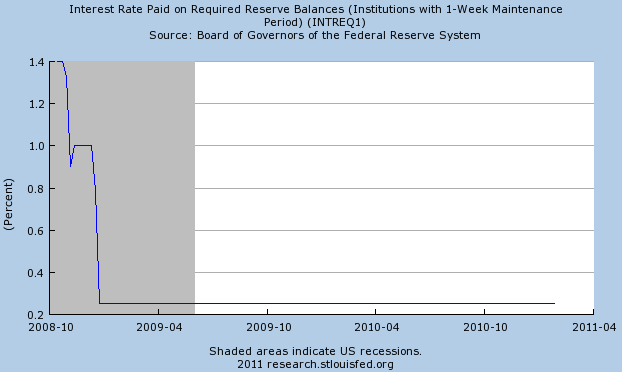
With economic conditions improving, along with banks seeming to get the lending side of their organizations in order, these reserve deposits can quickly find their way into the economy via more relaxed lending standards (increased velocity.) The Fed is doing all it can to stimulate money velocity including a reduction in the interest rate paid to banks on their reserve deposits.

From The Blog of HORAN Capital Advisors


Egypt, Investor Sentiment And The Market

The events in Egypt over the last week are now dominating headlines and impacting recent market actions. Many are commenting about the events in Egypt so I will not restate what is occurring in that part of the world. Readers can follow the news on Reuters live coverage link.

The events in that country have provided investors with a reason to take profits though. Often times market pullbacks or corrections occur as the result of unpredictable events. Given the strength of the market's advance since the lows in July last year, this pullback is not surprising.

From The Blog of HORAN Capital Advisors

As I noted in a post in mid December regarding the cup and handle formation of the S&P 500 Index, a breakout occurred around the 1,225 level. A retest of this level would not be surprising if the market falls through the 50-day moving average support. A retest of this cup and handle support would equate to a 4% decline in the market from Friday's close.

For investors then, they should maintain a focus on company fundamentals. With just over 40% of S&P 500 companies reporting earnings, Thomson Reuters notes 71% of those firms have reported earnings that exceeded analyst expectations. Additionally, the estimated earnings growth rate in Q4 is 36% and the forward four quarter (Q4 2010 – Q3 2011) P/E ratio for the S&P 500 is 13.3.

From The Blog of HORAN Capital Advisors

Investor sentiment figures reported by the American Association of Individual Investors is not overly bullish either. Last week's AAII sentiment survey reported that bullish investor sentiment declined nearly 9 percentage points to 42%. This compares to the long term average of 39%. Last week's bullish sentiment reading is down from the 63% reported in late December.

From The Blog of HORAN Capital Advisors

At HORAN Capital Advisors, we continue to be constructive on the longer term fundamentals for equities, especially compared to bonds. To us large multinational U.S. firms appear to be trading at more reasonable valuations vis-à-vis midcap and small cap equities. One factor we are focusing on is the ability of firms to generate top line revenue growth, and not at the expense of margins. The potential pullback the market may experience near term will likely give investors an opportunity to build or add to equity holdings.


Sunday, January 23, 2011

QE2: A Reason Risky Assets Are Inflating?

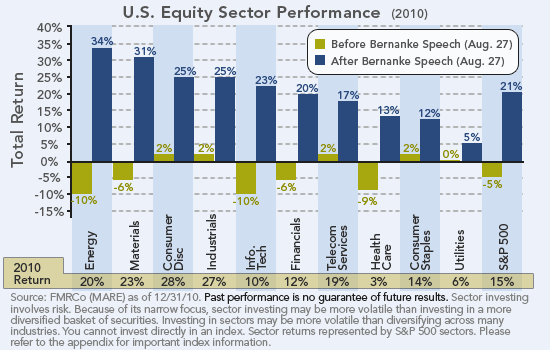
On August 27th of last year Ben Bernanke's speech at the Jackson Hole, WY meeting signal beginning of the Fed's second round of quantitative easing. Since the speech the stock market has responded favorably for long equity investors.

From The Blog of HORAN Capital Advisors

Not only have equity prices reacted favorably to the Fed Put, many commodity assets have responded as well and noted in our post, More Evidence Of Inflation In The System.

I do not recall the source of the below chart; however, during the Fed's first round of quantitative easing, the market experienced strong upward returns. The market's positive return during QE1 could be viewed as a coincidence; however, the quantitative easing dollars need to flow somewhere, and risky asset prices seem to be the beneficiary. This has been a stated desire by the Fed as well.

From The Blog of HORAN Capital Advisors

One question that comes to mind is what will be the market's reaction once QE2 comes to an end in June. One date that might be of importance is the Fed's Humphrey-Hawkins testimony before Congress in February. Given the change in the control of the House to the Republican side and their prior opposition to quantitative easing, might the Fed step up the QE program and have it end around the time of the Humphrey Hawkins testimony? Ron Paul, who has not displayed much favor for the Federal Reserve, has been named Chairman of the Subcommittee on Domestic Monetary Policy and Technology, the committee charged with overseeing the Federal Reserve.


Friday, January 21, 2011

Funds Flowing Out Of Bond Investments

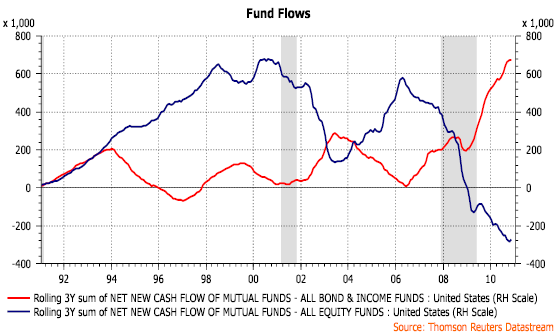
Investors seem to be realizing that higher interest rates are not good for their bond investments. As we wrote in mid November in our article, Interest Rates On The Rise, higher interest rates translate into a declining value in the price of an investor's bonds. Recent mutual fund flow data shows investors have been placing less of their funds into bond mutual funds. The below chart shows the trend in the flow of funds into bond and equity funds through mid November. Bond inflows had essentially dried up.

From The Blog of HORAN Capital Advisors

The below table from the Investment Company Institute shows that bond flows have now turned negative with a majority of the outflow occurring in municipal bond funds.

From The Blog of HORAN Capital Advisors

This recent action reverses a long term trend of investors pouring investment dollars into fixed funds since 2006 and detailed by the red line in the below chart.

From The Blog of HORAN Capital Advisors


Wednesday, January 19, 2011

4th Quarter Investor Insight Newsletter

We are a little more than two weeks into the new year and 2010 seems to be quickly fading in investors' minds. The common theme this year, 2011, is the new year is looking similar to the last half of 2010. Our firm's 4th quarter investor letter summarizes 2010 and provides our insights into 2011. HORAN Capital Advisor's complete Investor Letter can be accessed at the following link: 4th Quarter Investor Letter.

Information on HORAN Capital Advisors can be found at http://www.horancapitaladvisors.com/.


Monday, January 17, 2011

Sector Rotation And The Economic Cycle

Since the S&P 500 reached a low in March 2009, the market has enjoyed a strong recovery to the upside. Along with the stronger equity market, the economy has gained a firmer footing as well. Some of the economic support is a result of the Fed's and government's intervention. Some would say that in spite of this intervention the economy is experiencing growth, albeit slow growth. An important fact for investors is the market sectors perform differently depending on where the economy is as it relates to the economic cycle.

From The Blog of HORAN Capital Advisors

The chart below shows the performance of the various market sectors at various points along the economic cycle. A report prepared by Fidelity last year, A Tactical Handbook of Sector Rotations, details the four phases of the economy. The first two phases:
  • Early-cycle phase: Begins prior to the end of a recession as investors begin to anticipate an economic recovery, and extends through the initial economic acceleration. The stock market historically has registered exceptional gains, on average 32% during this period. [For the purposes of this article, this phase begins three months prior to the end of a recession and extends through the first nine months of recovery.]
  • Mid-cycle phase: Begins prior to the Fed’s initial rate increase, as the recovery broadens into expansion and the Fed moves to dampen inflation pressure. The market typically performs well during this phase (average return of 11%). [Begins three months prior to the initial rate hike, and extends nine months beyond.]

From The Blog of HORAN Capital Advisors

The early cycle phase tends to last through the first nine months of the recovery. The National Bureau of Economic Research (NBER) sets the beginning and ending dates of recessions. NBER has marked the end of the current recession as occurring June of 2009. If the economy follows its average cycle, the early cycle phase would have ended on March 2010. At HORAN we do not believe this is a typical recovery for a number of reasons, many of which have been debated in the media. Much debate occurred during the summer last year about a double dip recession. Consequently, the phases of this cycle seem to be lengthened. Having noted this, we believe the economy is in the later stages of the early-cycle. The mid-cycle phase begins prior to the Fed's initial rate increase.

From The Blog of HORAN Capital Advisors

Among many factors, one that investors need to look at are actions and statements by the Fed to gain clues that a rate increase may be forthcoming.

Source:

A Tactical Handbook of Sector Rotations
Market Analysis, Research & Education
A unit of Fidelity Management & Research Company
August 23, 2010
http://personal.fidelity.com/products/pdf/a-tactical-handbook-of-sector-rotations.pdf


Saturday, January 08, 2011

Ed Hyman And Dennis Stattman Outlook

On this week's Consuelo Mack WealthTrack, she conducts an exclusive interview with Wall Street's long-time number one ranked economist, Ed Hyman of ISI Group, plus BlackRock's star Global Asset Allocation Fund manager, Dennis Stattman. Both discuss the outlook for the United States' economy and markets in the new world order.


Wednesday, January 05, 2011

Dividend Payers Outperform Non Payers In 2010

The average return of the dividend paying stocks in the S&P 500 Index outperformed the non dividend paying stocks in 2010. The dividend payers returned 18.75% versus 16.24% for the non payers in 2010. Given the attractive valuations and yields for many dividend paying stocks, especially compared to fixed income yields, outperformance of dividend paying equities has a high likely to continue in 2011.

From The Blog of HORAN Capital Advisors


Gold's Chart Pattern Indicates A Triple Top Has Formed

The market action in gold has created a triple top pattern in gold's stock chart. Additionally, it is common for the volume to continue to decline when triple top chart patterns are formed. This technical pattern development would indicate there is likely more downside weakness in the price of gold ahead.

From The Blog of HORAN Capital Advisors


Sunday, January 02, 2011

Returns For Various Market Segments In 2010

Several of the hard commodities such as Gold and Copper lead returns in 2010. Below are several graphics from Thomson Reuters that show segment returns in both Dollars and local currency. Readers can click the graphs for an interactive feature for other return periods.

Returns In Dollars
From The Blog of HORAN Capital Advisors

Returns In Local Currency
From The Blog of HORAN Capital Advisors


Significant Decline In Bullish Investor Sentiment

This past week saw a significant decline in bullish investor sentiment as reported by the American Association of Individual Investors. Bullish sentiment fell over 11 percentage points to 51.6% versus the prior week's reading of 63.3%. The bull/bear spread remained at a fairly wide 31 percentage points. As the market enters a new year, it does appear, from a sentiment perspective, investors are somewhat cautious about the future direction of the market.

From The Blog of HORAN Capital Advisors