Tuesday, August 31, 2010

The Real Facts About The Recent Hindenburg Omen Trigger

One technical data point that has received quite a bit of press recently is the triggering of the criteria that make up the "Hindenburg Omen" indicator. On the surface, it would seem the data provides support for the underlying factors that comprise this indicator. However, as Bespoke Investment Group and Liz Ann Sounders of Charles Schwab note, the facts are not as they appear.

As Bespoke notes, the five criteria that need to be met are as follows:
  1. The daily number of New York Stock Exchange new 52-week highs and daily number of new 52-week lows must both be greater than 2.2% of total NYSE issues traded that day.
  2. The smaller of these numbers is greater than or equal to 69 (2.2% of 3126 NYSE issues). This is not a rule, but more like a check.
  3. The NYSE 10-week moving average must be rising.
  4. The McClellan Oscillator must be negative on the same day.
  5. New 52-week highs can't be more than twice new 52-week lows (however, it's fine for lows to be more than double highs).
As Schwab outlines in a recent research article the most important factor is the first one noted above. Following are the real facts behind the supposed trigger of this variable:
"Looking at the list of news highs and lows from Thursday, August 12 (the first Hindenburg Omen trigger day), there were 92 stocks (2.9% of NYSE) that hit new highs and 82 (2.5%) that hit new lows.

However, a closer look at the list of new highs shows that most of the "stocks" hitting new highs were hardly stocks at all. Practically all were closed-end fixed income securities, preferred stocks or some other form of fixed income product masquerading as stocks. In fact, of the 92 issues that hit new highs, only seven were common stocks!

Given that there are so many fixed income products that now trade on the NYSE, and with demand for them so high, perhaps a better way to measure new highs (or lows) is by filtering out all the quasi-stocks. B.I.G. did this by looking only at stocks in the S&P 500® index and applying the same Hindenburg Omen parameters.

On the initial trigger day, only 0.2% of S&P 500 stocks hit new highs while 5.6% hit new lows. Of course, a day with 5.6% new lows doesn't highlight a healthy market, but it may not reflect the confusion that the Hindenburg Omen supposedly conveys. As B.I.G. noted, 'Call us crazy, but an indicator that measures the internals of the equity market should probably avoid using fixed income securities in its analysis.'"
Appropriately, as one factors out the non-equity variables, only seven of the new highs were stocks! And, as the noted above, only .2% of the stocks hit new highs on the 12th of August.

For investors then, as uncertainty about the future direction of the market abounds, be sure not to take the bearish or bullish market signals at face value. This is not the same market your parents or grandparents invested in historically.

Source:

Land of Confusion … Bubbles and Omens Dissected
Charles Schwab & Co.
By: Liz Ann Sounders
August 30, 2010
http://www.advisorperspectives.com/commentaries/schwab_090110.php

Know Your Indicators: Hindenburg Omen
Bespoke Investment Group
August 18, 2010
http://www.bespokeinvest.com/thinkbig/2010/8/18/know-your-indicators-hindenburg-omen.html


Sunday, August 29, 2010

Change In Control Of Congress And The Market

Many eclectic technical market indicators have surfaced recently given the uncertain direction of the economy and the stock market. We have the Hindenburg Omen, the Kindleberger Cycle just to name a few. I sometimes wonder if these indicators bubble to the surface or gain popularity because fundamental indicators do not support a bear market case.

In any event, one other technical indicator that may come to pass is the potential change in the party that controls Congress. The last time the Democrats held control of both houses of Congress and the White House was during the first two years of President Bill Clinton's first term in office in 1993 and 1994. During the mid-term elections in 1994, the Democrats lost control of both houses of Congress. Prior to the election, the Democrats held 57 senate seats and 258 house seats. Today the Democrats hold 55 senate seats and 256 house seats. So how might the stock market react if one or both houses of Congress change hands over to the Republicans?

Subsequent to the 1994 mid term elections and during the second half of Bill Clinton's presidential term, the stock market advanced over 34% in 1995.

From The Blog of HORAN Capital Advisors

If one believes in cycles and playing in favor of the market now is the fact the third year of a president's term tends to be the best performing one.

From The Blog of HORAN Capital Advisors

More detail can be found in an earlier post I wrote on this topic titled, Presidential Election Cycle Nearing Its Best Quarters. The above table comes from a Standard & Poor's research piece written by Sam Stovall and titled, Whistling a New Tune in June?

One can track the prediction market for these potential outcomes on Intrade. The likelihood that the House of Representatives changes over to Republican control has increased to 77% from below 30% at the beginning of 2009.

The reported economic data is certainly not suggesting strong growth. Slow growth is a potential outcome, but sentiment could change as the end of the year approaches. (This week will see some important economic reports with initial claims for unemployment reported on Thursday and non-farm payrolls reported on Friday.)


Thursday, August 26, 2010

Money Supply, Velocity and Economic Growth

A great deal has been written recently about the fact that the Fed's effort to provide for more liquidity in the financial system has really not produced much growth as bank's are holding the liquidity in excess reserves.

From The Blog of HORAN Capital Advisors

The importance of this has to do with the Quantity Theory of Money (QTM) which describes the interplay of nominal GDP, money supply and velocity. I wrote on this topic in early 2009 in a post titled, Money Supply Causing Concern With Future Inflation.

Recently though, the velocity of M2 and the YOY percentage change are showing increases. As the below charts do show, it is not uncommon for velocity to take some time to pick up following an economic recession.

From The Blog of HORAN Capital Advisors

From The Blog of HORAN Capital Advisors

As I noted in my post in 2009, the relationship between velocity, the money supply, the price level, and output is represented by the equation:
  • M * V = P * Y where
  • M is the money supply,
  • V is the velocity,
  • P is the price level, and
  • Y is the quantity of output.
  • P * Y, the price level multiplied by the quantity of output, gives the nominal GDP.
This equation can thus be rearranged as V = (nominal GDP) / M. Conceptually, this equation means that for a given level of nominal GDP, a smaller money supply will result in money needing to change hands more quickly to facilitate the total purchases, which causes increased velocity. In the QTM, velocity is assumed to be constant in the short run since it is not easy to manipulate. If the above equation holds and output is not quickly changed, prices will rise. Additionally, a rise in prices multiplied by an unchanged output will result in higher GDP. The question is whether or not there is demand for the output.

At HORAN Capital Advisors, we do believe the consumer demand side of the equation is being restrained for a number of reason, the uncertain regulatory environment, consumer deleveraging and high unemployment to name just a few. At HORAN we are cautiously optimistic that higher velocity is being realized and will lead to higher nominal GDP via an upward pressure on prices. GDP growth is likely not to be strong near term, but growth nonetheless.


Thursday, August 19, 2010

Inflation In The Pipeline

Of appropriate concern is the fact the economy could be entering into a period of deflation. The concern stems from the fact the Consumer Price Index continues to trend lower. As the below chart notes, the overall YOY change in the CPI is a little over 1% while the core CPI is near .9% (not shown.)

From The Blog of HORAN Capital Advisors

The inflation concern comes into play as its cause tends to be the result of a fall in overall demand. With high unemployment and thus lower anticipated consumer spending, the lower demand trend feeds into the bear case for the economy and the market.

A deflationary period would certainly have an impact on appropriate investment strategies for investors. In mild deflationary periods though, stocks tend to deliver fairly decent returns. More detail on stock returns in various inflation scenarios can be found in an earlier post I wrote titled, Where to Invest in an Inflationary Environment. The below chart details the average return for the S&P 500 during various inflation/deflation periods. The number in parenthesis represents the number of return periods for each range of inflation/deflation.

From The Blog of HORAN Capital Advisors
From a valuation perspective, looking at the price earnings ratio or PE, stocks will tend to trade at lower PE multiples in a deflationary environment; however, many of the high quality large company stocks are already trading at low PE multiples today.

At the end of the day then the relevant question is whether we are entering an inflationary or deflationary cycle. As the below table shows, inflation does appear to be entering the supply chain at the producer level. Argus Research notes:
"...Producer Price Inflation for finished goods has increased at a 4.2% rate over the past year through July. This is higher than consumer inflation, and up month-to-month from 2.8%. Deeper in the production pipeline, pricing pressures are even more pronounced. For intermediate and crude goods, prices have jumped 6.4% and 20.5%, respectively, over the past year...."
From The Blog of HORAN Capital Advisors

Deflation concerns certainly warrant watching; however, in mild deflation periods, there are investment categories that can generate profits for investors. From a PPI perspective though, inflation pressures appear to be bubbling up in the producer level of the economy. This higher producer price pressure often leads to higher consumer prices; hence, a potential counter to the deflation case.


Tuesday, August 17, 2010

Business Activity Actually Strengthening

Today's release of the industrial production and capacity utilization data ("V-shaped" recoveries?") indicated an improvement in manufacturing activity. Industrial production rose to 93.4% and exceeded expectations of 93%. Although motor vehicle production was up 10%, the Federal Reserve release notes indicate:
...manufacturing production excluding motor vehicles and parts advanced 0.6 percent. The output of mines rose 0.9 percent, and the output of utilities increased 0.1 percent.
From The Blog of HORAN Capital Advisors

In addition to an improvement in industrial production, the Federal Reserve reported an increase in capacity utilization. Capacity utilization increased to 74.8% versus expectations of 74.5%.

From The Blog of HORAN Capital Advisors

The demand for truck drivers is on the increase with driver shortages now a reality. In essence, these trucks are not driving around empty and are supporting the distribution of more goods due to the improving economy. This improving anecdotal evidence seems to indicate an environment where the economy is improving.


Wednesday, August 11, 2010

Cisco Comments Indicative Of Economy That Is Just Bumping Along

Cisco's (CSCO) earnings release and comments after the market close is indicative of an economy that is just bumping along with weaker growth. See the August 2010 comment that Chambers today. The forecasting foresight of John Chambers during other significant economic turning points and pulled together by Reuters is outlined below.

I do believe we will be in this uncertain economic environment until there is more clarity on the regulatory and tax environment that is coming out of Washington. This may not be visible until November; however, the market is pretty good at predicting what the future holds and is likely to react a month or two in advance of November.
CHRONOLOGY-Cisco CEO John Chambers' comments on the economy
6:42 PM Eastern Daylight Time Aug 11, 2010

NEW YORK, Aug 11 (Reuters) - Cisco Systems Inc Chief Executive John Chambers said there was "unusual uncertainty" in the economy and gave a revenue forecast that was below Wall Street expectations, sending shares tumbling. Chambers, one of Silicon Valley's longest-serving executives, is considered a good reader of industry trends. He was one of the first executives to flag the impact of the financial meltdown on the technology sector in late 2007.

Here are some of Chambers' comments in recent years.

AUG 2007
"I have been in this business for 30 years ... It's the strongest global economy I have been a part of."

NOV 2007
Chambers warned of "dramatic decreases" in orders from U.S. banks.

FEB 2008
Chambers said orders slowed rapidly from December to January in the United States and Europe. "It's the most cautious I've seen CEOs in the U.S. and Europe in many years."

MAY 2009
On customer sentiment: "You can call it stability, you can call it leveling out ... for the first time many of them feel something solid beneath their feet as opposed to going into deeper and deeper water."

FEB 2010
"In our opinion Q2 marked the second phase of the recovery with additional across-the-board acceleration -- in other words, balance across the board -- in all of our geographies and market segments."

MAY 2010
"Given all the uncertainties regarding the strength and shape of the recovery, concerns about the recovery possibly slowing and the unknown extent of job creation, we encourage you to wait for additional economic data before becoming too optimistic."

AUGUST 2010
"We are seeing a large number of mixed signals in both the market and from our customers' expectations, and we think the words 'unusual uncertainty' are an accurate description of what is occurring."
In this environment, equity investors should focus on higher quality companies that have strong cash flow and lower debt levels. Many of these companies pay growing dividends and hold up better during down market periods.


Tuesday, August 10, 2010

Wholesale Inventory to Sales Ratio Near All Time Low

One area businesses have focused on is not getting stuck with high inventory levels in the event the economy takes a double dip. At this point in time, at HORAN, we are not in the double dip camp.

As the below chart details, the wholesale inventory to sales ratio is near a record low at 1.15:1.

From HORAN Capital Advisors

If we continue to see an improving trend in consumer sentiment, sales activity would likely improve.

From HORAN Capital Advisors

This higher demand on inventory at a time when inventories have been reduced may lead to upward pressure on selling prices. Today it was noted that Wal-Mart (WMT) has been raising prices by an average of 6% in some markets. The company cites lower sales as the reason; however, one wonders if tight supplies are driving the pricing decision as well.

On Friday retail sales and business inventories will be released. Business inventories are expected to increase .2% and retail sales are expected to be higher by .5%. This would result in a decline in the business inventory to retail sales ratio. The detailed report can be found on the U.S. Census Bureau/Department of Commerce website.


Sunday, August 08, 2010

Earnings In Q2 Still Strong, Forward PEG Less Than 1.0

Earnings for the S&P 500 Index in the second quarter continue to exceed expectations.

From HORAN Capital Advisors
According to Thomson,
  • Of the 443 companies in the S&P 500 that have reported earnings to date for Q2 2010, 75% have reported earnings above analyst expectations.
  • The blended earnings growth rate for the S&P 500 for Q2 2010 is 38%.
  • The forward four-quarter (Q3 2010 – Q2 2011) P/E ratio for the S&P 500 is 12.7, below the average forward four-quarter P/E ratio of the previous 52 weeks (14.2).
From HORAN Capital Advisors

The forward PE to earnings growth rate (PEG) for the S&P 500 Index is .77. This is arrived at by calculating the earnings growth rate from CY 2010 to CY 2011 and dividing the result into the estimated CY 2011 P/E of 11.7.


Saturday, August 07, 2010

Emotions Can Lead To Poor Investment Returns

Benjamin Graham, often referred to as the father of value investing, once said,
"Individuals who cannot master their emotions are ill-suited to profit from the investment process."
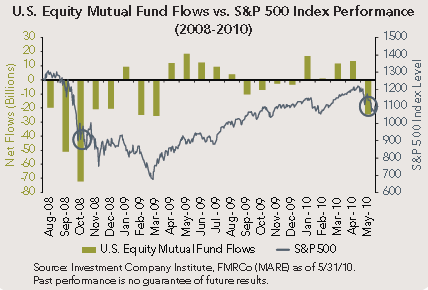
Graham's quote was alluding to the fact that individual investors tend to make incorrect investment decisions when they let their emotions overtake investment discipline. Behavioral finance has shown that investors have a much stronger preference for avoiding investment losses than they do investment gains. As a result, this bias against losses causes investors to sell an investment after the investment has already incurred substantial loss. A recent article in the Financial Analyst Journal, titled Relative Sentiment and Stock Returns ($), provides research supporting this conclusion.

The below chart details mutual fund equity flows relative to the performance of the S&P 500 Index. As the chart shows, equity outflows are at their greatest near the bottom of market cycles.

From The Blog of HORAN Capital Advisors

The impact on investors' investment returns due to this behavioral bias is lower overall investment returns. During the height of the financial crisis in late 2008 and through 2010, investors who maintained their exposure to stocks through the crisis have generated a higher level of return than those who sold all their stocks and stayed out of the market or those that sold all of their stocks and jumped back into the market.

From The Blog of HORAN Capital Advisors

Because of the tendency for individual investors to let emotions influence investment decisions, at HORAN we review various sources of sentiment data on an ongoing basis. In last week's individual investor sentiment report released by the American Association of Individual Investors, it shows bullish sentiment fell over nine percentage points to 30.4%. Bearish sentiment increased to 38.2% versus the prior week's bearishness level of 33.3%. A result is the bull/bear spread was reported at -7.9% versus the prior week's spread of 6.7%.

From The Blog of HORAN Capital Advisors
In concluding, investors should use this behavioral knowledge to review ones appropriate asset allocation and risk tolerance. Additionally, investment decisions should be grounded in a disciplined process to reduce the likelihood of making decisions that can harm overall investment returns. Also, choosing an investment approach that has its foundation built on lower volatility, especially in down markets, can reduce the feelings that influence ones emotions during volatile market periods.

Source:

Defending Your Investment Brain
Market Analysis, Research & Education
Fidelity Management & Research Company
July 29, 2010
http://personal.fidelity.com/products/funds/content/pdf/defending_your_investment_brain.pdf


Tuesday, August 03, 2010

Dividend Payers Achieve Strong Performance Through July

The dividend payers in the S&P 500 Index continue to generate strong performance through the month of July. On a year to date basis the payers are outperforming the non-payers 4.53% to 1.46%, respectively. For the 12-month period the payers are outperforming both the non-payers and the S&P 500 Index.

The payer/non-payer performance is calculated on an average basis while the S&P returns in the below table are on a weighted basis. As noted in an earlier post, equal weighted holdings in the S&P Index have outperformed the market cap weighted holdings. This seems to be playing out with the dividend payers as well.

From The Blog of HORAN Capital Advisors


Saturday, July 31, 2010

Equal Weighting Stocks In Ones Portfolio Might Lead To Higher Returns

In January 2003 Standard and Poor's began tracking an equal weighted S&P 500 Index versus the traditional market cap weighted S&P 500 Index. In the short seven year period, the equal weighted index (EWI) has outperformed the market cap weighted S&P 500 Index.

From HORAN Capital Advisors
To market research theorist, this seems like an odd outcome as it does not conform to the capital asset pricing model (CAPM) or Efficient Market Hypothesis (EMH). So what does CAPM and EMH imply?

According to a recent S&P report that evaluated the performance of the equal weighted and market cap weighted indices, they provide the following summary of EMH and CAPM.
The theoretical underpinnings for market capitalization weighted indices as a basis for investment lie in the Capital Asset Pricing Model (CAPM) and the Efficient Market Hypothesis.

According to the CAPM model, the expected return implicit in the price of a stock should be commensurate with the risk of that stock. However, stocks are subject to two types of risk – systematic risk, resulting from potential movements in market factors; and unsystematic risks, resulting from factors associated with individual assets. Since unsystematic risk can be diversified away, stocks should be priced solely based on systematic risk. This also implies that it is optimal to hold a well diversified portfolio in order to minimize unsystematic risk for a given level of expected return.

According to the efficient market hypothesis, it is impossible to beat the market because prices already incorporate all relevant information. Based on this, the most efficient portfolio would be the entire market and a broad market capitalization index would represent the optimal investment. However, there is much debate as to how efficient the market is in practice. Thus, there are countless different strategies being used in an attempt to beat the market. This has led to indices created based on alternative factors that measure different strategies.
In addition to the question with EMH, there are questions surrounding Modern Portfolio Theory as well. I discussed issues with MPT in an earlier post titled, Modern Portfolio Theory: Is It Over Relied On?

Recent S&P research suggests the EWI outperformance is attributable to a couple of factors. The two prominent ones are size and style. As the below graphic shows, the EWI tends to have more exposure to the mid size companies in the S&P index as well as being more tilted towards value style companies. If one reviews Ibbotson data, the best performing asset class over the long run has been midcap value. As the performance table above shows, the larger sized S&P 100 Index has underperformed the cap weighted and equal weighted S&P 500 Index.

From HORAN Capital Advisors
In conclusion, the equal weighting in the indices has provided an investor with superior returns compared to the market cap weighted indices. Investors should read the entire S&P report as it shows this higher return comes with higher volatility. Additionally, the equal weighted indices have much higher turnover (rebalanced quarterly) in order to maintain the equal weighting of the underlying holdings. This higher turnover level is likely to lead to higher capital gains being realized. And lastly, given the higher volatility in the market today and likely into the foreseeable future, an investment portfolio that has more funds allocated to larger, generally higher quality companies, should hold up better in down market environments.

Source:

Equal Weight Indexing
Standard & Poor's
July 2010
http://tinyurl.com/24hshfn


Earnings Better Than Expectations and Revenues In Line

As the below graphic details, earnings have certainly improved compared to the end of the first quarter (first third of chart).

From HORAN Capital Advisors
According to Thomson Reuters, of the 336 S&P 500 companies that have reported earnings through the end of July, 75% have reported earnings above expectations. In a typical quarter since 1994, 62% of companies have beat expectations.

The market seems focused not only on earnings but on revenues as well. It is true revenues do drive earnings so long as sales are not generated by steep discounting resulting in slim or no gross margins. Again, according to Thomson Reuters, of these 336 companies, 64% reported revenues above analyst expectations, 0% reported revenues in line with analyst expectations, and 36% reported revenues below analyst expectations. Over the past four quarters, 61% of companies beat the estimates, 0% matched and 39% missed estimates. In the aggregate, companies are reporting revenues that are equal to estimates.

One factor to keep an eye on is the preannouncement ratio. For Q3 2010, 46 companies have provided negative earnings guidance while 15 have provided positive guidance. This equates to a negative/positive preannouncement ratio of 3.1. The N/P ratio for Q3 is above the long term N/P ratio of 2.1 for the S&P 500 Index.

From HORAN Capital Advisors


Tuesday, July 27, 2010

Norfolk Southern's Earnings Support Improving Economic Picture

After the market close today, Norfolk Southern (NSC) reported earnings (PDF) that increased 58.7%. The earnings of $1.04 per share bettered year ago results of 66 cents per share. Additionally, the results were 5 cents higher than analyst expectations of 99 cents per share.

Revenue increased 30.9% to $2.4 billion. During the company's conference call tonight, NSC noted, "effectively, all T&E employees have been returned from furlough status and we've started hiring in areas where traffic levels dictate and based upon expected attrition." Lastly, NSC announced a 6% increase in the company's third quarter dividend to 36 cents per share versus 34 cents per share in the same quarter last year.

From HORAN Capital Advisors

Both FedEx (FDX) yesterday and United Parcel Service (UPS) last week, cited an improving business environment as reasons to raise their outlooks. Other rail companies have reported this earnings season that their business conditions are improving.

These reports are certainly positive signs for the economy. Worries still remain with high unemployment and government and municipal debt issues though. In the end, all the news is not bad and investors can selectively find attractive investments in the current market.

Disclosure: Our firm is long NSC


Indexing Concerns And The Second Derivative Make This A Stock Pickers Market

One issue confronting investors at this point in the market cycle is the fact the growth rate of earnings on the S&P 500 Index are anticipated to slow going into 2011. Although operating earnings for the S&P 500 Index are projected to reach $92.19 per share, this level of earnings represents a lower rate of increase (the second derivative) than the earnings growth achieved in 2010.

From The Blog of HORAN Capital Advisors

For 2010 it is estimated that earnings will go from a -5% rate of growth in 2009 to a 22% growth rate in 2010. This represents a 27 percentage point positive swing in the rate of change in the increase in earnings on a year over year basis. It could be said the market's strong return in 2009 was forecasting this positive earnings change. The market does tend to be a good predictor of the future. As we now sit at mid year 2010, what are the estimated earnings for the S&P 500 Index in 2011 and what can be inferred from these estimates?

Although estimates show near record earnings of $92.19 for 2011 and a 16% increase over 2010 earnings of $79.53, this rate of growth is 6 percentage points lower than the estimated change in the growth rate of 27% in 2010. In other words, the second derivative of the earnings increase for 2011, or rate of change, is a negative 6%. Therefore, what investment strategy should investors pursue at this point in the market's cycle?

At HORAN Capital Advisors, we believe indexed large cap stock investors could be caught in this trading range cycle due to the negative second derivative of earnings, i.e. a negative rate of change in the growth rate. As a result, investors will likely achieve better returns, with less volatility, if they focus on individual high quality companies that exhibit a stable or consistent rate of growth in earnings when looking at earnings estimates for 2011 compared to the growth in earning for 2010. Those companies that can consistently growth earnings 10-15% over time are likely to provide investors with a more consistent return while assuming less downside risk as well. A couple of companies we own for our clients that satisfy this consistent or increasing growth criteria are Waste Management (WM) and Genuine Parts (GPC). As one can see by reviewing the below earnings charts, a steady or rising earnings per share growth rate is estimated for 2011. The 2011 EPS growth is near or better than the growth rate achieved in 2010. This represents just one of a number of variables we analyze, but it is certainly an important one.

From The Blog of HORAN Capital Advisors

One unpredictable variable is the market's potential reaction to the results of the midterm elections in November. What ever the election outcome, it could have a significant impact on sentiment for consumers and business.


Disclosure: Long GPC and WM


Thursday, July 22, 2010

Sentiment Swings From Bullish To Bearish

In this week's investor sentiment survey reported by the American Association of Individual Investors, bullish sentiment fell 7.2 percentage points to 32.16%. Bearish sentiment rose by a like amount to 45.03%. The 8-period moving average was reported at 33.2% and is still off of the YTD high reported earlier this year in the low 40% range. The bullish sentiment reading remains below the long term average of 39%.

From The Blog of HORAN Capital Advisors


Wednesday, July 21, 2010

Anxious Index

The Anxious Index is published by the Federal Reserve Bank of Philadelphia and refers to the probability of a decline in real GDP, as reported in the Survey of Professional Forecasters. The survey asks panelists to estimate the probability that real GDP will decline in the quarter in which the survey is taken and in each of the following four quarters. According to the Philly Fed the Anxious Index is the probability of a decline in real GDP in the quarter after a survey is taken. For example, in the survey taken in the second quarter of 2010, the anxious index is 9.81 percent, which means that forecasters believe there is a 9.81% chance that real GDP will decline in the third quarter of 2010.

From The Blog of HORAN Capital Advisors

In looking at the index over time beginning in the fourth quarter of 1968, the index often goes up just before recessions begin. For example, the first quarter survey of 2001 (taken in February) reported a 32% anxious index; the National Bureau of Economic Research subsequently declared the start of a recession in March 2001. The anxious index peaks during recessions, then declines when recovery seems near. For example, the index fell to 14 percent in the second quarter of 2002, when economic indicators began improving.


Monday, July 19, 2010

Is The Economy Rolling Over?

The economic data seems to be signaling a slowing of the economy; however, this slowing does not mean a double dip recession yet. Lackshman Achuthan of the Economic Cycle Research Institute noted in a recent Yahoo interview that we are experiencing a "sharp drop" in the weekly leading indicators. On the other hand the coincident indicator continues to show a sharp rise in economic activity.
Source: Briefing.com
One variable not included in the coincident measure and a part of the leading indicators is the direction of stock prices and stock prices have trended lower over the last three months; thus one component that is pulling down the leading indicator. Mark Thoma, a professor of economics at the University of Oregon, notes the relationship between capacity utilization and unemployment. In his article on his Economist's View website, he notes,
"In the past, there was a fairly close contemporaneous relationship between capacity utilization and unemployment. However, much like the relationship between output and unemployment, a lag in the relationship has developed in the last two recessions (see graph). That is, in past recessions an upturn in capacity utilization was matched by an upturn in employment, there was no delay in the relationship, but in recent recessions there has been about a half year delay before unemployment reacts to changes in capacity utilization (or perhaps even a bit longer)."
Thoma goes on to point out two favorable aspects of the above graph.
"First, the "V" in capacity utilization seems steeper than it was in the last two recessions. If the steep recovery of capacity utilization continues and employment follows, the recovery could be a bit faster than I've been anticipating (though the recovery of capacity utilization could certainly flatten out, and that possibility has to be factored into any policy response -- in the past two recessions the initial change in capacity utilization was also steep for the first few months, but it didn't last). Second, the lag between changes in capacity utilization and the change in employment appears to be shorter than the last two recessions. If so, then employment will recover faster. But the word "appears" here is important. Looking at the response of unemployment in the last (2001) recession, there were initial encouraging signs for unemployment just like this time, but then the recovery of unemployment stalled and actually increased a bit more before finally beginning to decline consistently. It's certainly possible that will happen again. Thus, while there are some encouraging signs here -- the steepness of the recovery for capacity utilization and the apparently shorter lag between improvements in capacity usage and improvements in employment -- but neither of these are unqualified, the steepness could change and the shorter lag isn't yet certain..."
The economic recovery we are experiencing is certainly fragile. Much of the support has been provided by the public sector and we need to see the private sector be more of a stimulus. Social, economic and tax policies coming out of Washington are creating potential headwinds. We continue to expect positive economic growth, although the growth is slowing at this time.


Sunday, July 18, 2010

Positioning For Higher Interest Rates

In a recent WealthTrack interview, conducted by Consuelo Mack, she talks with Loomis Sayles Bond Fund manager Dan Fuss. Dan Fuss is a two time winner of Morningstar’s Fixed Income Fund Manager of the Year award and has beaten the markets and its peers since the Loomis Sayles Bond Fund’s inception in 1991.

In the below interview, Dan Fuss provides insight into where he is finding value in the bond market. He also describes why he has recently shortened the average maturity of the bonds in the Loomis Sayles Bond Fund. Additionally, he talks about where he is finding value in the bond universe, which includes some global bond investments.

The lead in to the interview contains a performance comparison for treasury STRIPs and equity investments. The treasury investments have outperformed stocks for a very extended period of time. I do not believe the history of outperformance that is shown in the lead-in will repeat itself.


Saturday, July 17, 2010

Earnings In Second Quarter 2010 Better Than Expected

Earnings for the 2nd quarter of 2010 are coming in better than expected. A few facts noted by Thomson Reuters:
  • Through July 16, 48 companies in the S&P 500 Index have reported earnings for Q2 2010. Of these 48 companies, 75% reported earnings above analyst expectations, 13% reported earnings in line with analyst expectations and 13% reported earnings below analyst expectations. In a typical quarter (since 1994), 62% of companies beat estimates, 18% match and 20% miss estimates.
  • Over the past eight quarters, 69% of companies beat the estimates, 9% matched and 22% missed estimates. In the aggregate, companies are reporting earnings that are 16% above the estimates, which is above the 2% long-term (since 1994) average surprise factor and above the -1% surprise factor recorded over the past eight quarters.
From The Blog of HORAN Capital Advisors


Waning Consumer Confidence Hits The Market

One factor that contributed to the market's decline on Friday was the decline in the University of Michigan's Sentiment Index. The preliminary results came in at 66.5 versus expectations of 74.5. In prior posts I have noted how this index tends to lag the market's return by about 2-3 months. The recent market correction began in April and the consumer confidence index peaked in June.

(click for larger image)

From The Blog of HORAN Capital Advisors

Negative sentiment can translate into a negative impact on consumer spending as well.

From The Blog of HORAN Capital Advisors

It's not that the government can create jobs, but it can create an environment that translates into more confidence by consumers. The uncertainty created by the recent passage of a number of new policies and regulations is certainly negatively impacting consumer and business confidence. If the mid term elections result in a change in the party that has power in Congress, the market may view this as a positive and begin advancing prior to November. This is one factor that could lead to a more confident consumer.