Tuesday, January 30, 2018

Pullbacks Are A Normal Part Of A Bull Market

During the Fed's move to increase short term interest rates, some have expressed concerns due to the yield curve's increased flattening, i.e., short rates moving higher versus long term interest rates. This increased flattening move can be seen in the below chart and the concern centers around the fact that every recession since 1960 has been preceded by an inverted yield curve, i.e., short term rates higher than long term rates. The move by the Fed to push short term rates higher is part of a normal process to get interest rates back to a normalized level.


Saturday, January 20, 2018

Will The Stock Market Ever Decline Again?

For many investors it may seem difficult to believe since it has been so long ago, but the equity markets do go through negative returning periods. The average intra-year decline for the S&P 500 Index since 1980 is 14% and the last double digit decline was in February 2016, nearly two years ago. So what in the world is going on that has stocks in what seems an uninterrupted climb?

The below 'monthly' chart shows the S&P 500 Total Return Index since the beginning of 2016. Over the course of the two years, 2016 and 2017, the S&P 500 Index has experienced only three negative returning months (red bars) with no down months in 2017. The last bar on the chart represents the January 2018 return and the start of this year has been decidedly bullish.


Saturday, January 13, 2018

A Balancing Oil Market, But Will It Last?

In May 2011 crude oil (WTI) hit $113 per barrel and remained elevated at or near that level until the summer of 2014. Given the high price of crude and the expansion of fracking at that time, crude supply continued to grow until peaking in mid 2017. I wrote about the high crude supply level in mid 2017 and its impact on keeping oil prices down, Higher Oil Prices Contend With Too Much Supply And Higher Energy Efficiency. Today, we are seeing crude oil inventory decline at a fairly rapid rate as can be seen with the green line in the below chart.


Thursday, January 11, 2018

Investor Sentiment More Actionable At Market Bottoms

Today's weekly AAII Sentiment Survey reports a drop in bullish investor sentiment of 11.1 percentage points to 48.7%. The bullish sentiment reading has been on a steady move higher since November 16 when the bullishness reading was 29.4%. The weekly readings tend to be more volatile and one can look at the 8-week moving average in order to eliminate some of this volatility. As a result, although the sentiment reading fell this week, the longer period average of bullish sentiment increased to 45.6%, largely due to dropping the 29.4% bullishness reading from November 16.


Wednesday, January 10, 2018

Winter 2017 Investor Letter: An Uninterrupted Climb

Our Winter 2017 Investor Letter provides commentary on 2017 and our thoughts and observations on the coming year. Many strategists and investors have either commented on or know from first hand experience, in 2017 the equity market saw very little downside market volatility. Our expectation for 2018 is the market will see a more normal level of volatility. As we comment on in our Investor Letter, that normal level of volatility would be a 14.1% decline from peak to trough. A decline of that percentage amount would equal 3,500 Dow points, and that would represent a normal pullback.


For additional insight into our views for the market and economy in the coming year, see our Investor Letter accessible at the below link.


Monday, January 08, 2018

High Beta Stock Outperformance Suggests A Strengthening Economy

For the first part of 2017 low volatility equities were outperforming their high beta counterparts. However, as tax reform talk began to look more a reality in late August, high beta stocks resumed their outperformance that really began in early 2016. As the maroon line in the below chart shows, this high beta outperformance is carrying over into the beginning of 2018.


Sunday, January 07, 2018

Sentiment: Simply More Buyers Than Sellers

I am re-reading Justin Mamis' book, The Nature of Risk, a worthwhile read by the way, and being reminded of the dissemination of information prior to the internet age, which is difficult for many to believe if they did not work in investments at that time. Simply gauging market sentiment prior to each day's market open at that time was much different than it is today, of course. As he notes in his book, when one inquired about, say, a higher market, the most appropriate answer was there simply were "more buyers than sellers" that day. In today's proliferation of business cable channels, that type of response will not sell many advertisements.

This focus on buyers and sellers is really an evaluation of investor sentiment and is one reason I write about sentiment reports on a fairly regular basis. To that end, the American Association of Individual Investors reported Sentiment Survey results last week and individual investor bullish sentiment jumped 7.1 percentage points to 59.8%. Most of this bullish improvement came from the prior week's bearish survey participants as bearish sentiment decline 5.1 percentage points to 15.6%. This spike in bullish sentiment can be seen in the below chart.


Saturday, January 06, 2018

Dow 30,000 By Year End

The Dow Jones Industrial Average pushed through 25,000 in the first week of 2018. True to form, the President weighed in on this record and indicated 30,000 is the next target, skipping over the 1,000 increment target milestones. His comment was replayed numerous times on television by the financial media Thursday with many commentators spinning his comment as hyperbole, but might a Dow target of 30,000 in 2018 be reasonable?

The below chart displays the calendar year returns for the Dow Jones Industrial Average going back to 1980. Also included on the chart are red dots representing the largest intra-year drawdown or decline. Looking at the mid 1990's returns, there was a five year period, 1995 - 1999, where the Dow returns ranged from 16% to 33%, but with four of the year's return above 20%. So what would it take for the Dow Index to hit 30,000? A 20% return.


The point being, with the Dow Index trading at a large absolute number level, these 1,000 or 5,000 point moves are not out of the realm of even a reasonable possibility. Just as today a 100 or 200 point decline in the Dow is not a significant drop at all, i.e., less than a tenth half of a percent. Importantly for the market and investors though, is the fact the market has not experienced a double digit pullback since February of 2016, nearly a two year period. The market will experience one of these double digit declines as it did 1997 and 1998, but looking at those prior years, the market can recover and generate strong returns for the entire calendar year period.


Tuesday, January 02, 2018

Equal Weighted Equity Performance Lagged In 2017

One equity market phenomenon that played out in 2017 was the fact larger capitalization stocks were larger contributors to market returns. One way to evaluate this is to review the return of the cap weighted S&P 500 Index versus the equal weighted Guggenheim S&P 500 Index (RSP). As the below chart shows, the equal weighted index underperformed the cap weighted S&P 500 Index by more than 300 basis points. Additionally, the largest 50 stocks by capitalization (XLG) outperformed both the the S&P 500 Index and the equal weighted S&P 500 Index.


Monday, January 01, 2018

Is The Glass Half Full Or Half Empty

The end of Friday trading was certainly interesting as the last thirty minutes of the trading day incurred most of the day's half of a percent loss. A few Twitter posts I read were comments in the vain of "this is the selling I have been anticipating." The market is over due for a pullback.


Sunday, December 31, 2017

Most Read Articles From Our Blog In 2017

Below is a list of the most read blog articles in each month during 2017. One interesting commonality for some of the top posts is the fact the ones focusing on investor sentiment tend to gain higher levels of readership. Sentiment is one important market factor we monitor on a fairly regular basis. Secondly, some prior articles seem to remain applicable as 2018 is set to begin. For example, articles like Market Pullbacks Should Be Expected and The S&P 500 Index Is Expensive and Has Been So Since The Early 1990's are certainly timely even today.

Our firm's bullish equity stance in 2016 and 2017 has certainly rewarded our clients. We are in the midst of finalizing our Winter Investor Letter which will contain some of our firm's thoughts on the coming year.

To our clients and readers, we wish all of you a Healthy and Prosperous New Year.

Second Longest S&P 500 Rally Since 1932 - January 25, 2017

Recent Outperformance Of Low Volatility A Sign Of Risk Off Ahead?
- February 12, 2017

Time To Reduce One's Equity Exposure? - March 1, 2017

Widespread Bearishness Indicating Market Nearing A Turning Point? - April 14, 2017

The Unfortunate Rise Of The Misleading 'Scary Chart' Comparisons Again
- May 29, 2017

Market Pullbacks Should Be Expected
- June 26, 2017

Strong Earnings Growth And Favorable Valuations Lead To Weak Stock Returns - July 22, 2017

The S&P 500 Index Is Expensive And Has Mostly Been So Since The Early 1990's
- August 5, 2017

Stocks Need Some Healthy Competition - September 16, 2017

Citgroup Economic Surprise Indices Have Little Bearing On Equity Market Performance
- October 15, 2017

Individual And Investment Manager Sentiment Is Diverging - November 2, 2017

If Cash Is King - December 19, 2017


Thursday, December 28, 2017

Continued Improvement In Bullish Investor Sentiment

In the few weeks after the 2016 presidential election, individual investor bullish sentiment spiked to near 50%. Over the course of the next five months though, bullish sentiment trended lower to a year low of 23.85%. From March through April the market had some volatile periods that may have influenced investor sentiment; however, true to form this year, the market never experienced a prolonged or significant contraction.


Sunday, December 24, 2017

Dogs Of The Dow Make Up Ground In Second Half Of This Year

Four trading days left until the calendar turns to 2018 and one will be able to determine the list of stocks that will comprise the Dow Dogs of 2018. The Dow Dogs were laggards in the first half of the year, but have made up significant ground in the second half of 2017. To date the Dow Dogs of 2017 have outperformed the S&P 500 Index on a total return basis due to the Dogs higher dividend yield. However, the Dogs of the Dow have underperformed the Dow Jones Industrial Average Index on both a price only and total return basis. The best performing Dow stock that is not included in the Dow Dogs this year is Apple (AAPL) and the stock is up 51.1%.

The Dogs of the Dow strategy is one where investors select the ten stocks that have the highest dividend yield from the stocks in the Dow Jones Industrial Index (DJIA) after the close of business on the last trading day of the year. Once the ten stocks are determined, an investor invests an equal dollar amount in each of the ten stocks and holds them for the entire next year. The popularity of the strategy is its singular focus on dividend yield.


As of Friday's close both Boeing (BA) and Caterpiullar (CAT) will drop out of the Dogs for 2018. The two holdings in the running for inclusion in next year's portfolio are Procter & Gamble (PG) and General Electric (GE) with dividend yields of 2.99% and 2.74%. respectively.


Thursday, December 21, 2017

Small Business Optimism And Equity Market Return One Year Later

When the NFIB Small Business Optimism reading for December 2016 was announced in January, the December reading jumped 7.4 points to 105.8. At that time the optimism reading was the fifth highest reading recorded by NFIB. Prior instances of strong optimism readings were followed by positive stock market returns in the subsequent twelve months. NFIB's Small Business Optimism report last week closed out the subsequent twelve month period from the December 2016 reading and the stock market did not disappoint. As the below chart shows, the S&P 500 Index was up over 18% from December 15, 2016. The market's return was the best performing one out of the other four top NFIB readings. 


As noted in an earlier post, last week's NFIB Small Business Optimism report has the index at its second highest level in its 44-year history.


I will begin tracking the market's performance over the next twelve months and will evaluate the return. If history rhymes at all, 2018 stock market returns would be positive.


Is Optimism Too High?

One of my more regular topics that I write about on the blog from time to time is an update on sentiment measures, both individual and business. Sentiment might be viewed as the third leg of a stool, with the other two being the economy and business financial health or earnings growth. Without positive sentiment from businesses and investors, the economy is more likely to see lackluster growth. What got me to thinking about whether optimism is too high or not was a recent post by Josh Brown whose blog is titled The Reformed Broker.


Tuesday, December 19, 2017

If Cash Is King

Much has been written about the stock market's advance since the end of the financial crisis in 2009. Without getting into the valuation issues, as I have written about that for maybe too many times, the recent return, nearly past two years, has been pretty remarkable and has occurred with a very low level of volatility.


Business and consumer optimism is high, institutional investor optimism is high and individual investor optimism is rising. Almost seems as good as it can get from a sentiment perspective. We know corporations are sitting on a lot of cash with large amounts trapped overseas. The tax bill working its way through Congress is addressing this issue via a change on the taxation of cash held outside the U.S. This increase in corporate cash seems to be an issue that has developed over many years as can be seen in the two charts below. The first chart notes the absolute dollar amount of the cash while the second chart shows corporate cash as a percentage of GDP.


With the passage of a tax reform package, undoubtedly, corporate cash will likely be used in a number of different ways. Recently, Factset reviewed how companies responded to the tax holiday in 2004. Factset's analysis notes:
"In 2003, a combined $30.3 billion in special dividends was paid to shareholders of S&P 500 constituents  this figure jumped to $179.4 billion in 2004, an increase of 492%. In 2005, aggregate special dividends fell to $49.2 billion. Of this $179.4 billion, a collective $149.8 billion (84%) came solely from companies in the GICS Information Technology sector. Notable companies such as Microsoft (MSFT-US) and Motorola (MSI-US) contributed the most to this total. Financials and Healthcare were also top contributors."
And finally, at the end of the day, there will likely be demand for stocks outside of just corporate buybacks. As the below chart shows, both in absolute terms and as a percentage of GDP, household deposits are far above pre-financial crisis levels. As a percentage, deposits are nearly 60% of GDP. If cash is king, individual investors are sitting on potential fuel for the next move higher in equities.


Disclosure: Long MSFT


Companies Begin Highlighting Earnings Benefit From Tax Reform

It seems a day does not go by where the market's valuation is a front and center topic of discussion. Suffice it to say that I believe, and have written as such recently, that the market does not correct simply because it may be trading at an elevated valuation. Although market declines or pullbacks have been few and far between, when the next pullback occurs, a factor in the the magnitude of the decline will likely center on the market's valuation.

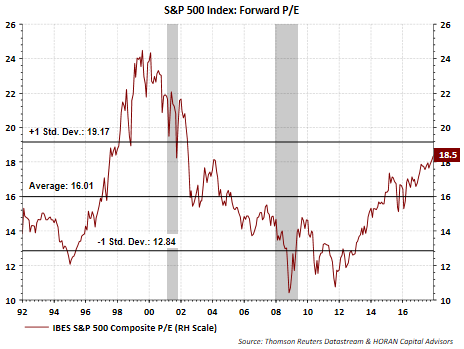
The below chart shows the current market P/E where the earnings are based on the 12-month forward earnings estimate supplied by I/B/E/S. Certainly the P/E is elevated at near a +1 standard deviation level, still the current P/E is quite a bit lower than the technology bubble valuation peak of near 25 times earnings.


Overall earnings growth will be important for the equity market to generate respectable returns in 2018. With passage of a tax reform package nearing realization, companies will benefit from the decline in the maximum corporate tax rate. As an example, tonight FedEx (FDX) reported earnings and noted in the conference call that a lower tax rate will add $.85 to $1.00 to per share earnings. This represents an earnings boost of 8% based on currently expected May 2018 earnings of $12.45 per share. What the tax bill does for many companies is provide an earnings benefit that will result in a reset of the market's valuation to a lower level. The result is the market's valuation is closer to its long run average of 16 to 17 times earnings.

Disclosure: Long FDX


Thursday, December 14, 2017

A Spike Higher In Bullish Investor Sentiment

Today the American Association of Individual Investors reported results of their Sentiment Survey for the week ending 12/13/2017. The report shows individual investor bullish sentiment jumped 8.1 percentage points to 45.0%. 


Most of the jump in bullish sentiment was a result of a 6.1 percentage point decline in bearish sentiment. This has resulted in the bull/bear spread widening to 16.9%, the third widest spread in 2017.


As I have noted in prior sentiment updates, the survey results can be volatile and the 8 period moving average removes the weekly volatility. Additionally, the sentiment measures are contrarian ones and are most useful when they are at their extremes. The current report is not at an extreme level; however, it is elevated and worth paying attention to as the market continues to move higher and exhibit a low level of volatility.


Tuesday, December 12, 2017

A Continued Surge In Small Business And Consumer Optimism

Sentiment for both consumers and small businesses continues to soar. Today the NFIB Small Business Optimism Index was reported at 107.5. I highlighted the surge in consumer sentiment at the end of November.


NFIB notes in its report,
"Not since the roaring Reagan economy has small business optimism been as high as it was in November, according to the National Federation of Independent Business (NFIB) Index of Small Business Optimism, released today." 
“We haven’t seen this kind of optimism in 34 years, and we’ve seen it only once in the 44 years that NFIB has been conducting this research,” said NFIB President and CEO Juanita Duggan. “Small business owners are exuberant about the economy, and they are ready to lead the U.S. economy in a period of robust growth.”
The report also indicates the current reading for November is the second highest reading in the 44-year history of the Index. Some highlights in the report:
  • Job Creation plans increased six points last month, providing more evidence of a strong labor market.
  • The number of owners who said it’s a Good Time to Expand rose four points.
  • Inventory Plans increased by three points.
  • Inventory Satisfaction increased by three points and,
  • Actual Earnings Trend moved up two points.
The significant improvement in sentiment, especially in business sentiment, has been a common theme for the last year. NFIB's report on December 2016 small business optimism saw one of the Index's largest increases. Below is a chart tracking the market's performance since NFIB's last five highest readings from December of last year. This year's market return has been the strongest.


Sentiment is an important part of investing psychology. With both consumer and small business expressing high levels of optimism, it is not surprising equity returns have been as strong as they have been this year.


Sunday, December 10, 2017

Earnings, Not Multiple Expansion, The Key To Favorable 2018 Equity Returns

It seems like an eternity since the S&P 500 Index experienced a pullback of more than 5%. In fact, the last greater than 5% pullback occurred over a year ago during the period of June 8, 2016 to June 27, 2016. This lack of downside volatility has taken place during a nearly uninterrupted increase in the market that began in February last year. Additionally, the market advance since the end of the financial crisis looks remarkable as well. Little or no downside volatility might be understandable if the equity markets were trading sideways this entire time; however, that has not been the case as can be seen below.