Sunday, November 25, 2012

Retailers Open Thanksgiving To Counteract E-commerce Sales

A significant reason retailers opened their doors on Thanksgiving was an attempt to limit the impact of online sales on that day. ComScore reported e-commerce sales increased 32% YOY to $633 million on Thanksgiving. E-commerce sales on Black Friday increased 26% YOY to $1.042 billion, the first time surpassing the one billion dollar mark.

From The Blog of HORAN Capital Advisors

Bricks and mortar retailers had a respectable showing in the sites most visted by online consumers.

From The Blog of HORAN Capital Advisors

Source:

Black Friday Billion: Kick-Off to Brick-and-Mortar Shopping Season
Surges Past $1 Billion in E-Commerce Spending for the First Time

comScore
November 25, 2012
http://tinyurl.com/cn9xhhf


Saturday, November 24, 2012

A Buyback Strategy Does Outperform

In this week's Barron's an article, Beware the Buyback ETF Strategy ($), appears stating "there's precious little evidence that share repurchases do much for long-term investors." In fact, this could not be further from the truth. One of the more popular buyback ETFs is the PowerShares Buyback Achievers Portfolio (ticker-PKW.) I have written articles on this index as recently as October of last year. In that article, Companies Buying Back Shares Are Outperforming, the buyback index was significantly outperforming the broader market. Year to date, the Buyback Index is only slightly trailng the S&P 500 Index, 11.46% versus 12.05%, respectively. A large part of this minor underperformance is the absence of Apple (AAPL) in the buyback index.

From The Blog of HORAN Capital Advisors

On a 2-year basis though, the buyback index is up 26.80% versus the S&P 500 Index return of 19.35%.

From The Blog of HORAN Capital Advisors

In addition to the buyback index outperforming over longer periods than a year, the buyback index is less volatile. The 3-year standard deviation of PKW is 14.37% versus the S&P 500 Index standard deviation of 15.54%. Additionally, the buyback index experienced a smaller maximum drawdown in all time periods for 1, 3 and 5 years as of 10/31/2012.

For investors then, if you are allocating dollars based on a long term strategy, focusing on companies that buyback their stock might be a rewarding one.


Friday, November 23, 2012

The Challenge: Finding A Balanced Solution To The Fiscal Cliff

Since November 15th the S&P 500 Index has managed to gain over 4% in spite of the rhetoric surrounding the consequences of going over the fiscal cliff. Finding a "balanced" solution to the budget issues in Washington is more than a near term issue. As the below chart shows, total credit market debt to GDP has been on an increasingly higher growth trajectory. A contributor to this debt increase is the growth in debt at the U.S. government level due to the significant budget deficit from year to year. Additionally, the economy continues to grow a rate a that is below its long term trend potential.

From The Blog of HORAN Capital Advisors

USA Today reported recently that the deficit in 2011 would actual total $5 trillion if standard accounting rules were utilized by the government.

From The Blog of HORAN Capital Advisors

The point in noting the aforementioned data is a balanced approach to closing the deficit is a must. It is fine to focus on revenue on the on hand; however, the revenue increase must consider a structure that also creates an environment where the economy is likely to grow. Simply raising taxes, and thinking that is the answer to growing revenue, is sure to tip the economy into a recession.

From The Blog of HORAN Capital Advisors

The below table provides market performance data during past time periods when the capital gains tax rate was increased. One of the tax changes that will go into effect if Washington goes over the fiscal cliff is a higher capital gains tax rate. The table was reproduced from a recent market comment by Liz Ann Sonders, Chief Investment Strategist for Charles Schwab & Co. She notes the mixed market results that occurred when capital gain tax rates were increased. However, she goes on to note, "but looking more closely, you can see that the capital gains tax hike in 1986 was met with very strong market performance. Why? Because it was part of President Ronald Reagan's bipartisan tax reform, which slashed marginal and corporate tax rates while also eliminating many deductions. I hope our policy-makers heed the message of this particular history."

From The Blog of HORAN Capital Advisors

The important takeaway from the above table is the necessity to craft a budget solution that includes components that are conducive to economic growth.

H/T: The thoughts behind a portion of this article were gleaned from an article on Zero Hedge.


Thursday, November 22, 2012

U. S. Government Spending Growth Nearly Always Positive (Updated)

It goes without saying the most cited market topic every day of late, but I will mention it anyway, is the discussion about the fiscal cliff. The anticipated negative impact on the economy, and hence the market, of going over the cliff is significant. At the end of the day Congress and the administration in Washington, D.C. need to address the mismatch between revenue and expenses of the federal government. The stumbling block at the moment seems to be what additional revenue sources will be on the table. However, as the below chart details, no matter what the increase in revenue [growth] taken in by the government, expenses [growth is] always [positive] grow at a faster percentage rate. The consequence is the budget deficit never rarely closes and government debt continues to increase. A primary reason the deficit does not close is Washington's definition of expense cuts is simply a lower "growth rate" of spending. Only in Washington does this type of math seem logical. [revised chart]

From The Blog of HORAN Capital Advisors


Sunday, November 18, 2012

New Healthcare Law: Higher Employee Turnover And Reduced Company Stock Returns?

One aspect of the new healthcare law (The Patient Protection and Affordable Care Act (PPACA)), and commonly called Obamacare, is the requirement that employers with more than 50 employees must provide healthcare to those employees working more than 30 hours per week. A number of companies, especially in the retail and fast food industries, have stated they will reduce employee hours to below 30 hours per week in order not to be required to provide healthcare to the employee as required under the new law. A potential consequence is companies might see higher levels of employee turnover.

As the below chart shows, companies that do have higher turnover rates tend to have lower equity returns. Investors will want to monitor a company's employee turnover in the event higher turnover rates do begin to negatively impact company profitability and hence the company's stock performance.

From The Blog of HORAN Capital Advisors


Many Believe Market Is Oversold So What Will Happen

In reading a number of strategists' take on the current market technicals, it seems many believe the market is oversold and due for a bounce.
 Updated: 11/18/2012 3:43pm
As Tiho Brkan notes on his website, The Short Side of Long, "when it is obvious to the public, it is obviously wrong." As the below chart shows, the University of Michigan Sentiment indicator appears to indicate a pretty positive sentiment level.

From The Blog of HORAN Capital Advisors

The American Association of Individual Investors sentiment release this past week saw a significant decline in investor bullish sentiment. The bullishness level fell 9.68 percentage points to 28.82%. The bull bear spread came in at -20 versus the prior week spread of -1.4. It should be noted this contrary indicator tends to be most accurate at extremes and it is not uncommon for a bottom market to turn when the bullishness level falls to the low 20's or even into the teens as one can see in the below chart.

From The Blog of HORAN Capital Advisors

Certainly, the market can bounce in the short run. The below chart of the S&P 500 Index includes the percentage of stocks selling above their 50 day moving average and currently stands at 23%.

From The Blog of HORAN Capital Advisors

I do believe the market could see a bounce short term; however, resistance will likely be reached at S&P 1,382, which is the 200 day moving average for the index. In Tiho's recent article, and well worth reading he notes, "despite a decently strong sell off, Investor Intelligence proportion of bearish advisors has not risen meaningfully. From intra day high of 1474 towards intra day low of 1343, [the] S&P 500 has lost almost 10% and yet it is difficult to find a true bear out there. Various market participants continue to talk about bottoms and buying opportunities, neglecting deterioration in growth and earnings discussed above."

In this enviroment, investors should focus on high quality companies that have the ability to grow their earnings in spite of near term economic and political uncertainties. It is the political uncertainties in the U.S. and the euro zone that may be weighing most on the markets at this time. If Congress some how agrees to a solution that avoids the fiscal cliff, that is more than kicking the can down the road again, the market would likely respond quite favorably.


Monday, November 12, 2012

Fiscal Cliff Tax Impact By State

The Tax Foundation released a report today showing the tax impact on a median four person family for each state if Congress and the President allow the country to go over the so-called "fiscal cliff." New Jersey would see the largest tax increase of $6,933 or 6.82% on median family income of $101,682. The smallest tax increase would be experienced by the state of Washington at $3,362 of 4.12% on median family income of $81,582. The Tax Foundation's report, How Would the Fiscal Cliff Affect Typical Families in Each State?, is insightful and well worth the read. Given consumers account for 70% of economic activity, this level of tax increase would undoubtedly be contractionary to the economy's growth.

From The Blog of HORAN Capital Advisors


Equity Put/Call Ratio On The Rise

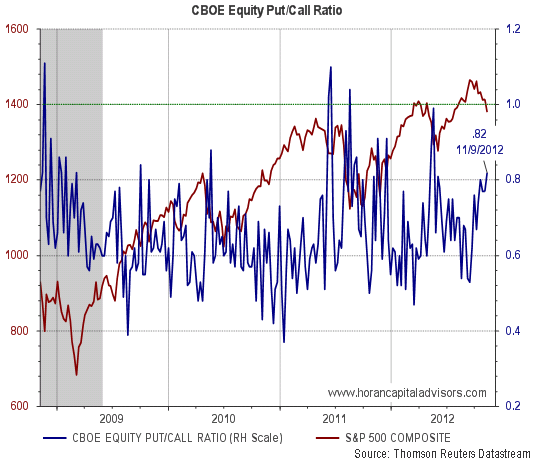
The equity put/call ratio has been in an uptrend since mid September when the put/call ratio fell to .53. Not too coincidentally the S&P 500 Index hit 1,465, the high for the year. As noted in May's prior post, Equity Put/Call Ratio Approaching 1.0:
"The equity P/C ratio tends to measure the sentiment of the individual investor by dividing put volume by call volume. At the extremes, this particular measure is a contrarian one; hence, P/C ratios above 1.0 signal overly bearish sentiment from the individual investor. This indicator's average over the last 5-years is approximately .7, indicating the individual investor has been generally mostly bullish and more active on the call volume side"
As noted in the below chart, the market has a history of reversing itself at levels above .80.

From The Blog of HORAN Capital

Advisors


Saturday, November 10, 2012

QE3 Not Positive For "Risk On" Asset Class Performance

As the below chart shows, QE3 has not had the positive impact on "risk on" asset price performance since its implementation unlike in prior QEs.

From The Blog of HORAN Capital Advisors
Just looking at prior QE's impact on the S&P 500, the following chart does show the positive impact on the index. However, each successive QE/Twist program has been less effective.

From The Blog of HORAN Capital Advisors
Source: Schwab


Thursday, November 08, 2012

Recession Risk Rising

An interesting post has been published by Political Calculations noting the rise in the recession risk indicator. Additionally, the article notes other factors, specifically, dividend cuts, that are signaling increased risk of a recession in the U.S.

From The Blog of HORAN Capital Advisors

As noted in the post, The Reformed Broker's Joshua Brown states:
"Do you see the percentages on the left side of the chart? 20% is the line in the sand. We've never hit that level and NOT had a recession. In 2006 we got close (18%?) but that particular Great Recession would be a year and half in the making. Note that we're back at that 20% line again. And I can't think of anything that keeps the leading indicators from going through it to the upside - the Fiscal Cliff stuff could only speed its ascent"

H/T: Political Calculations


Wednesday, November 07, 2012

Election Is Over But More Uncertainty Ahead

What surprises me the most on this day after the election is the outpouring of advice pundits are freely offering to President Obama on how to deal with the current state of our economy. Following are just a few comments from today.
I surmise many pundits feel compelled to offer their advice to the President since they likely believe they did not hear concrete and credible solutions to dealing with the country's current fiscal predicament during the campaign leading up to Tuesday's election. This seems hard to believe since the two candidates spent over $1.6 billion on this election. In hindsight, the voters have told Governor Romney they did not hear or believe his solutions either. This is some of the uncertainty the market is trying to digest. Although the election has come and gone, the uncertainty surrounding the fiscal cliff and debt ceiling debate will likely weigh on the market.

Ignoring the political party divide and looking at the state of our economy from a purely financial perspective, it appears the country is on a very slippery slope. Many individuals in their prime working years will likely not be too impacted from all of this as compared to events that may face our children and grandchildren. As Mohamed El-Erian says in his letter to the President, "For the first time in a very long time, our nation faces the possibility of seeing our children's generation end up worse off than their parents." In short, he is saying living beyond ones means has consequences.

At the end of October the Treasury issued a refunding statement and noted in the statement's last paragraph, "Treasury continues to expect the debt limit to be reached near the end of 2012." The debt ceiling has been reached again after it was just increased on August 2, 2011, when President Obama signed a deal he had negotiated with congressional leaders to increase the debt limit of the federal government by $2.4 trillion. But now, after only 15 months, almost all of that additional borrowing authority has been exhausted. The government has taken on an additional $2.4 trillion dollars in debt in just over a year. This is not a sustainable path to go down as a country.

The consequences of the the U.S. government's continued printing of money to support deficit spending, I believe, may very well be low or stagnant economic activity and higher unemployment. In the end though, investors will be able to make money in this environment, but it will be more difficult. As Warren Buffett once said though, "Be fearful when others are greedy and greedy when others are fearful." The foreseeable future may be a time where investors can really take advantage of this contrarian sentiment investment advice.


Saturday, November 03, 2012

Job Creation Versus Growth In Food Stamp Rolls

No matter what your political affiliation, the significant growth in food stamp rolls versus little new job creation since January 2009 is an unsettling data point in the weak U.S. economic recovery.

From The Blog of HORAN Capital Advisors

As noted in a recent Weekly Standard article:
  • "In January 2009, there were 133.56 million Americans with jobs and 31.98 million on food stamps. Today, there are 133.76 million Americans with jobs and 46.68 million on food stamps. The employment rolls have thus grown by 0.15 percent and the food stamp rolls have grown by 46 percent, meaning that for every one American who found a job, 75 Americans signed up for food stamps.
  • Total spending on food stamps is now more than $80 billion annually, a fourfold increase from 2001. Total spending on federal means-tested welfare—food stamps, public housing, social services, cash aid, etc.—is now approximately $1 trillion. That amount is enough, if converted to cash, to send every household beneath the federal poverty line an annual check for $60,000."
As noted in an article I published earlier this week, U.S. Federal Budget At Critical Juncture, the growth in entitlements is on an unsustainable path. Stronger economic growth and more fiscal discipline in Washington is necessary to reverse the U.S. deficit growth.


Thursday, November 01, 2012

U.S. Federal Budget At Critical Juncture

The title of this post is a little misleading since Congress hasn't passed a federal budget in over three years. Nonetheless, one is able to gain insight into the actual revenue and expenses going into and out of Washington and it is not positive.

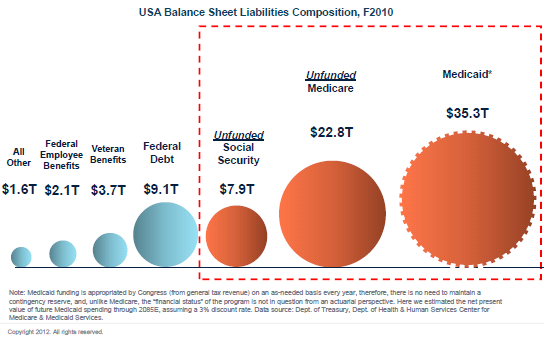
A recent presentation by Mary Meeker, general partner at Kleiner Perkins Caufield & Byers, at the Ira Sohn Foundation Conference titled USA, Inc, provides detail on the out of balance nature of the federal government's budget. Some highlights from her presentation:
  • Expenses exceed revenue.


The entire USA, Inc presentation is a worthwhile and eyeopening read.

h/t: Dealbook: New York Times


Sunday, October 28, 2012

Apple: Anticipated Future Price Action

An article written by Ali Meshkati on his Zenpenny site provides his take on the potential price action for Apple (AAPL) in the coming weeks. He notes:
"10-28-12: The best case scenario with AAPL going forward is a period of sideways chop. Those highs at $700 won't be challenged for some time. The low created on Friday will likely be broken within the next few weeks, following a move up to $630 - $640 to convince the convincible that the iPhone 6 & 7 mean a $1,000 stock price in the near future.

The path that AAPL is likely to take has been revealed in the not to distant past. Check out box A. A high volume reversal that resulted in a gap and eventual failure.

While I don't expect a gap up here, I expect a retrace of a portion of the recent losses that should give AAPL enough new blood to make heads roll in the weeks ahead.

$520 - $550 remain the likely target for a solid buy point."
(click chart to enlarge)
From The Blog of HORAN Capital Advisors
Source: Zenpenny


HORAN Begins Financial Planning Blog

A few days ago, HORAN's Director of Financial Planning, Michael Napier, joined the blogosphere by starting HORAN's financial planning blog. As Michael notes in his initial post,

"Everybody blogs. In fact, it is estimated that close to 44 million blogs are created each year. Doing the math, that is nearly one new blog per second! So why am I jumping into the blogosphere? To help you get one step closer to achieving your financial goals in easy-to-understand language.

Two of the biggest challenges facing Americans today are access to great health care and the discipline to sustain wealth management strategies such as making smart decisions about investing and wealth transfer. My focus will primarily be sharing topics I come across on a daily basis to help your financial life. Strategies in tax- savings, estate planning, college savings, budgeting, insurance and retirement will be discussed."
Subsequent to the initial post, he wrote two articles readers will find of interest.

The RSS Feed for all of the HORAN blogs can be found here: HORAN RSS Blog Feed


P/E Level For S&P 500 Index At Level Not Seen Since 1990s

The Chart of the Day charting service recently noted the valuation or P/E for the S&P 500 Index is at levels last seen in the early 1990s. Importantly for investors though is valuation alone does not make a particular equity attractive. As the below chart notes, valuations can certainly get cheaper. Chart of the Day noted in the commentary to the below chart:
"[The] chart illustrates the price to earnings ratio (PE ratio) from 1900 to present. Generally speaking, when the PE ratio is high, stocks are considered to be expensive. When the PE ratio is low, stocks are considered to be inexpensive. From 1900 into the mid-1990s, the PE ratio tended to peak in the low to mid-20s (red line) and trough somewhere around seven (green line). The price investors were willing to pay for a dollar of earnings increased during the dot-com boom (late 1990s), surged even higher during the dot-com bust (early 2000s), and spiked to extraordinary levels during the financial crisis (late 2000s). Since the early 2000s, the PE ratio has been trending lower with the very significant but relatively brief exception that was the financial crisis. More recently, the PE ratio has moved slightly higher. It is worth noting, however, that even with this recent uptick, the PE ratio still remains at a level not often seen since 1990."
From The Blog of HORAN Capital Advisors


Saturday, October 27, 2012

Companies Becoming More Cautious As Fiscal Cliff Nears

Much is being made about the impact on the economy in light of the impending "fiscal cliff" in the U.S. Most strategists agree the impact on the economy will be significantly contractionary if the U.S. goes over this so-called cliff. In reality though, the negative impact of the cliff is already being felt and it appears businesses are positioning themselves for a potential worst case outcome.

Over the course of the last week or so, many writers have referenced the chart of manufacturers new orders of capital goods. The below chart contains "new orders ex defense" compared against the S&P 500 Index. As can be seen, this decline in capex spending has been a precursor to a potential recession. The current spending level is certainly flashing a warning. The chart in the article at this link shows capex spending compared to economic growth or GDP. In short, Washington is playing with fire as it relates to the current economy and if there recent actions are an indication, the administration and Congress do not understand how businesses plan and operate. Businesses hate uncertainty.

From The Blog of HORAN Capital Advisors


Sunday, October 21, 2012

Investors Continue To Reduce U.S. Equity Exposure

Investors continue to shun U.S. equity investments as noted in the below chart. In spite of this data most U.S. equity indexes have continued to move higher this year. As we have noted in several earlier posts, it appears investors are allocating increasingly more of their investment assets to fixed income funds. Then what is driving U.S. equity prices higher?

From The Blog of HORAN Capital Advisors

As discussed in our third quarter investor letter, the Federal Reserve's Flow of Funds Z.1 quarterly report, shows corporations had negative net equity issuance of $218 billion in 2011. Currently, net equity issuance is running at an annual rate of negative $259.5 billion through the second quarter of this year. In other words, one reason the equity market continues to move higher is the fact companies are reducing the supply of available equity in the market place. This has been accomplished via stock repurchases. Another factor contributing to negative equity issuance is the increase in the number of corporate acquisitions by publicly traded companies and private equity firms. That being said, if demand for equities stays the same and available equity supply continues to decline, equity prices will trend higher. In 2006 and 2007, net equity issuance was nearly negative $1 trillion which preceded the peak of the market in 2008. Corporations seem to be more confident in buying their own shares than investing in future growth.

Certainly, Q3 earnings reports are anything but stellar. However, the risk/reward of fixed income investments does not seem to favor bond investors at this point in time.


Saturday, October 20, 2012

Steven Romick Interview On WealthTrack: Focusing On High Quality

The below video contains a rare interview with Steven Romick, portfolio manager of the FPA Crescent Fund (FPACX), and Consuelo Mack of WealthTrack. Romick provides insight into his investment approach that includes his current views surrounding his portfolio's current construction. In large part, he is most concerned about the consequences of the money printing that is currently taking place by the monetary authorities around the globe. As he notes, this appears to be a grand experiment that could end in disaster. He believes this is more than "kicking the can down the road", but more like a snowball rolling downhill. As he and others have noted, Ben Bernanke indicated the Fed's current approach is a little like "learning by doing." Not too comforting. From an equity investing perspective, he is focusing on the highest quality companies. He believes with this type of company, it isn't whether they will grow, but more a question of by how much. In his mind, it is more about preparing for the worst and hoping for the best. In spite of his concerns, he believes there is value in high quality global companies.


Thursday, October 18, 2012

Investor Sentiment Near Lows Seen Last Summer

The investor sentiment survey, a contrarian indicator, released today by the American Association of Individual Investors noted the bearish sentiment level increased by 5.7 percentage points to 44.55%. This level of bearishness was last seen this past summer when the S&P was trading in the low 1,300s. Bullish sentiment fell to 28.66%, also at levels seen this past summer. In spite of this level of sentiment negativity, the S&P has continued to move higher. This higher move in the market is typical of a market climbing the proverbial "wall of worry". If companies continue to disappoint on earnings though as they have tonight, the market advance could be nearing an end in the short term.

From The Blog of HORAN Capital Advisors