Sunday, October 28, 2012

Apple: Anticipated Future Price Action

An article written by Ali Meshkati on his Zenpenny site provides his take on the potential price action for Apple (AAPL) in the coming weeks. He notes:
"10-28-12: The best case scenario with AAPL going forward is a period of sideways chop. Those highs at $700 won't be challenged for some time. The low created on Friday will likely be broken within the next few weeks, following a move up to $630 - $640 to convince the convincible that the iPhone 6 & 7 mean a $1,000 stock price in the near future.

The path that AAPL is likely to take has been revealed in the not to distant past. Check out box A. A high volume reversal that resulted in a gap and eventual failure.

While I don't expect a gap up here, I expect a retrace of a portion of the recent losses that should give AAPL enough new blood to make heads roll in the weeks ahead.

$520 - $550 remain the likely target for a solid buy point."
(click chart to enlarge)
From The Blog of HORAN Capital Advisors
Source: Zenpenny


HORAN Begins Financial Planning Blog

A few days ago, HORAN's Director of Financial Planning, Michael Napier, joined the blogosphere by starting HORAN's financial planning blog. As Michael notes in his initial post,

"Everybody blogs. In fact, it is estimated that close to 44 million blogs are created each year. Doing the math, that is nearly one new blog per second! So why am I jumping into the blogosphere? To help you get one step closer to achieving your financial goals in easy-to-understand language.

Two of the biggest challenges facing Americans today are access to great health care and the discipline to sustain wealth management strategies such as making smart decisions about investing and wealth transfer. My focus will primarily be sharing topics I come across on a daily basis to help your financial life. Strategies in tax- savings, estate planning, college savings, budgeting, insurance and retirement will be discussed."
Subsequent to the initial post, he wrote two articles readers will find of interest.

The RSS Feed for all of the HORAN blogs can be found here: HORAN RSS Blog Feed


P/E Level For S&P 500 Index At Level Not Seen Since 1990s

The Chart of the Day charting service recently noted the valuation or P/E for the S&P 500 Index is at levels last seen in the early 1990s. Importantly for investors though is valuation alone does not make a particular equity attractive. As the below chart notes, valuations can certainly get cheaper. Chart of the Day noted in the commentary to the below chart:
"[The] chart illustrates the price to earnings ratio (PE ratio) from 1900 to present. Generally speaking, when the PE ratio is high, stocks are considered to be expensive. When the PE ratio is low, stocks are considered to be inexpensive. From 1900 into the mid-1990s, the PE ratio tended to peak in the low to mid-20s (red line) and trough somewhere around seven (green line). The price investors were willing to pay for a dollar of earnings increased during the dot-com boom (late 1990s), surged even higher during the dot-com bust (early 2000s), and spiked to extraordinary levels during the financial crisis (late 2000s). Since the early 2000s, the PE ratio has been trending lower with the very significant but relatively brief exception that was the financial crisis. More recently, the PE ratio has moved slightly higher. It is worth noting, however, that even with this recent uptick, the PE ratio still remains at a level not often seen since 1990."
From The Blog of HORAN Capital Advisors


Saturday, October 27, 2012

Companies Becoming More Cautious As Fiscal Cliff Nears

Much is being made about the impact on the economy in light of the impending "fiscal cliff" in the U.S. Most strategists agree the impact on the economy will be significantly contractionary if the U.S. goes over this so-called cliff. In reality though, the negative impact of the cliff is already being felt and it appears businesses are positioning themselves for a potential worst case outcome.

Over the course of the last week or so, many writers have referenced the chart of manufacturers new orders of capital goods. The below chart contains "new orders ex defense" compared against the S&P 500 Index. As can be seen, this decline in capex spending has been a precursor to a potential recession. The current spending level is certainly flashing a warning. The chart in the article at this link shows capex spending compared to economic growth or GDP. In short, Washington is playing with fire as it relates to the current economy and if there recent actions are an indication, the administration and Congress do not understand how businesses plan and operate. Businesses hate uncertainty.

From The Blog of HORAN Capital Advisors


Sunday, October 21, 2012

Investors Continue To Reduce U.S. Equity Exposure

Investors continue to shun U.S. equity investments as noted in the below chart. In spite of this data most U.S. equity indexes have continued to move higher this year. As we have noted in several earlier posts, it appears investors are allocating increasingly more of their investment assets to fixed income funds. Then what is driving U.S. equity prices higher?

From The Blog of HORAN Capital Advisors

As discussed in our third quarter investor letter, the Federal Reserve's Flow of Funds Z.1 quarterly report, shows corporations had negative net equity issuance of $218 billion in 2011. Currently, net equity issuance is running at an annual rate of negative $259.5 billion through the second quarter of this year. In other words, one reason the equity market continues to move higher is the fact companies are reducing the supply of available equity in the market place. This has been accomplished via stock repurchases. Another factor contributing to negative equity issuance is the increase in the number of corporate acquisitions by publicly traded companies and private equity firms. That being said, if demand for equities stays the same and available equity supply continues to decline, equity prices will trend higher. In 2006 and 2007, net equity issuance was nearly negative $1 trillion which preceded the peak of the market in 2008. Corporations seem to be more confident in buying their own shares than investing in future growth.

Certainly, Q3 earnings reports are anything but stellar. However, the risk/reward of fixed income investments does not seem to favor bond investors at this point in time.


Saturday, October 20, 2012

Steven Romick Interview On WealthTrack: Focusing On High Quality

The below video contains a rare interview with Steven Romick, portfolio manager of the FPA Crescent Fund (FPACX), and Consuelo Mack of WealthTrack. Romick provides insight into his investment approach that includes his current views surrounding his portfolio's current construction. In large part, he is most concerned about the consequences of the money printing that is currently taking place by the monetary authorities around the globe. As he notes, this appears to be a grand experiment that could end in disaster. He believes this is more than "kicking the can down the road", but more like a snowball rolling downhill. As he and others have noted, Ben Bernanke indicated the Fed's current approach is a little like "learning by doing." Not too comforting. From an equity investing perspective, he is focusing on the highest quality companies. He believes with this type of company, it isn't whether they will grow, but more a question of by how much. In his mind, it is more about preparing for the worst and hoping for the best. In spite of his concerns, he believes there is value in high quality global companies.


Thursday, October 18, 2012

Investor Sentiment Near Lows Seen Last Summer

The investor sentiment survey, a contrarian indicator, released today by the American Association of Individual Investors noted the bearish sentiment level increased by 5.7 percentage points to 44.55%. This level of bearishness was last seen this past summer when the S&P was trading in the low 1,300s. Bullish sentiment fell to 28.66%, also at levels seen this past summer. In spite of this level of sentiment negativity, the S&P has continued to move higher. This higher move in the market is typical of a market climbing the proverbial "wall of worry". If companies continue to disappoint on earnings though as they have tonight, the market advance could be nearing an end in the short term.

From The Blog of HORAN Capital Advisors


Tuesday, October 16, 2012

Investor Letter: 3rd Quarter 2012

At the beginning of the third quarter, investors following the “sell in May” strategy felt vindicated as the S&P 500 Index declined over 9.0% from May 1st to June 4th. The June 4th date turned out to be the intra-year market low and the equity rally was almost uninhibited throughout the remainder of the third quarter. The rising tide seemed to lift all markets during the quarter.

As noted in our Third Quarter Investor Letter, in spite of the strong market advance, the Federal Reserve felt compelled to institute a third round of quantitative easing (QE3)in the third quarter. Maintaining loose monetary policy has not been as effective as the Fed would hope during this household and corporate deleveraging cycle. Companies have been vocal in regard to their greater concern about the future of tax and regulatory policies.

As we look ahead, we are mindful of near term potential risks, i.e., the U.S. fiscal cliff, Europe struggling with sovereign debt and growth issues, heightened Middle East tension and a more muted outlook for third quarter corporate earnings. We are positioned for a slower economic growth environment. We see some signs for long-term optimism as housing seems to have regained some footing, energy independence is increasingly possible and the repatriation of U.S. jobs is gaining traction. Longer term we continue to believe equities will be a strong performing asset class supported by compelling long term valuations.

The entire Letter can be accessed directly from our website at the following link: 3rd Quarter 2012 Investor Letter.


Monday, October 08, 2012

More Weakness Seen With Modern Portfolio Theory

Niels Jensen's, of Absolute Return Partners, market letter to investors notes how Modern Portfolio Theory (MPT) has become less effective over time. Over the past few years we have written several posts (here and here) on the problems with MPT. One chart in the Jensen's market letter displays the increasing correlation between asset classes that has developed since 2000 thus limiting the effectiveness of diversification as outlined in Modern Portfolio Theory.

From The Blog of HORAN Capital Advisors

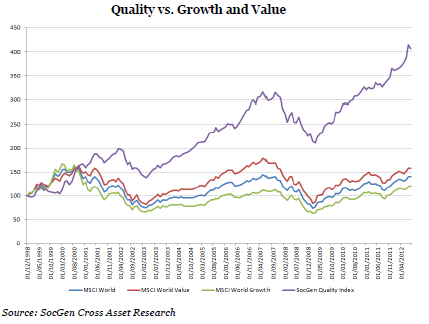
Additionally, the market letter notes the outperformance of "quality" stocks versus say growth or value. As the letter states, quality refers to the strength of a company's balance sheet as well as the sustainability of its dividend policy.

From The Blog of HORAN Capital Advisors

A key for investors is to understand the approach taken by their investment manager in constructing their investment portfolio.

Source:

When Career Risk Reigns (PDF)
Absolute Return Partners LLP
By: Niels J. Jensen
October 2012
http://www.arpllp.com/core_files/The_Absolute_Return_Letter_1012.pdf


Sunday, October 07, 2012

Weak CEO Confidence, Weaker Market Ahead?

Last week The Conference Board released its CEO Confidence Measure and noted a decline to 42 in the third quarter versus 47 in Q2. A reading below 50 reflects more negative responses than positive ones. The report notes a third of the CEO's surveyed indicated they were curtailing capital spending plans. Lynn Franco, Director of Economic Indicators at The Conference Board noted,
"This latest report reflects ongoing concern about the strength of the economy. CEOs’ assessment of current conditions remains weak and they have grown increasingly pessimistic about the short-term outlook. Sluggish growth and a persistent cloud of uncertainty have played a role in CEOs curtailing spending plans this year.”
Historically, when this Measure reached this level of pessimism, the equity market was not too far from a near term peak.

From The Blog of HORAN Capital Advisors


Saturday, October 06, 2012

Dividend Payments Increase In Third Quarter

In a report recently released by Standard & Poor's, they note more companies increased their dividend payments in the third quarter versus the same quarter last year. The number of positive actions (439) equals the number in Q3 2007. The report notes:
"...dividend net increases (increases less decreases) were $8.8 billion in the third quarter of 2012, setting what is believed to be a new record dividend quarterly payout in aggregate dollars for U.S. domestic listed common stock issues..."
From The Blog of HORAN Capital Advisors
 Data Source: Standard & Poor's

As we will discuss in our soon to be released third quarter investor letter, investors have been searching for yield, especially retired investors, and have sought out dividend paying stocks. If Congress allows the budget to go over the so called fiscal cliff, retired investors will be harmed significantly due to the tax increase on dividends.The Sober Look website notes beginning in 2013, the U.S. will have the highest top dividend tax rate in the world if the tax increases subject to the fiscal cliff go into effect.

From The Blog of HORAN Capital Advisors


Sunday, September 23, 2012

Food Stamp Participation Versus Labor Force Participation

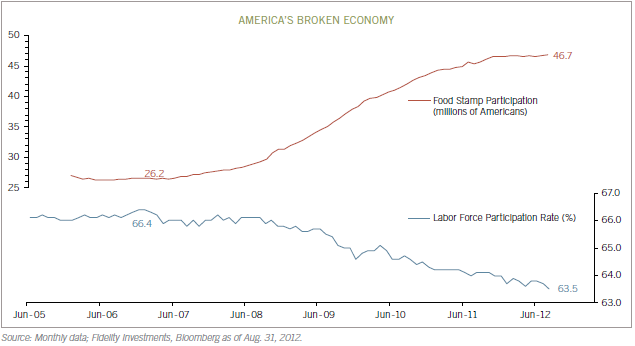
Central banks around the world are doing all they can to pump liquidity into their respective economies. To date though, their actions are having limited effectiveness when it comes to improving economic growth. One consequence of the slow growth in the U.S. is the dramatic increase in food stamp usage. The increased food stamp usage also seems to translate into a lower labor force participation rate as well.

From The Blog of HORAN Capital Advisors

Source:

Boxing Match: Central Banks vs. the Economy
Fidelity Viewpoints
By: Jurrien Timmer, Portfolio Manager
September 16, 2012
https://news.fidelity.com/news/article.jhtml?guid=/FidelityNewsPage/pages/fidelity-central-banks-vs-the-economy&topic=economy


Saturday, September 22, 2012

Private Fixed Investment Signaling A Recession?

An article from three months ago on the SentimentCharts website noted the slowing YOY change in Private Fixed Investment (FPI) had signaled all seven U.S. recession over the last 45 years. The data used in the SentimentCharts' article was through the first quarter of the year and an increase in the growth of FPI was seen. One quarter later though, through the second quarter, the YOY growth in FPI is slowing.

From The Blog of HORAN Capital Advisors

Private Fixed Investment is an element that goes into the calculation of GDP. In the BEA's second release of second quarter GDP, they noted weakness in fixed investment as a cause for the deceleration of Q2 GDP.
"The deceleration in real GDP in the second quarter primarily reflected decelerations in PCE, in nonresidential fixed investment, and in residential fixed investment that were partly offset by a smaller decrease in federal government spending, an acceleration in exports, and a smaller decrease in private inventory investment."
The slowing growth in fixed investment along with a significant increase in the number of companies lowering Q3 earnings guidance are just a couple of factors that should be a cause for concern for investors.


Strong Stock Buyback Activity in Q2

Standard & Poor's recently reported the buyback data for the S&P 500 Index for the second quarter. Noted in their release is buybacks increased 32.5% in Q2 versus Q1. Howard Silverblatt, Senior Index Analyst at S&P Dow Jones Indices noted,
"The last time we have seen this level of activity was during the pre-recession heydays of 2005-2007. While the second quarter produced a broad decline in the equity markets, companies used the quarter to increase holdings, reduce share counts, and add a tail-wind to their eps during a quarter which set an operating record for profits."
From The Blog of HORAN Capital Advisors
Notable buyback amounts in the quarter were:
  • Johnson & Johnson (JNJ): $12.9 billion
  • AT&T (T): $2.6 billion
  • American International Group (AIG): $2 billion
Investors need to analyze 3Q earnings reports carefully in order to determine the reasons behind potentially higher EPS that may be reported. S&P also noted they are seeing over 80 companies increase buyback activity in Q3. This lower share count will artificially inflate reported EPS. Reviewing a companies absolute earnings should be a focus of investors. Factset recently noted,
"So far, 103 companies in the index have provided guidance for the third quarter. Of those, 80% have guided  below Wall Street consensus estimates, according to John Butters, senior earnings analyst at FactSet. That’s the most negative outlook since FactSet began tracking the figures in the first quarter of 2006."

Disclosure: Long JNJ


Wednesday, September 19, 2012

Transport Company Warnings Not Positive Sign For Global Economic Growth

Over the course of the last two days, both FedEx (FDX) and Norfolk Southern (NSC) have issued significantly lower earnings guidance. In the case of FDX, the warning may be more of a concern given the global nature of their business. Additionally, the link between FedEx package shipments and YOY GDP growth suggests the global economy is experiencing a significant slowdown.

From The Blog of HORAN Capital Advisors

In the case of Norfolk Southern, after today's market close, the company lowered their 3Q earnings guidance to a range of $1.18 - $1.25. This compares to original 3Q guidance of $1.62 and 3q 2011 earnings of $1.59. Not surprisingly, the stock initially fell over 6% in after hours trading to $68 share before recovering to $69 per share. The Wednesday closing price for NSC was $72.69.

From The Blog of HORAN Capital Advisors

A recent Wall Street Journal report tht discussed the FDX earnings revision noted, "It isn't just FedEx. Data gathered by the CPB Netherlands Bureau for Economic Policy Analysis show that global trade volumes grew an unusually low 2.6% in the second quarter compared with a year earlier; the average pace over the past 20 years has been 6.1%. The two major West Coast ports, the ports of Los Angeles and of Long Beach, Calif., reported that outbound container volumes fell by 4.1% in August from a year earlier. That was the steepest drop since September 2009."

The lower earnings guidance by both of these companies and the West Coast port data are indications of slower economic growth, if not growth that is more indicative of a recessionary environment.

Disclosure: Long NSC


Jason Trennert: Short Term Bearish

Jason Trennert, chief investment strategist at Strategas Research Partners, recently discussed his views on the economy and believes the recent economic data is typically associated with an economy that is in a recession. In his Barron's article this week, Long-Term Bull, Short-Term Bear ($), Trennert noted,
"Profit margins are two standard deviations above the mean, and nominal GDP growth of 3.1% in this year's first half was at a level normally associated with a recession."
As he discusses in the below video, much of the earnings strength seen by companies has come from expense reduction (margin expansion) and not top line revenue growth. He believes current policies coming out of Washington are not growth oriented, the impending fiscal cliff being one such example.


Federal Reserve Dominant Buyer Of Treasuries

An end result of the Federal Reserve's quantitative easing programs, including operation twist, is the Fed's balance sheet has swelled with the growth in U.S. treasury holdings. In 2011, the Fed purchased over 60% of all the treasuries issued by the government. A recent Bloomberg comment notes the Fed now owns over 37% of all treasuries with maturities greater than 5-years.

From The Blog of HORAN Capital Advisors

This is certainly a path that is unsustainable before reaching a tipping point. In order to continue down this path, the dollar printing press will need to run at full speed with an end result a further weakening of the U.S Dollar and consequent higher inflation.


Sunday, September 16, 2012

Dow's Recent Advance Below Average In Duration And Magnitude

Even with all the Fed's intervention and their attempt to force investors into risk assets, The Chart of the Day's recent market chart notes the current rally is both below average in duration and magnitude.

"The Dow made another post-financial crisis rally high Thursday on the news that the Fed will embark on a third round of quantitative easing (a.k.a. QE3). To provide some perspective on the current Dow rally, all major market rallies of the last 112 years are plotted on today's chart. Each dot represents a major stock market rally as measured by the Dow -- with a rally being defined as an advance that followed a 15% correction (i.e. a major correction). As today's chart illustrates, the Dow has begun a major rally 28 times over the past 112 years which equates to an average of one rally every four years. Also, most major rallies (78%) resulted in a gain of between 30% and 150% (29.8% to 150.5% to be exact) and lasted between 200 and 800 trading days (9.5 months to 3.2 years) -- highlighted in today's chart with a light blue shaded box. As it stands right now, the current Dow rally (hollow red dot labeled you are here) which began in October 2011 (since it followed a 16.8% correction), would be classified as well below average in both duration and magnitude."
From The Blog of HORAN Capital Advisors


Saturday, September 15, 2012

Jeffrey Gundlach: I Doubt You're Going To See Lost Decade In Equities

Fixed income manager, Jeffry Gundlach, sat down for an interview on Bloomberg recently. In the interview he discusses the risk that has developed in the bond market, specifically in treasuries. His firm DoubleLine, is considering expanding into equity fund management as well.


h/t: Abnormal Returns


Wednesday, September 12, 2012

Revenue And Earnings Growth Continue To Slow

One of the services provided by Thomson Reuters (TRI) is they aggregate financial data from analyst. TRI recently updated/aggregated all the analyst data as it relates to earnings and revenues for the S&P 500 Index companies for the third quarter. TRI notes:
"...companies in the S&P 500 are likely to post the slowest annual revenue growth rate [for Q3] in the last decade (barring the 2008/2009 financial crisis) and the trend seems to be getting worse, with more disappointments in store."
From The Blog of HORAN Capital Advisors

In order for companies to continue achieving earnings growth, they have focused on the cost side of their business. Unfortunately, companies can only cut costs for so long before this avenue to increase earnings comes to an end. Well, this reality may be setting in for Q3 2012 earnings. As the below chart details, Q3 earnings are expected to decline by 2.0%. It is likely, Q4 earnings are revised lower as well. The second chart shows the trend in fourth quarter earnings growth.

From The Blog of HORAN Capital Advisors

From The Blog of HORAN Capital Advisors

TRI discusses the potential consequences of this slowdown in the below video.


Source:

Idea of the Week: Analysts Cutting Their Q3 Revenue Forecasts
Thomson Reuters: Alpha Now
By: John Kozey
September 12, 2012
http://alphanow.thomsonreuters.com/2012/09/idea-of-the-week-analysts-cutting-their-q3-revenue-forecasts/

Disclosure: our firm is long TRI