Friday, March 30, 2012

Buybacks Decline Along With Earnings In Q4 2011

Standard & Poor's fourth quarter 2011 preliminary buyback report for the S&P 500 Index shows buybacks declined in Q4 along with reported earnings. Preliminary earnings were reported at $186.76 in Q4 2011 versus $206.08 in Q3 2011 and $187.67 billion in Q4 2010, while buybacks declined to $91.46 billion versus $118.41 billion in the prior quarter.

From The Blog of HORAN Capital Advisors

S&P's Howard Silverblatt, Senior Index Analyst, notes,
“Companies appear to have finally gotten it right with average share prices declining 14.3% during the third quarter of 2011, companies poured $118 billion into stock buybacks (the most since the heydays of 2007), buying back shares at reduced prices. With depressed prices, companies were able to scoop up additional shares, which reduced the number needed for year-end employee options. In the fourth quarter, with share prices increasing an average of 11.2%, they pulled back.”
I would agree with S&P that it is better for companies to buyback shares at the lower prices reached in Q3 last year. However, this buyback volume can distort reported earnings per share and mask weakness in earnings growth. With fewer shares, earnings growth on a per share basis will be higher than actual corporate earnings growth. Bloomberg reports, the buyback activity reduced Standard & Poor’s 500 Index divisor, a measure of outstanding shares, by 0.6 percent last quarter, the first drop since March 2009.

From The Blog of HORAN Capital Advisors


Sunday, March 25, 2012

The Number Of Dividend Payers In S&P 500 Index At 12-Year High

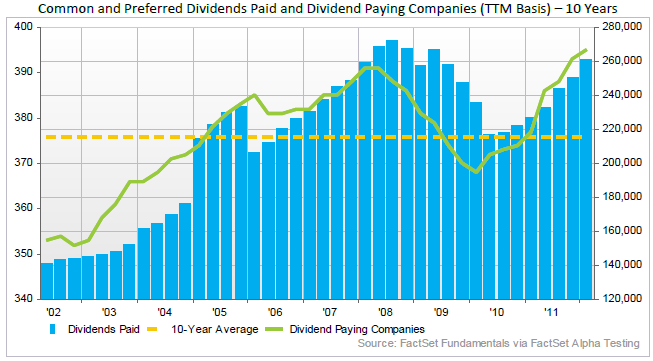
In a dividend report released by Factset this past Friday, it is noted the number of dividend paying companies in the S&P 500 Index has reached a 12-year high. The report notes,
"The number of dividend-paying companies was 393 at the end of Q4 2011 (January 2012), which marks a 12-year high. Aggregate quarterly dividend payments amounted to $260.8 billion over the trailing twelve months. On a per-share basis, the aggregate figure was $26.78 per share, reflecting year-over-year growth of 16.1%. The Financials, Materials, and Information Technology sectors led all sectors in year-over-year growth on a per-share basis (40.0%, 28.4%, and 23.5%, respectively)."
From The Blog of HORAN Capital Advisors

Interestingly, a majority (53.5%) of the companies in the technology sector now pay a dividend. This is up from only 17.9% in July of 2002, nearly 10-years ago. Is this a sign the technology sector is maturing?

We believe a primary reason for investors to look at a company's dividend practice is it provides insight into future expected earnings growth. And assuming a company is consistently growing its dividend at say a 10% rate, and all else being equal, that is, not borrowing to sustain the dividend growth rate and the payout ratio is not increasing, then the company's earnings are likely growing 10% as well. Over time the stock price should advance in line with the company's earnings growth rate. I am simplifying the analysis here as investors need to evaluate cash flow, etc. The Factset report, however, notes,
"a back test utilizing FactSet’s Alpha Testing application shows that stocks with the highest five-year compound annual growth rates in earnings per share have outperformed stocks with lower growth rates over fifteen years. However, the results for dividend per share (DPS) growth rates show a different relationship. Dividend paying stocks in the top quartile by DPS growth have underperformed the S&P 500 Total Return Index, while the lower three quartiles outperformed (emphasis added)."
If one removes the financial and health care sector stocks from the analysis, the top quartile dividend growers do exhibit the highest total return.

From The Blog of HORAN Capital Advisors

The negative influences to the health care and financial sector are well know, the housing bubble and heath care reform legislation. So just looking at dividend growth and investing based on this can be treacherous. Investors certainly need to evaluate macro factors that can negatively (or positively) influence a sector or stock's performance.

Companies in the S&P 500 index are now paying dividends at a record level after J.P. Morgan's (JPM) recent dividend announcement. This was noted recently by Howard Silverblatt, S&P's senior index analyst. The below chart is for the period ending 12/31/2011 and includes preferred dividends.

From The Blog of HORAN Capital Advisors

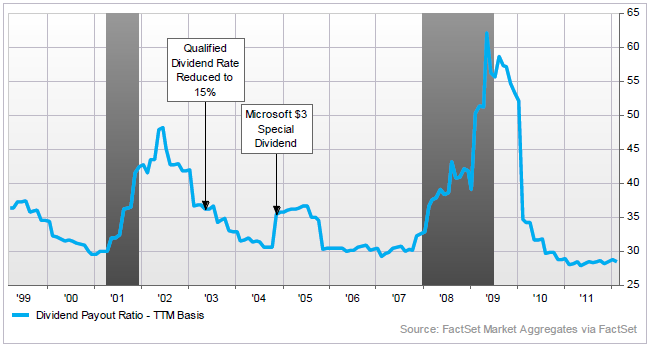
Lastly, given the level of cash on corporate balance sheets, and the still low payout ratio, future dividend growth looks promising.

From The Blog of HORAN Capital Advisors

Certainly, the change in the tax structure for dividend payments might be a headwind as noted in a recent Wall Street Journal article, Will A Dividend Tax Hike Spoil The Party? ($); however, the discipline of using dividend growth in ones stock analysis can be rewarding for even total return investors.

Source:

Factset Dividend Quarterly (PDF)
By: Michael Amenta, Research Analyst, John Butters, Senior Earnings Analyst
March 23, 2012
http://www.factset.com/websitefiles/PDFs/dividend/dividend_3.12/


Monday, March 19, 2012

The Disconnect Between The Economic Data And Sentiment

Recent unemployment data released by the Labor Department continues to indicate the economy is adding 200,000 jobs per month. This has been the case for the last three months. What is interesting about the continued job growth figures is the GDP growth rate is suggesting a much lower rate of job additions. A recent article in the Wall Street Journal, Piecing Together the Job-Picture Puzzle ($), notes the level of job improvement over the last year would indicate the economy is growing at a 4-5% pace. This projection is based on a study by Arthur Okun and is known as Okun's Law. The Fed has opined on Okun's Law and the relationship between output and unemployment. Mish's Global Economic Trend Analysis site highlights a comment from Madeline Schnapp, Director of Macroeconomic Research at TrimTabs Investment Research:
"Something about the U.S. economy isn't adding up.

At 8.3%, the unemployment rate has fallen 0.7 percentage point from a year earlier and is down 1.7 percentage points from a peak of 10% in October 2009. Many other measures of the job market are improving. Companies have expanded payrolls by more than 200,000 a month for the past three months, according to Labor Department data. And the number of people filing claims for government unemployment benefits has fallen.

Yet the economy is barely growing. Many economists in the past few weeks have again reduced their estimates of growth. The economy by many estimates is on track to grow at an annual rate of less than 2% in the first three months of 2012. The economy expanded just 1.7% last year. And since the final months of 2009, when unemployment peaked, the economy has expanded at a pretty paltry 2.5% annual rate.

How can an economy that is growing so slowly produce such big declines in unemployment?

TrimTabs thinks the problem lies in the heavily massaged BLS employment data and the highly suspect BEA personal income data.

That said, withholding tax data is also messy and not a perfect measure either, but no matter what I do with the data, I can't get to 200,000+ jobs unless a huge percentage of the workforce is suddenly working for McDonalds."
Recently, a number of consumer sentiment releases have turned negative. Last week's University of Michigan consumer sentiment index fell to 74.3 versus 75.3 in the prior month. Expectations were for an increase to 76. Additionally, the IBD/TIPP Economic Optimism Index declined to 47.5 versus 49.4 in February. This decline was the the index's first since August of last year. Readings below 50 indicate consumer pessimism. Both sentiment reports highlight gasoline prices as a prime contributor to the weaker sentiment figures.

From The Blog of HORAN Capital Advisors

TechnoMetrica's (TIPP) president, Raghavan Mayur, notes, "There is a basic disconnect between the media and the American public," he said, adding that coverage of the jobs picture has been too positive. "It's like there are two realities in this country. The report noted that 87.2% of those survey in the poll expect gas prices to top $4 over the next three months and 37.1 expect gas prices to reach over $5. It should be noted that all three of the components of the index worsened. The three components consist of:
  • The Six-Month Economic Outlook: a measure of how consumers feel about the economy’s prospects in the next six months.
  • The Personal Financial Outlook: a measure of how Americans feel about their own finances in the next six months.
  • Confidence in Federal Economic Policies: a proprietary IBD/TIPP measure of views on how government economic policies are working.
There certainly seems to be a disconnect from much of the reported economic data versus consumer/business sentiment.


Wednesday, March 14, 2012

Unlocking The Risk Associated With Stock Concentrations

Various techniques are available to investors in order to customize an effective approach to reducing a concentrated investment. Investors must continually evaluate the investment landscape, concentrated position risk, opportunity cost, time horizon and taxable consequence related to concentrated holdings. We recently prepared a report titled, Unlocking Concentrated Risk (PDF), that we feel is timely for investors as the market and individual stock prices have increased significantly since the market lows in September of 2011.


Wednesday, March 07, 2012

Is The Consumer's Financial Condition About To Worsen?

The consumer is the one important key to economic growth as they account for nearly 70% of GDP. Recent data does show consumer balance sheets have been improving based on the Fed's Financial Obligation Ratio.

From The Blog of HORAN Capital Advisors

Even consumer loan charge offs at commercial banks continue to show significant improvement.

From The Blog of HORAN Capital Advisors

The water on the fire though is the fact consumer delinquencies have recently turned higher. Is this a precursor to a less robust consumer spending environment? The fact gasoline prices have been on the rise as well is likely to reduce the cash available to consumers for discretionary spending.

From The Blog of HORAN Capital Advisors


Markets Retrace Significant Amount Of Losses Since Financial Crisis

The Chart of The Day charting service provides a graphic look at the market recovery for various indices since the financial crisis trough in March 2009.
"For some perspective on the post-financial crisis rally, today's chart illustrates how much of the downturn that occurred as a result of the financial crisis has been retraced by each of the five major stock market indexes. For example, the Dow peaked at 14,164.53 back in October 9, 2007 and troughed at 6,547.05 back on March 9, 2009. The most recent close for the Dow is 12,980.30 -- it has retraced 84.5% of its financial crisis bear market decline. As today's chart illustrates, each of these five major stock market indices have retraced over 78% of their financial crisis decline. However, it is the S&P 400 (mid-cap stocks) and the tech-laden Nasdaq that have recouped all the losses incurred during the financial crisis and currently trade higher than their 2007 credit bubble peak."
From The Blog of HORAN Capital Advisors


Monday, March 05, 2012

Risk On Trade Not Kind To Dividend Payers This Year

The dividend paying stocks in the S&P 500 Index have significantly lagged the performance of their non paying counterparts. The payers return in February and YTD have totaled 3.84% and 8.92% respectively. The non-payers on the other hand have generated February and YTD returns of 5.55% and 14.19% respectively.

From The Blog of HORAN Capital Advisors

One could say the market has been in a "risk on" mode this year and at least since the end of September last year. As we discussed this in our 4th Quarter Investor Letter the "risk on" "risk off" trade has been a common discussion item of late. Investors that desire to track the "risk on" and "risk off" cycles of the market are now able to follow the newly issued exchange traded notes with tickers "ONN" and "OFF". As the below charts show, these ETRACS notes came into existence in late 2011. Until the last few trading days, these indexes have shown the market has been mostly in a "risk on" mode. The question becomes whether the "risk off" trade exhibited over the last two to three trading days is one that will be sustained. If so, the dividend payers might regain some of the ground lost to the non-payers.

From The Blog of HORAN Capital Advisors


Saturday, March 03, 2012

Investor Equity Fund Flows Indicate They May Be Late To The Rally

Mutual fund flow data appears to indicate investors have been late to allocate additional funds to equities in spite of the strong equity market advance since the end of September last year. As the blue bar in the below chart indicates, monthly net flows into equity mutual funds has been negative in spite of the continued advance in the market.

From The Blog of HORAN Capital Advisors

The below chart shows the same data with flows accumulated on a rolling one year basis. Historically, when equity flows have been negative, the equity market returns have not been favorable. During this most recent period though, equity returns have been extremely strong in the face of the negative equity fund flows.

From The Blog of HORAN Capital Advisors

Not until this past month have equity fund flows turned positive. The biggest beneficiary of flows though has been fixed and money market funds.

From The Blog of HORAN Capital Advisors
Source: ICI

From The Blog of HORAN Capital Advisors

From a contrarian standpoint, and taking into account only the fund flow data, investors don't seem to have thrown in the towel and piled into equities.Maybe this market continues to climb the proverbial "wall of worry" until we see investors capitulate and plow into equities.


Sunday, February 19, 2012

$4 Gasoline Has Negative Impact On Confidence And Retail Sales

The recent rise in oil prices and subsequent increase to near $4 per gallon for regular unleaded gasoline is likely to negatively impact consumer confidence and retail sales. The below chart shows the negative influence increasing gasoline prices (inverted on chart) has on consumer confidence.

From The Blog of HORAN Capital Advisors

The negative impact on confidence also negatively impacts retail sales when gasoline reaches $4 per gallon. Note, gasoline prices lead retail sales by one month in the below chart.

From The Blog of HORAN Capital Advisors

Lastly, as noted in an earlier post, declining confidence often translates into weaker equity prices.

From The Blog of HORAN Capital Advisors


Saturday, February 11, 2012

Volatile Equity Market Returns

Absent the significant market contraction in 2008/2009, both the Dow and S&P 500 Index have generated decent returns. For investors though, the equity market pullback during the financial crisis period of '08/'09 remains top of mind. As the below tables show, the year over year returns for these two indices have been pretty strong resulting in 3-year annualized returns in the mid-teens. Unfortunately, the significant decline during the financial crisis has resulted in no return over the four and five year time period.

returns 1 31 2012

The Chart of the Day puts this most recent rally in perspective in their below commentary and chart.
"The Dow made another post-financial crisis rally high Thursday as it approached the 13,000 level. To provide some perspective to the current Dow rally that began back in early October 2011, all major market rallies of the last 111 years are plotted on today's chart. Each dot represents a major stock market rally as measured by the Dow. As today's chart illustrates, the Dow has begun a major rally 28 times over the past 111 years which equates to an average of one rally every four years. Also, most major rallies (78%) resulted in a gain of between 30% and 150% (29.8% to 150.5% to be exact) and lasted between 200 and 800 trading days (9.5 months to 3.2 years) -- highlighted in today's chart with a light blue shaded box. As it stands right now, the current Dow rally (hollow blue dot labeled you are here) would be classified as well below average in both duration and magnitude."
dow rallies

At HORAN Capital Advisors, we believe this heightened volatility is likely to represent the return pattern for investors for the foreseeable future. As such we believe it is important for investors to incorporate a high quality portfolio for their core equity investments. Additionally, making use of so called alternative investments that potentially minimizes downside returns is equally important.


Friday, February 10, 2012

Pick Your Strategist/Advisor Carefully

The below chart was provided by the Wall Street Journal courtesy of Doug Kass.

rosenberg roubini sp chart


Wednesday, February 08, 2012

Congress Desires To Eliminate Tax Deferral Option Of Inherited IRAs

In Congress' effort to continue transportation funding, Senate Finance Chairman Max Baucus (D., Mont.) has recommended the bill include a provision limiting the tax deferral options of inherited IRAs unless the IRAs have been converted to a Roth. In simple terms, currently, inherited IRA beneficiaries are able to withdrawal funds over the beneficiary's life expectancy. Beginning in 2013, the proposed legislation would require most non-spouse inheritors of traditional IRAs to withdraw the entire amount from a traditional IRA within five years. There are a few exceptions that are detailed in a recent Forbes article, Congress May Crush Key Tool For IRA Inheritors. The Forbes article notes, "Let’s hope there’s enough of a public outcry that this legislation doesn’t pass. If it does, owners of traditional IRAs will have one more reason to convert them to Roth accounts. The mark up legislation can be viewed at this link (PDF).


Tuesday, February 07, 2012

January A Risk On Month

As we noted in our fourth quarter investor letter, the new phrase repeated throughout 2011 was “risk on/risk off,” simply defined as buying riskier investments during positive market moves and selling riskier investments during downward moving equity markets. “Risk on” assets include stocks, commodities and high-yield bonds; whereas “risk off” assets include cash, U.S. treasuries and gold. Specifically, in a "risk on" environment, stocks that have higher betas tend to be favored by investors. Higher quality dividend paying stocks tend to move out of favor during these "risk on" phases relative to the higher beta investments.

January was certainly a case in point where "risk on" was the operative strategy. In January the average return for dividend payers in the S&P 500 Index trailed the non payers by 3.30 percentage points.

payers vs non payers 1 2012


Sunday, February 05, 2012

Presidential Election Year Stock Market Return

More times than not, in a presidential election year the stock market has had better performance when the incumbent party wins. As noted in a recent T. Rowe Price report, "the S&P 500 Index has risen in 12 of the 16 election years since World War II. While that’s about the same percentage of all up years in that time, the index had an average gain of 9.2% when the incumbent party won and just 2.2% when it lost, according to Ned Davis Research." The report also notes that the market has declined in two of the last three presidential election years.

From The Blog of HORAN Capital Advisors

Source:

The Stock Market In Presidential Election Years (page 7)
T. Rowe Price Report
Winter 2012
http://individual.troweprice.com/public/Retail/xStaticFiles/Winter2012PriceReport.pdf


Saturday, February 04, 2012

Milton Friedman On Capitalism 32 Years Ago

A two minute excerpt from a 1979 Phil Donahue show where Milton Friedman talks about capitalism and socialism.


Friday, February 03, 2012

Labor Market Only Marginally Better

Although the equity market liked the employment report this morning, the labor market is far from where it needs to be to absorb the jobs lost since the last recession. The 243,000 jobs that were added was the highest in the last nine months; however, the number of employed is far below the level prior to the recession--5.6 million below.

From The Blog of HORAN Capital Advisors

Certainly the addition of 200,000+ new jobs is a positive, but this recovery remains one of the weaker recoveries in terms of job creation. The participation rate remains at a level last reached more than 20 years ago. The employment to population ratio and the average duration of unemployment also remain at problematic levels.

From The Blog of HORAN Capital Advisors


Sunday, January 29, 2012

Stock Buybacks Do Not Benefit Future Stock Performance

In a recent research report by Thomson Reuters they note that a company's stock buyback activity generally does not add value subsequent to the buyback. A reason cited is the fact companies generally have more cash on hand in good economic environments and this tends to be after the stock price has already reflected a more positive operating environment. The report concluded:
"...most companies in the S&P 500 index have not been successful in adding value through stock buybacks in the time frames we observed. The positive correlation between buyback activity and price suggests a combination of poor market timing as well as policies that increase repurchases when firms have more free cash flow. This may be partially explained by the need for officers of public companies to make some use of the cash on hand, including keeping less of it due to the possibility of being taken over. The negative correlation between repurchases and forward returns shows that most buybacks did not pay off within the year after purchase."
Even for the market (S&P 500 Index) overall, the increased buyback activity occurs at ever increasing price levels.

From The Blog of HORAN Capital Advisors

One interesting aspect of the buyback activity at this point in time is it does seem to be at a sufficient level that it makes up for the lack of investor fund flows into equity mutual funds. As the below chart notes, cumulative outflows in equity mutual funds is running at a little over $400 billion dollars since 2006. Buybacks over that same time period total approximately $2.1 trillion through the 3rd quarter of 2011 as reported by Standard & Poor's (PDF).

From The Blog of HORAN Capital Advisors

A few companies were highlighted in the Thomson report as having timed their buybacks successfully. One example is St. Jude Medical (STJ). As the below chart shows, the company tended to successfully execute its buyback on dips in the company's stock price.

From The Blog of HORAN Capital Advisors


On the other hand, Exxon Mobil's (XOM) buyback timing seems to occur after the company's stock price has rallied.

From The Blog of HORAN Capital Advisors

For investors then, buybacks tend not to be a good predictor of future stock price performance. We have written several posts in the past about some of the pitfalls in company stock buyback programs. Ideally, investors should focus on a company's dividend practices. When a company increases its dividend, it is making a long term commitment of its future cash flow; hence, a more significant statement about future earnings prospects.

Disclosure: Long XOM and no position in STJ


Friday, January 27, 2012

Fourth Quarter 2011 Investor Letter

Fortunately for investors, the calendar has turned to a new year and 2012 has gotten off to a strong start in January. As our 4th Quarter Investor Letter notes, 2011 was a flat but volatile year for the market (S&P 500 Index); however, as of 12/31/2011, the 3-year annualized return for the S&P is 14%. Not bad for a 3-year time period. The disparity in valuations between stocks and bonds is near record levels as we discuss in our Investor Letter.

The Letter can be accessed directly from our website at the following link: 4th Quarter 2011 Investor Letter

We hope you find the content of our letter insightful as we look to 2012.


Sunday, January 15, 2012

High Ratio Of Public Debt To GDP Constrains Economic Growth

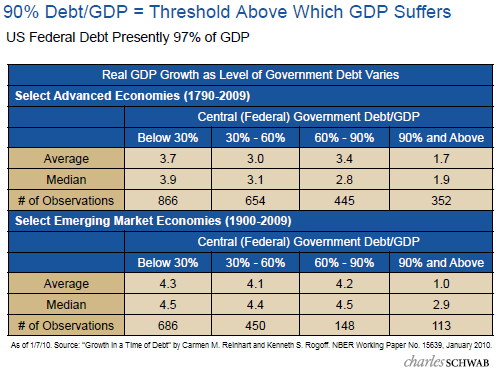
Approximately two years ago Carmen M. Reinhart and Kenneth S. Rogoff completed a comprehensive study, “Growth in a Time of Debt”, which looked at public debt levels around the globe and the resultant impact on economic growth for the respective economies. The study noted the historical consequences of various debt levels relative to an economy's GDP growth with the impact of increasing public debt levels on a country's economy being different for emerging and developed economies. The study authors concluded economic growth does tend to suffer significantly when a country's debt to GDP level exceeds 90%. For some emerging economies, debt to GDP levels over 70% begin to constrain growth. In the U.S. public debt to GDP is now over 90%.

From The Blog of HORAN Capital Advisors

Reinhart and Rogoff noted in their study:
"The simplest connection between public debt and growth is suggested by Robert Barro (1979). Assuming taxes ultimately need to be raised to achieve debt sustainability, the distortionary impact imply is likely to lower potential output. Of course, governments can also tighten by reducing spending, which can also be contractionary. As for inflation, an obvious connection stems from the fact that unanticipated high inflation can reduce the real cost of servicing the debt. Of course, the efficacy of the inflation channel is quite sensitive to the maturity structure of the debt. Whereas long-term nominal government debt is extremely vulnerable to inflation, short term debt is far less so. Any government that attempts to inflate away the real value of short term debt will soon find itself paying much higher interest rates...

...In principle, the manner in which debt builds up can be important. For example, war debts are arguably less problematic for future growth and inflation than large debts that are accumulated in peace time. Postwar growth tends to be high as war-time allocation of manpower and resources funnels to the civilian economy. Moreover, high war-time government spending, typically the cause of the debt buildup, comes to a natural close as peace returns. In contrast, a peacetime debt explosion often reflects unstable underlying political economy dynamics that can persist for very long periods."
Finally, as the below chart shows, debt levels in Europe (emerging and developed) and the U.S., have seen significant growth since just 2003.

From The Blog of HORAN Capital Advisors

An important outcome of these higher debt levels will be how each country decides to reduce its dependence on debt (balance governmental budgets), while at the same time not implementing policies that constrain private sector growth.


The Dangers Of Leveraged ETFs

From time to time questions arise about using leveraged ETFs in one's portfolio strategy. We caution longer term oriented investors to not use these type of ETF investments. For example, if an investor believes the market will rise in the near term, why not consider a two or three times ultra bull ETF. In this case an investor would expect the ETF to generated two or three times the return of the underlying index. Well, for an investor, it is not that simply due to how the math calculation works. Let's look a 2x's ultra long or bullish ETF example.
  • Lets assume at the beginning of day 1 an index is trading at $100. At the end of the day the index closes at $90 or down 10%. The leveraged ETF would close at $80 or down 20%.
  • On day 2 the index rises to $99 or up 10%. The 2x's leveraged ETF would increase to $96, that is $80 * 1.20=$96.
  • Over the two day period though the index is down 1% while the leverage ETF is actually down 4% or four times worse than the index return versus the expected two times worse return.
From The Blog of HORAN Capital Advisors

One problem with many of these leverage ETFs is they reset daily and individual investors generally do not rebalance their portfolios on a daily basis. So as one can see, the performance of these ETFs over a period longer than one day can differ significantly from their stated daily performance objectives. More on this topic can be found on the SEC's web site in an article they wrote titled, Leveraged and Inverse ETFs: Specialized Products with Extra Risks for Buy-and-Hold Investors.