Sunday, March 28, 2010

Misconception Surrounding The Importance Of The Asset Allocation Decision

Many investment advisers will indicate that one of the most important variables an investor needs to determine is their asset allocation. The reason behind this has to do with a study completed over 20 years ago by Brinson, Hood and Beebower that indicated that 93.6% of an investor's return is attributable to asset allocation. I wrote a post on this study a few years ago titled, Asset Allocation: Pros and Cons.

In a study reported in the March/April 2010 Financial Analyst Journal titled, The Equal Importance of Asset Allocation and Active Management and written by James Xiong, CFA, Roger Ibbotson, Thomas Idzorek, CFA and Peng Chen, CFA, it is shown that asset allocation is not nearly as important as many believe. In another article in the March/April 2010 FAJ, The Importance of Asset Allocation (PDF), Roger Ibbotson provides a summary of the aforementioned study.

In the summary several important conclusions are noted:
  • many investors mistakenly believe that the BHB (1986) result (that asset allocation policy explains more than 90 percent of performance) applies to the return level (the 100 percent answer). BHB, however, wrote only about the variation of returns, so they likely never encouraged this misrepresentation.
  • In general (after controlling for interaction effects), about three-quarters of a typical fund’s variation in time-series returns comes from general market movement, with the remaining portion split roughly evenly between the specific asset allocation and active management.
  • Do the BHB (1986) time series have any meaning at all in explaining the incremental importance of a specific asset allocation policy? Not necessarily. Perhaps the simplest illustration was given by Mark Kritzman (2006) in a letter to the editor of this journal titled “‘Determinants of Portfolio Performance—20 Years Later’: A Comment.” Kritzman constructed an example in which stock and bond returns moved up and down perfectly together (i.e., were equal to each other each year) while underlying securities did not. The BHB methodology incorrectly ascribed all 100 percent of the return variation to asset allocation, whereas, in fact, all the variation came from stock selection and general market movement.
  • The time has come for folklore to be replaced with reality. Asset allocation is very important, but nowhere near 90 percent of the variation in returns is caused by the specific asset allocation mix. Instead, most time-series variation comes from general market movement, and Xiong, Ibbotson, Idzorek, and Chen (2010) showed that active management has about the same impact on performance as a fund’s specific asset allocation policy (emphasis added).
Investors are encouraged to read the Ibbotson summary to get a clearer perspective on asset allocation decisions.


Thursday, March 25, 2010

Bullish Investor Sentiment Continues To Deteriorate

The market continues to advance in spite of continued weakness in the bullish investor sentiment reading from the American Association of Individual Investors. The weekly readings can be somewhat volatile, but looking at the 8-period moving average can smooth out this volatility. The 8-period M.A. of the bullishness reading has declined for ten straight weeks going back to January 14, 2010. Since this is a contrarian indicator, it will be interesting to see how this plays out over the course of the next quarter.


Data Source: AAII.com


Friday, March 19, 2010

Dow Rally Below Average In Duration & Magnitude

The Chart of the Day has an interesting chart this week that shows the current Dow Jones Industrial Average rally compared to past rallies back to 1900. It may come as a surprise to many investors, but this rally is below average in duration and below average in magnitude of the advance. The Chart of the Day notes:
  • each dot on the chart represents a major stock market rally as measured by the Dow
  • as the chart illustrates, the Dow has begun a major rally 27 times over the past 110 years which equates to an average of one rally every four years.
  • most major rallies (73%) resulted in a gain of between 30% and 150% and lasted between 200 and 800 trading days -- highlighted in the below chart with a light blue shaded box.


Air Products Increases Dividend 9%

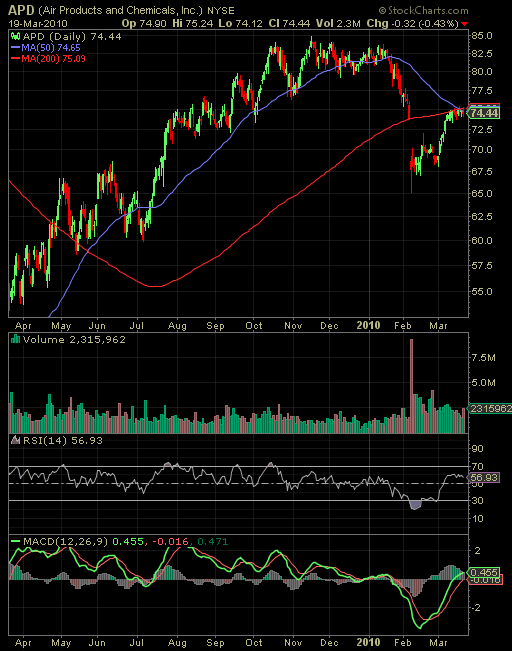
On Thursday Air Products & Chemicals (APD) announced a nearly 9% increase in the company's second quarter dividend. The new quarterly dividend increases to 49 cents per share versus 45 cents per share in the same quarter last year. The payout ratio is estimated at 40% based on September 2010 EPS estimates of $4.92. The 5-year average payout ratio is approximately 42%. The company carries an S&P Earnings & Dividend Quality Ranking of A and the company is one of S&P's Dividend Aristocrats.

As is always the case, investors need to perform their own due diligence before investing in any of the companies mentioned on this site. As it relates to APD, the company has a hostile takeover bid on the table for Airgas (ARG).


Disclosure: long interest in APD


Bullish Sentiment Continues Decline And Market Moves Higher

The individual investor bullish sentiment reading for the week ending 3/17/2010 fell 9.9 percentage points to 35.37%. This level is below the average of the bullishness reading of 39.3%. Since January 13th, the less volatile 8-period moving average of the bullishness reading has declined from 42.9% to this week's reading of 36%. As investors have become less bullish, the market continues to trend higher.


Tuesday, March 16, 2010

Six Notable Dividend Increases So Far In March

Following are six companies in the S&P 500 Index that have increased their dividends so far in March.


Source: Standard & Poor's

Long Interest: GD, PEP, QCOM, WMT


Sunday, March 14, 2010

Fairholme Fund's Bruce Berkowitz Interview

On Consuelo Mack's WealthTrack series, she interviewed Morningstar’s Domestic Equity Fund Manager of the Decade Bruce Berkowitz, founder and lead portfolio manager of the five-star Fairholme Fund (FAIRX). Her interview took place late last year but his advice for investors is invaluable. Berkowitz will explain how he has beaten the S&P by more than 200 percent over the past decade and where he is finding value now.


Better Investing's Most Active Stocks

From time to time I review Better Investing's most active stocks as reported by its members. According to members' recent buy and sell decisions, as reported by a small, informal sampling -- 107 transactions -- for the trailing 4-week period ended March 14, 2010, following are the most active stocks.

Better Investing's most active period ending March 14, 2010Companies Profiles:
  • Petmed Express (PETS)
  • Ford (F)
  • Walgreen (WAG)
  • Stryker (SYK)
  • Life Partners Holdings (LPHI)
  • Jacobs Engineering (JEC)
  • Bank of America (BAC)
  • Oracle (ORCL)
  • General Electric (GE)
  • Berkshire Hathaway (BRK.A)

Long interest: WAG, SYK, BAC, GE and BRK.A & B.


Thursday, March 11, 2010

Bullish Investor Sentiment Rises, But...

Although bullish investor sentiment spiked higher this week, the 8-period moving average continued to decline. The American Association of Individual Investors reported that bullish investor sentiment increased to 45.29% versus the prior week's reading of 35.86%. The bullish sentiment level plus one standard deviation is about 50%. The 8-period moving average of the bullishness reading actually declined to 36.6% versus the prior week's average of 36.9%. This is the ninth straight week the bullish 8-period average has declined.


Monday, March 08, 2010

Market In Denial Phase Of Sentiment Cycle

A reader posted a comment/question on my article about February's performance of dividend payers versus non payers curious if the market sentiment is one where investors are in the denial phase of the sentiment cycle. Several articles today made reference to the fact investors are leery of the market at this stage, in part due to the strong advance off of the March 2009 lows.
Below is a 2-year chart of the S&P 500 Index (SPX) with notations that coincide with a chart that was first publish in 1991 by technical analyst Justin Mamis in a book titled The Nature of Risk. The chart depicts investor sentiment at various stages in the market's cycle.


The market will hit resistance at around the 1,150 level on the S&P 500 Index. Additionally, the recent advance has been occurring on lower volume that may be a sign of investors in disbelief regarding further advance at this point in the cycle.


In short, I believe investors appear anything but confident or enthusiastic at this juncture. Even fund flow data shows investors are placing more money into bond funds than into equity funds.


Monday, March 01, 2010

Dividend Payers' Return Lags Non Payers In February

The average performance of dividend paying stocks in the S&P 500 Index ($INX) underperformed the non payers in February, 4.15% versus 4.74%, respectively. On a year to date basis, however, the payers are outperforming the non payers, 1.57% versus -.24%.

dividend payers versus non payers performance February 2010With respect to dividend actions, February was a much improved environment compared to February of 2009. February tends to be the busiest month for dividend news and the S&P 500 index companies saw 45 increases versus just 30 in the same period last year. Additionally, there were no dividend decreases in February versus 18 decreases in February 2009. For the three month period ending in February, there were 79 positive announcements and just two reductions versus 58 positive announcements and 41 reductions for the same period in 2009.


Source: Standard & Poor's


The Market Is Like A Puzzle

As one puts together a puzzle certain pieces will fit and others won't depending how far along one is in completing the puzzle. Investments aren't much different. Certain types of investments will fit into ones portfolio based on where the economy is in the economic cycle.

I read an interesting post today by Tadas Viskanta, the author of the site Abnormal Returns. His post titled, Play the Ball where it Lies, offers an interesting perspective for investors as they evaluate buy and hold decisions. One premise in the article notes that the markets are rarely "normal" so an investor needs to know why they are making specific investment decisions. At the end of the day, an investor should know why they own what they own. The brief article is a worthwhile read.


Sunday, February 28, 2010

Dividends Will Be A Company's Renewed Focus?

Money manager Neil Hennessy of the Hennessy Funds believes companies will reward shareholders by initiating or increasing dividend payments. In the below video Hennessy explains why he believes company managements will have a heightened focus on dividends.


Saturday, February 27, 2010

Berkshire Hathaway's 2009 Annual Letter Is Out

The much anticipated 2009 Berkshire Hathaway (BRK.A) annual letter to shareholders, written by Warren Buffett, is now available on the company's website. This letter is always an interesting read by investors. I anticipate noting my thoughts on the letter later this weekend. The PDF version of the annual letter can be accessed on Bershire's Hathaway's website.


Thursday, February 25, 2010

The Impact Of Rising Interest Rates On Stocks And Bonds

One thing that seems almost certain is the next move in interest rates will be a move higher. What will a move higher in interest rates mean for stock and bond investors?

It should be noted longer term market rates have already been trending higher over the past twelve months. The 30-year U.S. Treasury rate has increased from around 3.5% a year ago to 4.6% today. Short term rates, i.e., the 1-month Treasury rate, has actually declined from around .20% a year ago to .08% today. In other words the yield curve has steepened. But back to the original question.

For a bond investor, higher interest rates will have a negative impact on the price of a bond or price of a bond mutual fund. The impact of this "interest rate risk" depends on the maturity or duration of a particular bond. In its simplest form, the duration indicates how much the price of a bond or price of a bond mutual fund will change given a 1% or 100 basis point change in interest rates. For example, if the duration of the bonds in a bond mutual fund is 5 years, then the price (NAV) of the bond fund will decline 5% (increase) for a 100 basis point increase (decrease) in interest rates. The question for investors then is how long does it take to recover the loss in principal.

In a recent research article from Charles Schwab (SCHW) titled, Should You Worry About Bond Funds if Interest Rates Rise?, it is noted that,
"More than 90% of the total return since 1976 generated from a broadly balanced portfolio of US investment-grade Treasury, agency and corporate bonds has come from interest payments as opposed to change in price..."
If an investor understands the recovery time, they will then know if their time horizon matches the term or duration of the bonds or bond fund.

For stocks they tend to perform better in declining interest rate environments as well. Unlike bonds though, on average, stocks have generated positive returns in rising interest rate environments as well as in declining rate environments. Although stock returns have tended to be positive in periods where interest rates have increased, the better returns are found in declining interest rate periods.

In Standard & Poor's article, Rising Rates Revisited, they include returns be S&P 500 sector as well.

For investors then, if one believes interest rates will trend higher over a period of time in which it will be necessary to access the principal invested, paying attention to the duration of an investment as well as the types of stocks within a portfolio will be important.

Source:

Should You Worry About Bond Funds if Interest Rates Rise?
Charles Schwab & Co.
By: Rob Williams
February 24, 2010
http://tinyurl.com/ylbmaeu

Rising Rates Revisited
Standard & Poor's
By: Sam Stovall
February 19, 2010
http://tinyurl.com/23j6med


Sunday, February 21, 2010

Investor Fund Flows Favoring Fixed Income Investments

The below chart notes the change in fund flows for the broad mutual fund asset classes of equity, fixed and money market funds. If the line is above the "zero" x-axis, then the respective asset class saw positive fund flows for the period in question. For the periods earlier than 2010, the data is monthly.

The chart shows fixed income funds have generated positive investment flows since September of last year. During that same time period, equity funds saw outflows except for a brief period in early January of this year. The negative flow in money market cash has been driven mostly by institutional investors. Retail investors have actually added to their money market funds since the beginning of February. Is this a contrarian sign?


Investors interested in reviewing the data for a longer time period, the Investment Company Institute website contains more detail on flow data.


Wednesday, February 17, 2010

2010 Dogs Of The Dow Performance Update

The year to date performance of the 2010 Dogs of the Dow are slightly ahead of the Dow Jones Industrial Average Index. As the below table indicates, the best performing Dow dog is Boeing (BA) with a YTD return of 14.2%. The worst performing dog is Verizon (VZ) returning a negative 12%. In 2009, the Dow Dogs slightly underperformed the Dow Index, 17.8 versus 18.8, respectively.


The "Dogs of the Dow" investment strategy is one where an investor ranks the thirty Dow Jones Industrial Average members by yield, highest to lowest, based on the last trading day of the prior year. An investor then invests an equal amount in the ten highest yielding Dow stocks and holds them for one year. More information on the Dogs of the Dow investment strategy and other variations on the strategy can be found at a website devoted to Dogs of the Dow investing.


Sunday, February 14, 2010

4 Dividend Increases Earlier This Month

February is the busiest month for dividend increases and below is detail on four companies increasing their payouts earlier this month.


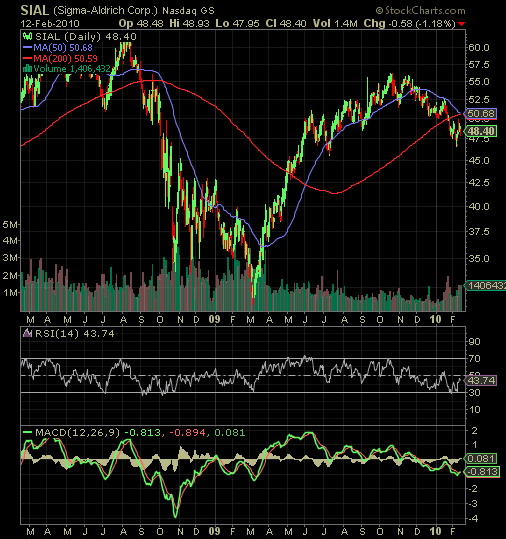
Sigma-Aldrich (SIAL)
  • announced a 10.3% increase in the quarterly dividend to 16 cents per share versus 14.5 cents per share in the same quarter last year.
  • based on 2010 estimated earnings per share of $3.14, the projected payout ratio is 20%. This compares to the 5-year average payout ratio of 20%.
  • SIAL carries an S&P Earnings & Dividend Quality Ranking of A+ and is one of S&P's Dividend Aristocrats.

United Technologies (UTX)
  • announced a 10.4% increase in the quarterly dividend to 42.5 cents per share versus 38.5 cents per share in the same quarter last year.
  • based on 2010 estimated earnings per share of $4.60, the projected payout ratio is 37%. This compares to the 5-year average payout ratio of 27%.
  • UTX carries an S&P Earnings & Dividend Quality Ranking of A+.

Archer-Daniels Midland (ADM)
  • announced a 7.1% increase in the quarterly dividend to 15 cents per share versus 14 cents per share in the same quarter last year.
  • based on June 2010 estimated earnings per share of $2.96, the projected payout ratio is 20%. This compares to the 5-year average payout ratio of 18%.
  • ADM carries an S&P Earnings & Dividend Quality Ranking of A and is one of S&P's Dividend Aristocrats.

Bemis (BMS)
  • announced a 2.2% increase in the quarterly dividend to 23 cents per share versus 22.5 cents per share in the same quarter last year.
  • based on 2010 estimated earnings per share of $1.92, the projected payout ratio is 48%. This compares to the 5-year average payout ratio of 49%.
  • BMS carries an S&P Earnings & Dividend Quality Ranking of B+ and is one of S&P's Dividend Aristocrats.


Disclosure: Long interest in UTX.


Saturday, February 13, 2010

The Value Is In Quality

For the period between the March low in 2009 and year end 2009, low quality stocks drove the market's move higher last year. The better return that was achieved in the lower quality equity assets in 2009 versus 2208 also occurred in other asset classes as detailed below.
Riskier Assets Outperform

With respect to stocks at this point in time, “If you go farther down on the quality scale, you are not getting a valuation discount,” said Cathy Seifert, head of financial services equity analysis at S&P. As noted in a number of my earlier blog posts, S&P's Quality Ranking measure looks at the growth and stability of a company's earnings and dividends over the prior 10-year period. S&P's research has noted that companies with above average quality rankings tend to outperform over the long run.

"S&P believes that high-quality stocks offer both increased safety of principal and potentially higher long-term returns versus low-quality issues,” says Richard Tortoriello, an S&P equity analyst. “We believe the recent market pull-back offers investors an opportunity to participate in a cyclical bull market. We would favor high-quality issues at this point."

A partial list of the stocks that carry S&P's 4 or 5 STAR rating and also have a buy rating by an S&P analyst is detailed below.


Disclosure:
Readers should assume I have a long interest in each company on the above list and/or may be selling an investment in one or more of the above companies at anytime.


Thursday, February 11, 2010

Conflicting Investor Sentiment Data

The sentiment data reported this week by the American Association of Individual Investors and Investors Intelligence is somewhat conflicting. The individual investor bullish sentiment as reported by AAII shows bullish sentiment rose to 36.75% versus last week's reading of 29.23%. Most of the increase in bullish sentiment came from those investors that were neutral last week. The neutral reading fell over six percentage points. On the other hand, the Investor Intelligence results show:
"bullish sentiment among newsletter writers is currently at 34.1%, which is the lowest level since March 2009. At the same time, bearish sentiment (26.1%) is the highest since November, while the percentage of newsletter writers in the correction camp has sky-rocketed all the way to 39.8%, which is a level that hasn't been seen since 1983," as reported by Bespoke Investment Group.