Source: American Association of Individual Investors
Posted by
David Templeton, CFA
at
6:29 AM
0
comments
Labels: General Market , Investments , Technicals
On an equal weighted basis, the dividend aristocrats outperform the Dow, S&P 500 and Nasdaq indices on 12/7/06--a down day for the domestic equity markets.
Posted by
David Templeton, CFA
at
9:49 PM
0
comments
Labels: Dividend Analysis , Dividend Return , General Market , Technicals
Ecolab Inc., (ECL) a marketer of cleaning, pest elimination, maintenance and repair products announced a 15% increase in its dividend today. The new quarterly dividend will total 11.5 cents per share versus 10 cents per share in the same quarter last year. The new yield is about 1.0% based on today's closing price of $45.23. The 5-year historical payout ratio is about 29%. Ecolab has an S&P Earnings and Dividend Ranking of A.
Posted by
David Templeton, CFA
at
6:31 PM
0
comments
Labels: Dividend Analysis , Dividend Return , Investments , Technicals
Stryker (SYK) announced a 50% increase in its dividend. The new dividend will total 22 cents per share versus 11 cents per share last year. The 5-year historical payout ratio is about 6%. Stryker is on of those companies that pays a dividend once a year. The new yield will equal approximately .4%. Stryker has an S&P Earnings and Dividend Ranking of B+.
When looking at dividend growth stocks, factor to consider is the yield level. If the yield is at a low enough level, how meaningful is a 50% dividend increase. The additional cash paid out will not be that significant relative to the level of earnings. On the other hand, the fastest growing dividend payers tend to be those with the lower yields.
Posted by
David Templeton, CFA
at
10:25 PM
0
comments
Labels: Dividend Analysis , Dividend Return , Investments , Technicals
Questar (STR): STR is a natural gas energy company.
Posted by
David Templeton, CFA
at
4:38 PM
0
comments
Labels: Dividend Analysis , Investments , Technicals
In Standard & Poor's annual rebalancing of their Dividend Aristocrats Index, the company announced the changes detailed below. The companies removed from the index are ConAgra Foods (CAG), Merck (MRK) and Alltel (AT).
Posted by
David Templeton, CFA
at
9:01 PM
0
comments
Labels: Dividend Analysis , Investments
Standard & Poor's announces changes to their dividend growth indices as follows:
Posted by
David Templeton, CFA
at
7:56 AM
0
comments
Labels: Dividend Analysis , Investments , Technicals
Following is detail on S&P 500 company dividend actions. All the dividend actions in November were increases. November saw 23 companies increase their dividend versus 25 companies in November of 2005 and 19 companies in November 2004.

Posted by
David Templeton, CFA
at
9:00 PM
0
comments
Labels: Dividend Analysis , Investments , Technicals
Emerson Electric is one of Standard & Poor's Dividend Aristocrats and has an S&P Earnings and Dividend Ranking of A.Although today was a "great day" for the market, last week was "brutal," Cramer told his viewers. He said he would love to say the selloff is over, but that's not the reality.
Instead, Cramer said he wants market players in secure dividend-boosting stocks, and in particular, he said he wants people to take a look at Emerson Electric (EMR), a stock that has boosted its dividend but has largely been forgotten about because of the selloff.
Although it might not be the most interesting stock, Cramer believes that it could make people money. The company, which should have 15% growth next year, is only trading at 15 times next year's earnings, which makes it "a steal," he said.
Emerson has already reported numbers that are "great," and although the stock should not be allowed to go lower than where it was after a dividend boost, that's what's happening here, he said.
There is "pure opportunity" to buy this stock, which has a 2.5% dividend yield, Cramer continued, adding that its dividend boost shows that Emerson has confidence in its future.
Another reason to buy Emerson now is that because short-term bond rates are higher, an "influx of investors who would have otherwise bought bonds," is likely to come to the market and buy dividend-boosting stocks like Emerson, he said.
The bottom line: "When you have a potential for a selloff, you need a stock that is going to be secure," like Emerson," Cramer said.
Source: Cramer's 'Mad Money' Recap: While Nike Sleeps
December 4, 2006
Posted by
David Templeton, CFA
at
8:45 PM
0
comments
Labels: Dividend Analysis , Dividend Return , General Market , Investments , Technicals
An article on psychological factors that can interfere with an individual's investment decision making is contained on the free content portion of the American Association of Individual Investors website.
The factors noted below are discussed in more detail in the article.
Decision-Making Biases
- Availability: Drawing conclusions based only on vivid and recent information.
- Irretrievability: Failing to think beyond a preconceived notion.
- Presuming associations: Assuming certain associations exist with no real evidence.
- Confirmation trap: An unconscious search for supporting evidence that the right decision has been made, while ignoring evidence that a bad decision was made.
Measurement Biases
- Sample size insensitivity: Reaching a conclusion based on a small sampling of information that does not truly represent the complete situation.
- Ignoring regression to the mean: Not recognizing that above- or below-average results won’t necessarily continue forever.
- Conjunctive and disjunctive events bias: Mis-estimating the likelihood that certain events will occur when those events must take place for a particular outcome to occur.
Misperceptions
- Insufficient anchor adjustment: Assuming an outcome of an event will be exactly the same as the outcome of a similar prior event without examining differences.
- Hindsight: Evaluating a judgment after an event has played out and with perfect knowledge of the outcome.
- Positive illusions: A tendency toward overly optimistic views of things rather than a realistic assessment.
Risk-Taking Biases
- Avoiding uncertainty: A preference for stability rather than uncertainty.
- Asymmetry of risk tolerance: Investors are risk-averse with regard to gains (preferring to sell “winners” and ensure the gain) but risk-takers when it comes to losses (preferring to hang on to “losers”).
- Regret avoidance: Investors tend to feel more regret toward committed actions that have turned out badly rather than omissions that could have turned out favorably.
- Internal escalation of commitment: The tendency of an investor to increase the support of their initial decision over time.
- Competitive escalation: The tendency of some investors to view competitors’ actions or other investors’ collective actions as validating an investment idea.
Source:
15 Short-Cuts and Biases that Lead to Bad Investment Decisions
Paul S. Szczygiel
AAII Commentary
American Association of Individual Investors http://www.aaii.com/commentary/articles/200605_stockstrategies.cfm
Posted by
David Templeton, CFA
at
7:47 AM
0
comments
Labels: General Market , Investments
Standard & Poor's reports that in November non-dividend paying stocks in the S&P 500 Index outperformed dividend paying stocks: 3.50% versus 2.28%.
Posted by
David Templeton, CFA
at
1:25 PM
0
comments
Labels: Dividend Analysis , Dividend Return
Just an FYI. I have been traveling since Thursday night and have limited access to the internet so posts will be sporadic until Monday.
Aristocrats certainly performed better than the tech laden Nasdaq on Friday.
Posted by
David Templeton, CFA
at
12:48 AM
0
comments
Labels: Dividend Return , General Market , Technicals
Regarding asset preferences:
Details about the survey:
"This summary highlights the major findings of a comprehensive telephone study among 1,209 U.S. residents 25 years and older (about 400 per age cohort: GenXers 40 and younger, Boomers 45 to 60 and seniors 65 years or older), who have over $50,000 invested in both qualified retirement plans and investments outside of qualified retirement plans (stock mutual funds, bond mutual funds, individual stocks, individual bonds, variable annuities and money market funds). This study, which represents a portrait of American investors' attitudes and practices about investing across three generations, was conducted by Penn, Schoen & Berland Associates, Inc. for Eaton Vance Corp.
This representative national study of 1,209 American investors was conducted between October 2 and November 11, 2006. By definition, all investors surveyed have a portfolio of at least $50,000, excluding housing. 71% have investable assets greater than $100,000, while one in seven have a portfolio of $1 million plus"
Source:
MSN Money
September 30, 2006
http://news.moneycentral.msn.com/ticker/article.aspx?Symbol=US:EV&Feed=BW&Date=20061130&ID=6237398
Posted by
David Templeton, CFA
at
1:00 PM
0
comments
Labels: General Market
Bearish sentiment as reported by AAII rises again as reported for November 30, 2006. Bullish sentiment stills seems a little high; however, is this contrarian indicator indicating another leg up for the market?
Posted by
David Templeton, CFA
at
11:49 AM
0
comments
Labels: Technicals
"(EBITDA) is calculated by adding "selected" expense items such as Interest expenses, Income taxes, Depreciation and Amortization back into earnings or net income. By adding "selected" expense items back into to a company's net income "more positive" earnings or cash flow per share numbers can be manufactured. When utilizing EBITDA an analyst or CFO is actually stating, "This is what our earnings would have been if it were not for interest, taxes, depreciation and amortization." Because it is based upon earnings, EBITDA is subject to the same "creative" accounting inherent in many earnings reports. EBITDA frequently does not reflect a company's true cash flow.... EBITDA is a manufactured "creative accounting" interpretation that presents a company in the best possible light. EBITDA's original use was for lenders to determine credit viability. Today these interpretations are used primarily by companies and Wall Street analysts to promote stock to an unwary public. Commonly, when EBITDA or CFPS (cash flow per share) are used in this way they are deceptively called "cash flow" or some form thereof."

Posted by
David Templeton, CFA
at
3:57 PM
0
comments
Labels: Dividend Analysis
Today, McCormick & Co. (MKC) announced a 11% year over year increase in the company's quarterly cash dividend to 20 cents per share versus 18 cents per share in the same quarter last year. MKC maintains an S&P Quality Ranking of A+. In the press release, the company's CEO stated:
"In 2006 we have rebounded from a challenging 2005 fiscal year. Our financial results through the first three quarters have exceeded our expectations and the stock price has risen 20% in the past 12 months."
Posted by
David Templeton, CFA
at
7:39 PM
0
comments
Labels: Dividend Analysis
"Buybacks aren't always what they seem. A company might throw confetti for its share repurchase plan with one hand while issuing shares with the other."
"At the same time, investors need to be careful to avoid mistaking earnings-per-share growth from buybacks for actual earnings growth."
Source:
Self-Serve in the Boardroom
JUSTIN LAHART
AHEAD OF THE TAPE
The Wall Street Journal Online, November 28, 2006 http://online.wsj.com/article/SB116466998414033857.html?mod=mkts_main_featured_stories_hs
Posted by
David Templeton, CFA
at
7:28 AM
0
comments
Labels: Dividend Analysis , General Market
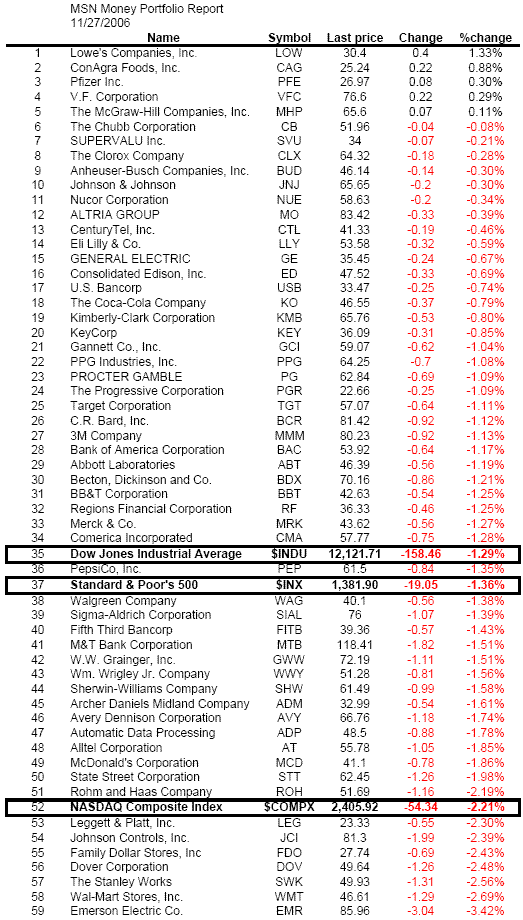
One of the advantages to investing in higher quality dividend paying stocks is the fact they historically have held their value better in a down market. Standard and Poor's Dividend Aristocrats' performance held up better in today's down market. These higher quality dividend paying stocks also performed substantially better than the Nasdaq index:
Posted by
David Templeton, CFA
at
10:54 PM
0
comments
Labels: Dividend Return , General Market
"The dividend discount model (DDM) is a widely accepted stock valuation tool found in most introductory finance and investment textbooks. The model calculates the present value of the future dividends that a company is expected to pay to its shareholders. It is particularly useful because it allows investors to determine an absolute or "intrinsic" value of a particular company that is not influenced by current stock market conditions. In contrast, most target prices published by analysts are set on a relative basis, based on the valuation of comparable companies. The DDM is also useful because the measurement of future dividends (as opposed to earnings for example) facilitates an "apples-to-apples" comparison of companies across different industries by focusing on the actual cash investors can expect to receive. Although it is conceptually simple, the DDM is not widely used except by some institutional investors because it can be cumbersome to apply without the necessary data and analytical tools. DividendDiscountModel.com makes the DDM accessible to all investors to determine whether they think a particular stock is over or under valued based on its dividend potential.A more flexible and detailed DDM program can be found by clicking here. The Excel file to review is named divginzu.xls in the section of the table titled "All-in-one Valuation Models". A review of the inputs in the Excel file noted previously will provide a more comprehensive understanding of the DDM concept for the investor wanting to analyze their own stock investments.
The Dividend Discount Model is also known as the "Gordon model" named after professor Myron J. Gordon who popularized the model. Professor Gordon wrote about the model in a book he authored in 1962 titled The Investment, Financing and Valuation of the Corporation. Since then the model has appeared in virtually every investments textbook. In his book titled Investment Valuation, Aswath Damodaran, a professor at New York University states: "In the long term, undervalued (overvalued) stocks from the dividend discount model outperform (underperform) the market index on a risk-adjusted basis." Although no investment model works for all stocks all of the time, the dividend discount model has proven to be a reliable way of selecting stocks that on average will perform relatively well on a long-term basis. It should be among the tools that investors use to select at least some of the stocks in their portfolio."
Posted by
David Templeton, CFA
at
12:09 AM
5
comments
Labels: Dividend Analysis

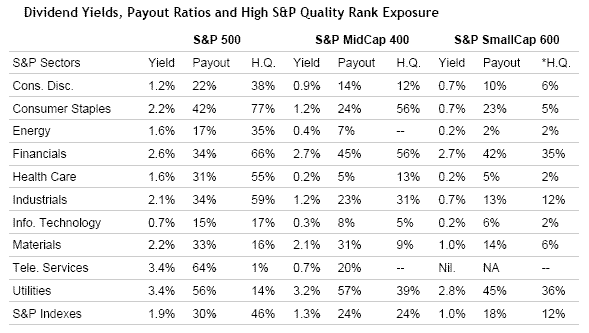
"Dividends—those steady streams of periodic payments received by equity investors—may seem as unexciting as a Social Security check, but you might think again when you realize that reinvested dividends have actually contributed more than 40% of the S&P 500's total return since 1929 (emphasis added). What's more, the S&P 500 dividend yield averaged nearly 4% in all years since the mid-1930s and averaged nearly 6% during the 1940s. Things look a little different these days, of course. The yield on the "500" has averaged only 1.6% thus far this decade, after averaging only 2.4% during the 1990s..."
S&P believes the economy is entering a slower growth phase. As a result, they believe investors should focus on higher quality dividend paying stocks:
"Due to the expected tepid market performance, S&P recommends that investors gravitate toward sectors and companies that offer relatively high dividend yields and have consistently increased their earnings and dividends over an extended period of time."
Source:
Making Dividend Plays Pay
SAM STOVALL
SAM STOVALL'S SECTOR WATCH
BusinessWeek Online, September 5, 2006 http://www.businessweek.com/investor/content/sep2006/pi20060905_559905.htm
Posted by
David Templeton, CFA
at
1:37 PM
0
comments
Labels: Dividend Analysis , Dividend Return , General Market , Technicals