![]() |
| From The Blog of HORAN Capital Advisors |
Thursday, September 23, 2010
Will Dividend Increases Follow An Increase In Stock Buybacks?
Posted by
David Templeton, CFA
at
11:31 PM
1 comments
Labels: Dividend Analysis
Tough Environment For Consumers
"Our customers are focused on their savings, and they need us now more than they ever have. Unemployment, we all know, remains mid-9s and doesn't appear to be going anywhere quickly. Gas prices are high. They don't appear to be going anywhere. We need to figure out how to operate in this environment.
The paycheck cycle we've talked about before remains extreme. It is our responsibility to figure out how to sell in that environment, adjusting pack sizes, large pack at sizes the beginning of the month, small pack sizes at the end of the month. And to figure out how to deal with what is an ever-increasing amount of transactions being paid for with government assistance.
And you need not go further than one of our stores on midnight at the end of the month. And it's real interesting to watch,about 11 p.m., customers start to come in and shop, fill their grocery basket with basic items, baby formula, milk, bread, eggs, and continue to shop and mill about the store until midnight, when electronic -- government electronic benefits cards get activated and then the checkout starts and occurs. And our sales for those first few hours on the first of the month are substantially and significantly higher.
And if you really think about it, the only reason somebody gets out in the middle of the night and buys baby formula is that they need it, and they've been waiting for it. Otherwise, we are open 24 hours -- come at 5 a.m., come at 7 a.m., come at 10 a.m. But if you are there at midnight, you are there for a reason. And we have to look at that and we have to watch that and we have a commitment to serve those customers who need that. And we are very, very focused on that."
Posted by
David Templeton, CFA
at
10:08 AM
0
comments
Labels: Economy
Wednesday, September 22, 2010
Standard & Poor's Reports Jump In Stock Buybacks
Posted by
David Templeton, CFA
at
4:39 PM
0
comments
Labels: Investments
Friday, September 17, 2010
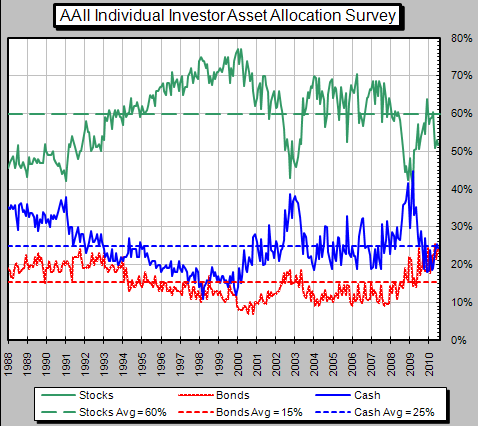
More Confirmation Investors Increasing Bond Allocation
| From The Blog of HORAN Capital Advisors |
| From The Blog of HORAN Capital Advisors |
| From The Blog of HORAN Capital Advisors |
Posted by
David Templeton, CFA
at
2:46 PM
0
comments
Labels: Bond Market, General Market, Investments
Thursday, September 16, 2010
Bullish Investor Sentiment Continues To Move Higher
| From The Blog of HORAN Capital Advisors |
Posted by
David Templeton, CFA
at
9:39 PM
0
comments
Labels: Sentiment
Sunday, September 12, 2010
The Dividend Paying Stocks In The S&P 500 Index
The yield is calculated by taking the latest declared dividend, annualized and divided by the stock price. Payout ratios are calculated based on latest quarterly dividend paid divided by earnings. The data is first sorted by the industry name alphabetically and then by the yield in descending order. Dividends are paid on a quarterly basis unless noted.
Posted by
David Templeton, CFA
at
12:40 PM
0
comments
Labels: Dividend Analysis
Saturday, September 11, 2010
Market Continues To Trade In A Range
| From The Blog of HORAN Capital Advisors |
| From The Blog of HORAN Capital Advisors |
Posted by
David Templeton, CFA
at
7:58 PM
0
comments
Labels: General Market, Technicals
Friday, September 10, 2010
U.S. Budget Deficit or Surplus
| From The Blog of HORAN Capital Advisors |
Posted by
David Templeton, CFA
at
8:18 AM
0
comments
Labels: Economy
Thursday, September 09, 2010
Inflation and Equity Valuations
At HORAN Capital Advisors, we do believe inflation will be a factor investors will need to contend with in the not to distant future. This being the case, what impact might this have on stock returns and valuations going forward? As I have noted in prior posts, specifically, Inflation in the Pipeline and Relating Company Fundamentals To The Dividend Discount Model, inflation does have an impact on stock valuations. An important question then becomes what level of inflation can an investor expect and what will be the impact on stock valuations. At HORAN we do believe inflation will be an issue in the future that investors need to factor into their expected stock returns. We do not believe we will see an environment where we get hyper inflation though.
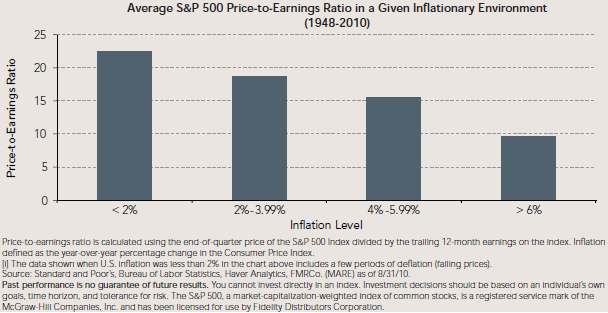
At today's valuations and moderate expected levels of inflation, stock valuations do seem to be trading at valuations levels below historical averages. Fidelity recently published a research article noting where stocks might trade at various levels of inflation.
| From The Blog of HORAN Capital Advisors |
As of July 2010, year-over-year inflation stood at 1.3%, while the S&P 500’s P/E ratio (using trailing 12-month earnings) was 15.6 as of August 2010—somewhat below the index’s historical average (17.7).
Using earnings forecasted over the next 12 months (to August 2011) the market’s P/E ratio was 14.1 as of the end of August—also below the index’s long-term average. Thus, given the low current level of inflation and both trailing and forward-looking measures of earnings, the stock market’s current valuation is somewhat below historical norms.
Posted by
David Templeton, CFA
at
8:31 PM
0
comments
Monday, September 06, 2010
More Stimulus and More Debt
| From The Blog of HORAN Capital Advisors |
Posted by
David Templeton, CFA
at
8:58 PM
1 comments
Labels: Economy
Sunday, September 05, 2010
Emerging Markets Representing Larger Percentage of World GDP
| From The Blog of HORAN Capital Advisors |
| From The Blog of HORAN Capital Advisors |
Posted by
David Templeton, CFA
at
3:18 PM
0
comments
Labels: International, Investments
Thursday, September 02, 2010
Dividend Payers Versus Non Payers Performance in August
| From The Blog of HORAN Capital Advisors |
Posted by
David Templeton, CFA
at
10:24 PM
2
comments
Labels: Dividend Return
Wednesday, September 01, 2010
Alternative Investments: Navigating Volatile Markets
| From Horan Capital Advisors Blog |
Investors need strategy specific solutions which can provide consistent returns and hedge systemic risk. The environment for the past decade calls for such. The investment management community has heard those cries and responded quickly by providing alternatives in various wrappers: ETFs, ETNs, alternative mutual funds, structured products, and hedge funds. Clearly the adoption of these various vehicles has added to market variability but nevertheless, their intent is often times to provide hedged market returns within specific or multiple asset classes. These vehicles attempt to set predetermined return expectations. Some managers focus on absolute returns while others position for hedged but directionally long exposures. Regardless of which strategy, both intend to provide consistent and more predictable return streams.
Alternative investments, in their truest form, are unencumbered from trading constraints and provide intellectual freedom far beyond traditional money manager constraints. Example strategies: capital structure arbitrage, special situation events, long/short exposure, discretionary and systemic market trading. The global opportunity set truly becomes utilized as alternative investment managers act to expose market dislocations without traditional market boundaries. Alternatives are simply an expansion of an existing asset class or an investment intermediary between traditional asset classes to help facilitate acceptable balances between risk and return. Investors move between equity and fixed in a blurred or complimentary fashion via alternative investments. Managers must evaluate the means in which they assess market volatility relative to the fees they pay for risk-adjusted returns. For example, hedged equity has mostly long equity properties and should perform like long equity over a full market cycle but with significantly less market variability. Fixed income arbitrage and equity market neutral strategies should exhibit standard deviations equivalent to conservative fixed income securities as they hedge most market risk in an effort to achieve absolute returns conservatively higher than the risk free rate. A liquid alternative with compelling numbers in this category is the TFS Market Neutral Fund (TFSMX).
| From Horan Capital Advisors Blog |
Posted by
Nick Reilly
at
5:42 PM
0
comments
Labels: Alternatives, Asset Allocation